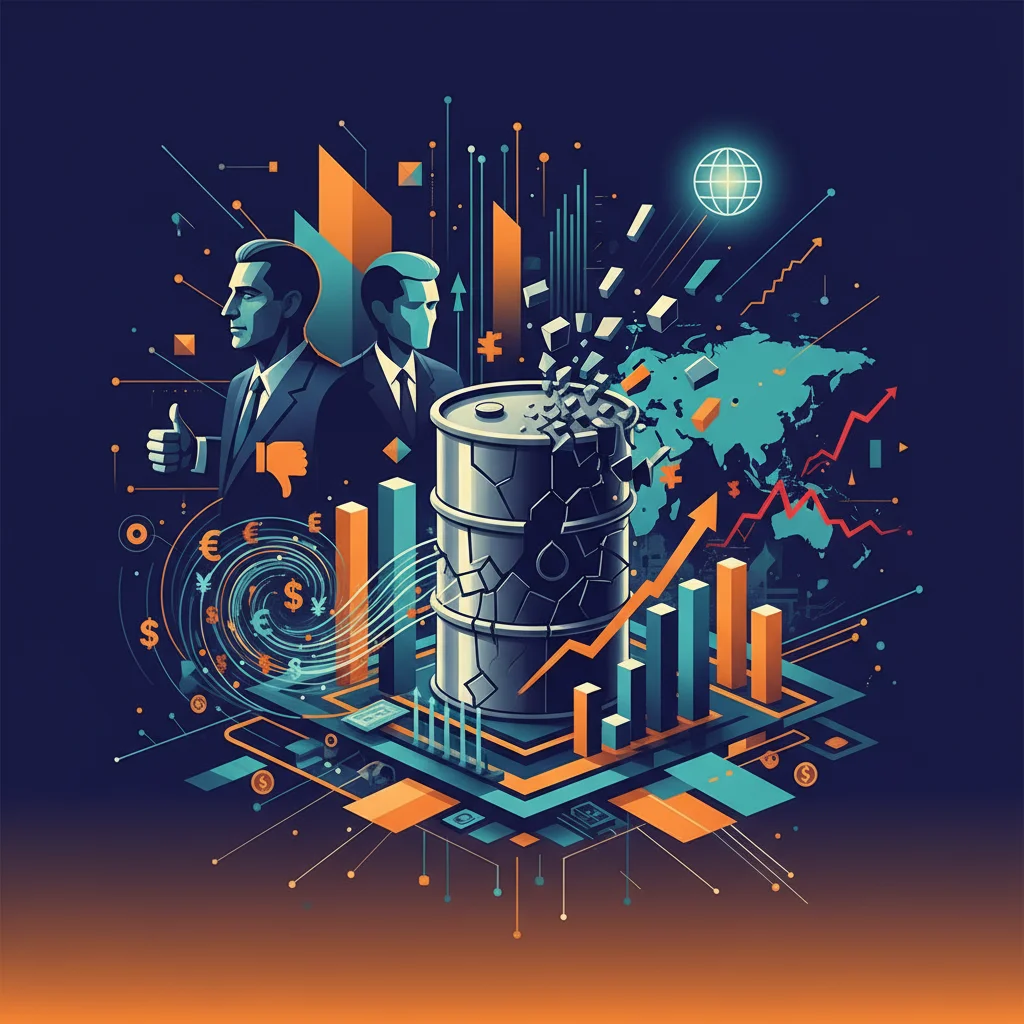
Beyond the Barrel: Why ExxonMobil Told Trump Venezuela is ‘Uninvestable’ and What It Means for Global Finance
A High-Stakes Dinner, A Stark Reality Check
In the world of high finance and global energy, some conversations carry the weight of billions of dollars and the fate of nations. One such exchange recently took place over dinner at Mar-a-Lago, where former President Donald Trump gathered the chief executives of America’s top oil companies. His proposition was audacious: if re-elected, he would dismantle environmental regulations. In return, he asked for a $1 billion donation to his campaign. But it was his suggestion for a specific investment that drew a sharp, unequivocal response, revealing a deep chasm between political ambition and corporate reality.
When Trump urged the assembled energy titans to “rush back” into Venezuela, a nation sitting atop the world’s largest proven oil reserves, it was ExxonMobil CEO Darren Woods who delivered the sobering verdict. He bluntly told the former president that Venezuela, in its current state, is simply “uninvestable” (source). This single word encapsulates decades of painful history, immense financial loss, and a complex web of risks that no responsible board could ignore. It’s a powerful statement that echoes through the halls of international finance, offering a crucial lesson for anyone involved in global investing.
This post will dissect why a corporate giant like ExxonMobil holds this line, explore the anatomy of an “uninvestable” state, and analyze the profound implications for the global economy, the stock market, and the future of energy trading.
A Painful History: The Ghost of Nationalization
To understand Darren Woods’ stark refusal, one must look back nearly two decades. ExxonMobil’s caution is not born from abstract risk models; it’s forged in the fire of direct, costly experience. The story begins with the rise of Hugo Chávez, whose Bolivarian Revolution fundamentally reshaped Venezuela’s political and economics landscape.
In the mid-2000s, flush with high oil prices, Chávez’s government moved to assert state control over the nation’s most prized assets. This led to a wave of nationalizations across the energy sector. Foreign companies that had invested billions to develop Venezuela’s heavy crude in the Orinoco Belt were given a harsh ultimatum: cede a majority stake to the state-owned oil company, PDVSA, or leave. While many companies reluctantly accepted the new terms, ExxonMobil refused to bow. The result? The government expropriated its massive Cerro Negro project, a multi-billion dollar investment. This wasn’t just a business deal gone sour; it was a fundamental violation of contract and property rights, the very bedrock of international investing.
ExxonMobil didn’t walk away quietly. The company pursued a decade-long, globe-spanning legal battle against Venezuela, seeking compensation through international arbitration. While they eventually won a significant award, the process was arduous and the recovered amount a fraction of the project’s true value. This history is now embedded in the company’s DNA—a permanent, institutional memory of the perils of political risk and the fragility of the rule of law.
Beyond the Pasta Bowl: Decoding the Economic Ripple Effects of a US Tariff Reversal
The Anatomy of an ‘Uninvestable’ State
Woods’ assessment goes far beyond past grievances. Venezuela today presents a near-perfect storm of risks that would deter even the most adventurous capital. A stable investment environment requires a predictable legal framework, reliable infrastructure, and a functioning government—all of which are tragically absent in the country.
Let’s break down the core factors that render the nation’s oil sector a no-go zone for a prudent investor like Exxon. We’ve summarized the key deterrents in the table below.
| Risk Category | Description | Impact on Investors |
|---|---|---|
| Political & Legal Instability | A contested government under Nicolás Maduro, a lack of an independent judiciary, and the constant threat of arbitrary state action. The sanctity of contracts is non-existent. | Extreme uncertainty. Assets could be seized, contracts voided, and legal recourse exhausted without a fair hearing, making long-term capital planning impossible. |
| Crumbling Infrastructure | Years of neglect and underinvestment have left Venezuela’s oil fields, pipelines, and refineries in a state of decay. Production has plummeted from over 3 million barrels per day to around 800,000 in recent months. | Any new investment would require tens of billions of dollars just to restore previous capacity before any new production could be considered. This represents a colossal upfront capital expenditure with no guarantee of return. |
| U.S. Sanctions Regime | A complex web of U.S. sanctions targets the Maduro regime and the state oil company, PDVSA. While temporary licenses have been issued (and rescinded), the regulatory landscape is a minefield. | Operating in Venezuela exposes companies to severe legal, financial, and reputational damage. It complicates everything from basic banking to sourcing equipment. |
| Massive Debt & Creditor Claims | Venezuela and PDVSA are in default on billions of dollars of debt. A horde of international creditors, including bondholders and other nationalized companies, have legal claims on the nation’s assets. | Any future oil revenue or foreign assets are targets for seizure by creditors, creating a chaotic legal environment where new investors could see their profits and assets claimed to pay old debts. |
Ripple Effects: From Global Markets to Your Portfolio
The standoff over Venezuela is more than a geopolitical curiosity; it has tangible effects on the global economy and financial markets. When the world’s largest oil reserve is effectively offline, it fundamentally alters the supply-demand equation. This structural constraint contributes to price volatility and keeps global energy markets on edge, impacting everything from inflation rates to consumer spending.
For investors, this situation offers several key takeaways:
- The Primacy of Political Risk: The Venezuela case is the ultimate cautionary tale. An abundance of natural resources is worthless without a stable and predictable legal and political framework. Investors in the stock market, particularly in emerging markets, must look beyond the balance sheet and incorporate sophisticated geopolitical risk analysis into their decision-making. Modern financial technology platforms are increasingly offering tools to model these non-financial risks.
- Diverging Corporate Strategies: It’s noteworthy that while Exxon holds a hard line, its rival Chevron has maintained a limited presence in Venezuela under a special license from the U.S. government (source). This reflects a different risk appetite—a strategy of keeping a foot in the door in the hope of a future political opening. This contrast between Exxon (XOM) and Chevron (CVX) provides a fascinating case study for investors analyzing corporate strategy in the energy sector.
- The Role of Sanctions in Finance: The complexity of U.S. sanctions highlights how intertwined geopolitics and the international banking system have become. Navigating these rules requires immense legal and compliance resources, effectively creating a barrier to entry and influencing capital flows on a global scale. The sophistication of these financial controls is a world away from simple trading, demonstrating the evolution of economic statecraft.
Beyond the Balance Sheet: The Economic Case for a Hot Meal
The Long Road to ‘Investable’
So, what would it take to change Venezuela’s status from “uninvestable” to a viable destination for capital? The checklist is daunting and extends far beyond simply lifting sanctions. It would require a democratic transition that is recognized and accepted by the international community, the establishment of an independent judiciary capable of enforcing contracts, and a comprehensive plan to address the claims of existing creditors. Furthermore, it would necessitate a new, modern hydrocarbon law that provides stable, attractive terms for foreign investors willing to risk billions in a shattered industry.
Some have speculated that emerging technologies could play a role in rebuilding trust. For instance, a transparent system for tracking oil revenues and royalty payments, perhaps utilizing distributed ledger technology or blockchain, could theoretically provide foreign partners with greater assurance against corruption. However, such fintech solutions are meaningless without the underlying political will and legal framework to support them. Technology can enhance transparency, but it cannot create the rule of law from scratch.
Until these foundational pillars are in place, ExxonMobil’s position is unlikely to change. The company’s stance serves as a powerful message to Caracas and to governments worldwide: access to global capital is not a right; it is earned through stability, predictability, and trust.
The K-Beauty Effect: How a Skincare Trend Became a Global Economic Powerhouse
Conclusion: A Lesson in Prudence and Principle
The brief but potent exchange between Donald Trump and Darren Woods is a microcosm of the complex interplay between politics, economics, and corporate governance. ExxonMobil’s declaration that Venezuela is “uninvestable” is not just a corporate decision; it is a verdict on the nation’s collapse of institutional integrity. It underscores a fundamental principle of modern finance: capital is cowardly and flows to where it is treated best. For a country with unparalleled natural wealth to be unable to attract investment is a profound tragedy of its own making.
For investors, business leaders, and policymakers, the lesson is clear. The siren song of immense resources can never drown out the deafening alarm of sovereign risk. Before a single dollar is invested or a single barrel of oil is drilled, the foundational elements of a stable society must be secure. Until then, Venezuela’s vast reserves will remain a symbol of squandered potential, locked away not by geology, but by a catastrophic failure of governance.

Related Posts
The Great Retail Divide: Why Food Feasted and Fashion Famished in the UK’s Christmas Showdown

Beyond the Balance Sheet: What Photography of “Home” Teaches Us About the Global Economy and Investing