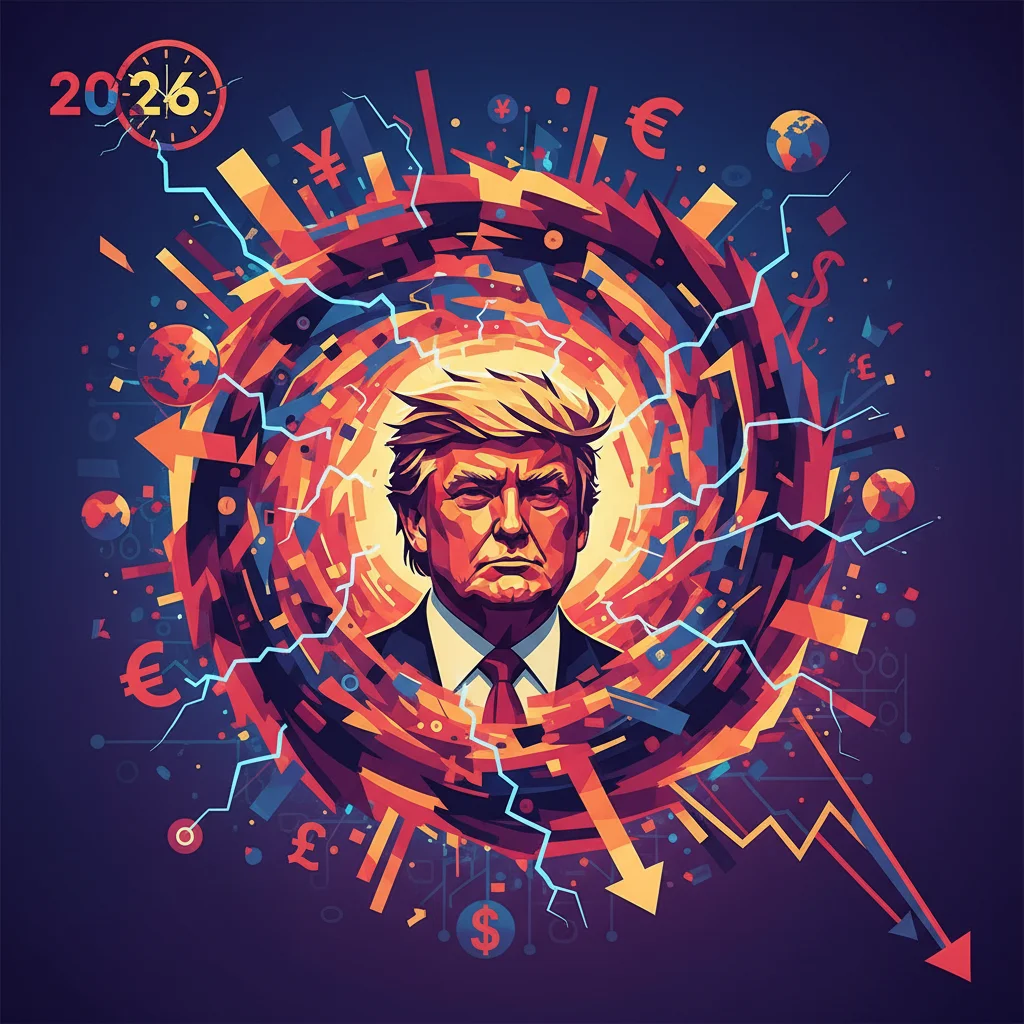
Trump’s 2026 Firestorm: How One Week of Chaos is Redefining Global Finance
The first weeks of 2026 will be remembered not for calm resolutions but for a political and economic whirlwind that has left global markets reeling. In a series of moves that defied conventional statecraft and economic policy, President Donald Trump’s administration unleashed a dual shockwave, beginning with a stunning geopolitical gambit in Venezuela and culminating in a verbal assault on one of Wall Street’s most powerful sectors: private equity. For investors, finance professionals, and business leaders, this tumultuous week was more than just headline noise; it was a stark signal of a new era of radical unpredictability, fundamentally reshaping the calculus of risk and reward in the global economy.
This wasn’t just another week of political drama. It was a stress test for the entire financial system, forcing a rapid re-evaluation of everything from geopolitical risk models to long-term investing strategies. Let’s dissect the two seismic events and explore their profound implications for the future of finance, banking, and the broader market landscape.
The Geopolitical Gambit: A Venezuelan Powder Keg
The week began with what can only be described as an audacious move on the international stage. Reports, first broken by the Financial Times, detailed a US-led special operation resulting in the “forced extradition” of Venezuelan leader Nicolás Maduro to face charges in the United States. While the administration framed it as a decisive blow against a corrupt dictatorship, the international community and global markets reacted with a mixture of shock and alarm. The immediate fallout was swift and severe.
The stock market experienced a knee-jerk reaction, with volatility spiking to levels not seen in over a year. The most direct impact was on energy markets. With Venezuela holding some of the world’s largest oil reserves, the prospect of prolonged instability and potential disruption to supply sent Brent crude prices surging by over 12% in a single trading session (source). This created immediate inflationary pressures and raised serious questions about energy security for nations reliant on foreign oil.
Beyond oil, the event sent tremors through emerging markets, particularly in Latin America, as investors priced in a higher risk premium for the entire region. Currencies faltered, and capital began to flow towards perceived safe havens like US Treasury bonds and the Swiss franc. For multinational corporations with operations in the region, it was a sudden, costly lesson in the tangible impact of geopolitical black swan events.
Navigating the New Economic Chapter: Opportunities in Finance and Technology for the Year Ahead
The Domestic Disruption: A Declaration of War on Private Equity
Just as the markets were beginning to digest the Venezuelan gambit, President Trump pivoted, turning his fire inward toward a cornerstone of modern capitalism: the private equity industry. In a series of fiery social media posts and a subsequent impromptu press conference, he lambasted private equity firms as “vultures” and “job killers” who “strip-mine American companies for parts” while benefiting from unfair tax loopholes.
He specifically targeted the “carried interest” tax provision, a long-standing point of contention that allows fund managers’ profits to be taxed at a lower capital gains rate rather than as ordinary income. “It’s a disgrace,” the President stated, “and we’re ending it. These guys make a fortune and pay less tax than a schoolteacher. That’s over.” (source).
The attack was a direct hit on the heart of the alternative investment world. The market’s reaction was immediate and targeted, as illustrated by the performance of publicly traded private equity giants in the 48 hours following the President’s remarks.
Below is a snapshot of the impact on key industry players:
| Private Equity Firm | Ticker | Stock Price Change (48-Hour Period) | Market Cap Loss (Approx.) |
|---|---|---|---|
| Blackstone Inc. | BX | -14.2% | $21 Billion |
| KKR & Co. Inc. | KKR | -16.5% | $15 Billion |
| Apollo Global Management | APO | -15.8% | $11 Billion |
| Carlyle Group Inc. | CG | -17.1% | $3 Billion |
This populist-fueled assault threatens to upend the business model that has generated trillions of dollars in wealth. The implications are enormous, affecting not only the firms themselves but also their vast network of investors, including pension funds, university endowments, and sovereign wealth funds that rely on private equity for outsized returns. The uncertainty surrounding potential new regulations and tax laws has cast a pall over the entire M&A and leveraged buyout landscape.
The Boardroom in Your Basement: Why Your Flat's Management Could Be Your Biggest Financial Risk
The New Reality: Navigating the Intersection of Politics and Finance
This whirlwind week has crystalized several critical trends and challenges for the financial world.
Reassessing Political Risk
The era of treating political risk as a secondary, “soft” variable in financial modeling is over. The events of this week demonstrate that presidential whims can have a more immediate and dramatic impact on asset prices than traditional economic indicators like inflation or employment data. Investment committees and risk management departments must now elevate political analysis to a primary input in their decision-making processes. This goes beyond simple country risk; it now includes “policy volatility risk” even in developed markets like the United States.
The Rise of Alternative Systems: A Moment for Fintech and Blockchain?
In an environment where centralized state power can create such profound and sudden disruptions, the appeal of decentralized systems grows stronger. The chaos may inadvertently serve as a powerful catalyst for the adoption of financial technology (fintech) and blockchain-based assets. Cryptocurrencies like Bitcoin, often touted as a non-sovereign store of value, saw a notable uptick as investors sought hedges against state-level unpredictability. The broader narrative of decentralized finance (DeFi)—creating a financial system free from the control of single governments or corporations—gains significant credibility in this context. While still nascent and volatile, these technologies offer a potential alternative for those looking to insulate a portion of their wealth from the caprice of political leaders.
The Impact on Banking and Macro Economics
For the traditional banking sector, the landscape has become more treacherous. The threat to private equity impacts a lucrative source of revenue for investment banks, from underwriting debt for buyouts to advisory services. Furthermore, the broader economic uncertainty complicates lending decisions and capital allocation. On a macroeconomic level, the combination of an oil price shock (inflationary) and a potential chilling effect on investment from policy uncertainty (deflationary) creates a complex and challenging environment for central banks to navigate. The study of economics is now, more than ever, intertwined with the study of political science.
The Crossroads of Capital: Why Protecting Old Tech Threatens Europe's Economic Future
Conclusion: A New Playbook for a New Era
The tumultuous start to 2026 is a wake-up call. The twin shocks of an aggressive foreign intervention and a domestic war on a key financial industry have shattered any lingering illusions of a return to predictable, rules-based global order. For investors and business leaders, the key takeaway is the urgent need for resilience and adaptability.
This new environment demands a multi-faceted strategy:
- Diversification: Not just across asset classes, but across geographies and political systems.
- Scenario Planning: Actively modeling for radical, low-probability, high-impact events is no longer a theoretical exercise.
- Hedging: Employing strategies and assets, potentially including commodities and digital currencies, that can perform well amidst volatility and political instability.
The line between Wall Street and Washington, always blurry, has now been effectively erased. Success in the years ahead will not just be about understanding balance sheets and market trends, but about deciphering the political winds that can change direction in an instant, leaving the unprepared in their wake. The whirlwind has passed, but the climate of uncertainty it created is here to stay.

Related Posts
The Trillion-Dollar Question: Trump, Big Oil, and the High-Stakes Gamble on Venezuela’s Black Gold
A New Economic Era: Unpacking the EU-Mercosur Trade Deal 25 Years in the Making