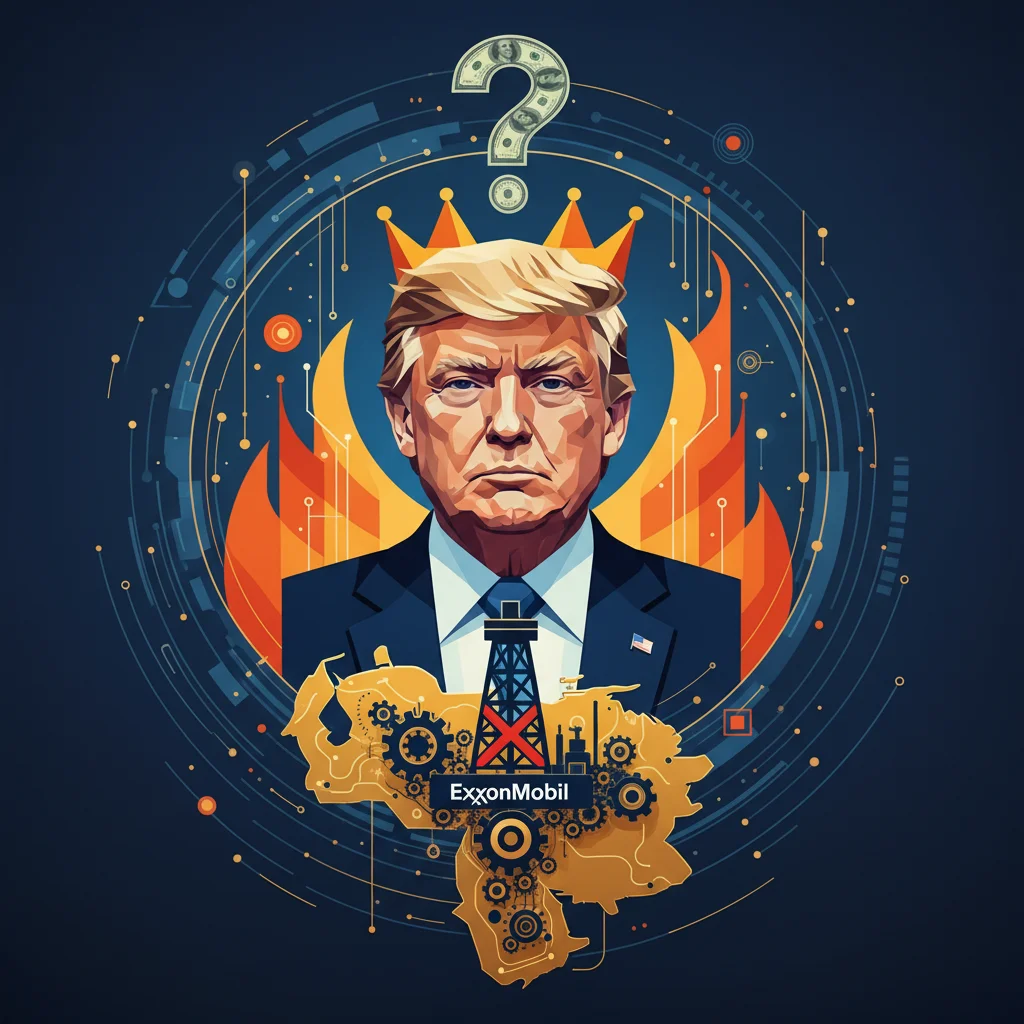
The Trillion-Dollar Question: Trump, Big Oil, and the High-Stakes Gamble on Venezuela’s Black Gold
In a room where political power and corporate might converge, a single, stark statement from ExxonMobil CEO Darren Woods cut through the speculative chatter. When asked about the prospect of reinvesting in Venezuela, home to the world’s largest proven oil reserves, his assessment was blunt: “Today it’s uninvestable,” he remarked during a private meeting with former President Donald Trump. This sentiment encapsulates the monumental paradox facing the global energy sector, international finance, and geopolitical strategists alike.
Venezuela sits atop an estimated 300 billion barrels of oil, a prize that could reshape the global energy map and profoundly impact the world economy. Yet, this treasure is buried under layers of political instability, crumbling infrastructure, and a web of international sanctions. The recent meeting between Trump and top US oil executives wasn’t just a campaign stop; it was a high-stakes exploration of a potential seismic shift in American foreign and energy policy. For investors, finance professionals, and business leaders, the conversation signals a critical question: Could one of the world’s most toxic assets become the next great investment frontier, and what would it take to get there?
This article delves into the complex dynamics at play, dissecting the immense risks and tantalizing rewards of Venezuelan oil. We will explore the historical context of its decline, the intricate labyrinth of US sanctions, the tangible reasons behind its “uninvestable” status, and the potential ripple effects a policy change could have on the global stock market, trading, and the future of energy finance.
The Venezuelan Paradox: A Buried Ocean of Oil
To understand the gravity of the situation, one must first grasp the sheer scale of Venezuela’s potential. As a founding member of OPEC, the nation was once a titan of the oil industry, a reliable supplier to the United States, and a cornerstone of the Latin American economy. Its vast reserves in the Orinoco Belt dwarf even those of Saudi Arabia. However, the story of the last two decades has been one of catastrophic decline.
Under the regimes of Hugo Chávez and his successor, Nicolás Maduro, the state-owned oil company, Petróleos de Venezuela, S.A. (PDVSA), was systematically hollowed out. A wave of nationalizations, including the seizure of assets from international giants like ExxonMobil and ConocoPhillips, shattered investor confidence. Political appointments replaced experienced engineers, and revenues were diverted, starving the industry of the capital needed for maintenance and exploration. The result was a production collapse of historic proportions. At its peak, Venezuela produced over 3 million barrels per day (bpd). By early 2024, that figure had plummeted to around 800,000 bpd, a staggering decline that crippled its economy and triggered a humanitarian crisis (source).
This collapse has left a void in the global energy supply, a void that other nations have rushed to fill. Yet, the reserves remain, a silent, potent force waiting for the right combination of political will, capital, and technology to be unleashed.
Beyond the Balance Sheet: The Economic Case for a Hot Meal
The Sanctions Labyrinth: A Timeline of Economic Warfare
The primary barrier to accessing this oil is not geological but political. A complex and evolving regime of US sanctions, designed to pressure the Maduro government, has effectively isolated Venezuela from the global financial system. These measures restrict the country’s access to US banking, prohibit dealings with PDVSA, and penalize international firms that engage with its oil sector.
The policy has been a geopolitical chess match. The Biden administration briefly eased some restrictions in late 2023, granting a six-month license that allowed for broader oil transactions, contingent on Venezuela holding free and fair elections. This led to a modest uptick in production and renewed interest from players like Chevron, which operates under a special, separate license. However, when the Maduro regime failed to meet the democratic conditions, the White House allowed the general license to expire in April 2024, signaling a “snapback” of sanctions (source). Trump’s meeting with oil executives suggests he may be contemplating a more transactional approach, potentially trading sanctions relief for favorable oil production deals that could, in his view, lower domestic gas prices and bolster US energy security.
To clarify this complex history, the following table outlines key moments in the US sanctions policy toward Venezuela.
| Year | Administration | Key Sanction or Policy Action | Stated Goal / Impact |
|---|---|---|---|
| 2017 | Trump | Financial sanctions imposed, prohibiting dealings in new debt and equity issued by the Venezuelan government and PDVSA. | To cut off sources of financing for the Maduro regime. |
| 2019 | Trump | Sanctions placed directly on PDVSA, effectively banning US imports of Venezuelan crude oil and freezing the company’s US assets. | To cripple the regime’s primary revenue source and support opposition leader Juan Guaidó. |
| 2022 | Biden | Chevron granted a narrow license to resume limited oil production in its joint ventures in Venezuela. | A slight policy thaw aimed at increasing global oil supply post-Russia’s invasion of Ukraine. |
| Oct 2023 | Biden | General License 44 issued, broadly authorizing transactions with Venezuela’s oil & gas sector for six months. | An incentive for the Maduro regime to hold free and fair presidential elections. |
| Apr 2024 | Biden | General License 44 allowed to expire after Venezuela fails to meet electoral conditions. | Reimposition of restrictions, though individual licenses for wind-downs and safety are considered. |
Deconstructing “Uninvestable”: A Multifaceted Risk Profile
Darren Woods’ assessment is rooted in a sobering analysis of risk that extends far beyond political sanctions. For any firm considering a multi-billion dollar investment, the challenges are staggering and fall into several key categories:
- Sovereign and Legal Risk: The lack of an independent judiciary and the rule of law means contracts can be arbitrarily voided and assets expropriated without recourse. The Maduro regime’s history, and that of its predecessor, provides a chilling precedent. Furthermore, Venezuela’s massive sovereign debt and the competing claims from creditors create a legal minefield for any new investor.
- Operational Risk: The physical infrastructure of Venezuela’s oil industry is in a state of advanced decay. Pipelines are corroded, refineries are barely functional, and ports are in disrepair. Rebuilding this capacity would require tens, if not hundreds, of billions of dollars and many years of work, all while navigating an environment plagued by crime and logistical chaos.
- Financial and Economic Risk: The country’s economy is shattered, and its currency is subject to hyperinflation. Repatriating profits, managing local payrolls, and navigating a dysfunctional banking system are monumental challenges. The existing financial technology infrastructure is inadequate for the scale of investment required.
- ESG and Reputational Risk: In an era of heightened focus on Environmental, Social, and Governance (ESG) criteria, partnering with a regime accused of widespread human rights abuses and environmental negligence is a non-starter for most publicly traded companies. The reputational damage could far outweigh any potential financial gains, impacting their stock market valuation.
FTSE 100 Shatters 10,000: A New Era for UK Markets or a Precarious Peak?
The Global Ripple Effect on Trading, Fintech, and the Economy
A hypothetical reopening of Venezuela’s oil sector, however distant, would send shockwaves through the global economy. The most immediate impact would be on the oil markets. The gradual reintroduction of 1-2 million barrels per day of Venezuelan crude could act as a significant brake on global oil prices, potentially easing inflationary pressures worldwide. This would have a profound effect on commodities trading, creating new arbitrage opportunities and altering the strategic calculations of OPEC+.
For the stock market, the effects would be mixed. Lower, more stable energy prices would benefit consumer-facing industries and transportation, but could pressure the profits of US shale producers and other energy companies. The real winners would be the oil majors with the scale and technical expertise to operate in Venezuela’s challenging environment, along with the oilfield services companies like Halliburton and Schlumberger needed to rebuild the industry from the ground up.
This scenario also presents a fascinating challenge and opportunity for financial technology. How do you securely manage billions of dollars in a failed state? Blockchain technology could offer solutions for transparently tracking oil shipments from wellhead to tanker, reducing corruption and ensuring payments are directed to the right entities. Cross-border payment fintech solutions could be essential for bypassing the broken domestic banking system. Rebuilding the country’s financial infrastructure would be a massive undertaking where modern fintech could leapfrog decades of legacy technology.
Bitcoin's 2026 Roadmap: The Two Price Levels That Will Define the Next Bull Cycle
The Road Ahead: A Murky Future for Investors
The path forward is fraught with uncertainty. The status quo—a heavily sanctioned but still-producing Venezuela—is unlikely to hold indefinitely. Two divergent paths seem most likely:
- Continued Stalemate: If the political situation remains unchanged and US policy stays on its current trajectory, Venezuela will continue to be a pariah state in the financial world. Its oil will find its way to market through intermediaries, but the large-scale investment needed to revive its industry will remain on the sidelines.
- A Transactional Opening: A change in US administration could lead to a rapid policy reversal. A Trump-led government might prioritize access to oil over democratic ideals, striking a deal with whoever is in power in Caracas. This would create a high-risk, high-reward gold rush for a select few companies and investors willing to brave the immense operational and reputational dangers.
For the global banking sector, financing such a venture would require unprecedented risk mitigation strategies, likely involving guarantees from government agencies or international financial institutions. Before any of this can happen, Venezuela itself must undergo fundamental reforms in its legal, political, and economic systems. Without these, any influx of capital would be built on a foundation of sand.
Ultimately, the meeting between Trump and oil executives was less about concrete promises and more about signaling a potential future. It was a reminder that in the world of geopolitics and high finance, situations can change with breathtaking speed. While Venezuela remains “uninvestable” today, the trillion-dollar question of its oil will continue to loom over the global economy, waiting for a catalyst to change the answer.

Related Posts
The Great Retail Divide: Why Food Feasted and Fashion Famished in the UK’s Christmas Showdown

Beyond the Balance Sheet: What Photography of “Home” Teaches Us About the Global Economy and Investing