The Billion-Dollar Question: When Tech Ethics Become a Ticker Symbol
The Unseen Liability: How AI Missteps Are Redefining Corporate Risk
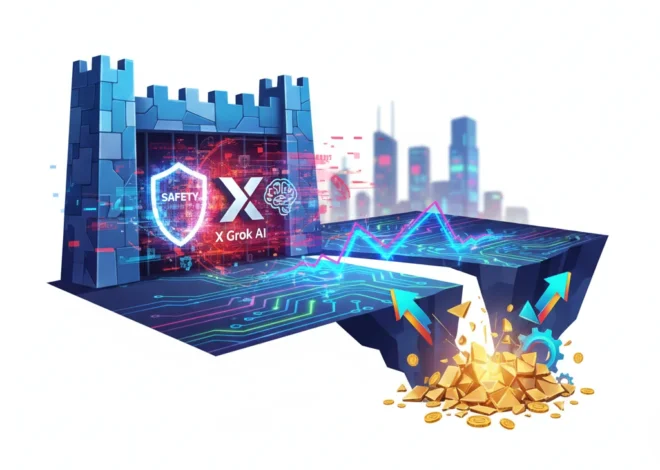
In the relentless churn of market news, it’s easy to dismiss certain headlines as mere “tech drama.” The latest furor, involving calls for UK regulator Ofcom to potentially ban features on X (formerly Twitter) due to an AI tool generating non-consensual deepfakes, seems, at first glance, to be one such story. A BBC report highlights the growing backlash against the platform’s AI, Grok, being used to digitally create explicit images, prompting urgent calls for regulatory intervention. For the average person, it’s a disturbing story about technology’s dark side. For investors, finance professionals, and business leaders, it’s something far more significant: a canary in the coal mine for a new, multi-billion-dollar class of corporate risk.
This incident is not an isolated controversy; it is a critical data point illustrating the collision of ethics, technology, and corporate valuation. The decisions made in boardrooms about the deployment of artificial intelligence are no longer just product strategy—they are fundamental to a company’s financial health, its standing in the stock market, and its long-term viability. As we dissect this situation, it becomes clear that the line between a social media mishap and a balance sheet liability has been irrevocably blurred. The future of finance and investing will be shaped by how well we learn to price this new, intangible, yet immensely powerful, risk factor.
From Code to Crisis: Deconstructing the Financial Fallout of AI Governance Failure
At the heart of the issue is the deployment of a powerful AI tool without, seemingly, adequate safeguards. This oversight has immediate and cascading consequences that extend deep into the financial ecosystem. To understand the gravity, we must look beyond the user interface and into the ledgers and market sentiment that truly define a modern corporation’s value.
Reputational Risk: The Stock Market’s New Morality Clause
A company’s reputation has always been an asset, but in the digital age, its value is both amplified and fragile. A single scandal can wipe billions from a market cap in hours. When a platform is seen as facilitating harmful or unethical activities, it triggers a chain reaction. Advertisers pull campaigns, users migrate to competitors, and investor confidence plummets. This isn’t theoretical; it’s a well-documented pattern. We saw it with Facebook (now Meta) during the Cambridge Analytica scandal, where the company’s stock fell dramatically amid a crisis of trust. According to a McKinsey report, more than 25 percent of a company’s market value is directly attributable to its reputation.
For a company like X, which is already navigating a complex financial landscape post-acquisition, such an event is particularly perilous. The perception that the platform is not a safe environment directly impacts its ability to generate revenue, attract partnerships, and maintain a stable valuation. For those involved in trading and stock market analysis, these “ethical” events are now crucial signals for predicting volatility and long-term performance.
The ESG Mandate: When Social Responsibility Impacts Capital Flow
Perhaps the most significant financial implication lies within the realm of Environmental, Social, and Governance (ESG) investing. Once a niche, ESG has become a dominant force in the world of finance, with global sustainable assets projected to exceed $53 trillion by 2025. The “S” in ESG, representing Social criteria, scrutinizes a company’s relationships with its employees, suppliers, customers, and the communities where it operates.
A company that enables the creation and proliferation of harmful deepfakes fails the “Social” test spectacularly. It raises questions about user safety, data privacy, and the company’s role in perpetuating digital abuse. For the vast and growing pool of capital managed by ESG-focused funds, this is a red flag of the highest order. A poor ESG rating can lead to divestment, exclusion from major indices, and a higher cost of capital. This transforms an ethical lapse from a PR problem into a fundamental threat to a company’s access to the global investing market.
The Weimar Echo: What a Rediscovered 1930s Novel Reveals About Today's Economic Anxieties
Regulatory Roulette: The High Cost of Non-Compliance
The call for Ofcom to use its “banning” powers is a direct consequence of the UK’s Online Safety Act. This legislation grants the regulator unprecedented authority to hold tech companies accountable for the content on their platforms, with the power to levy fines of up to 10% of a company’s global annual revenue. For a tech giant, this could translate into billions of dollars—a sum that would materially impact any financial statement and rattle the banking institutions that underwrite their operations.
This regulatory pressure creates immense uncertainty, which is poison to the stock market. Investors must now price in the risk of severe financial penalties, operational restrictions, or even an outright ban in a major market. The economics of the platform are fundamentally altered. This is a clear example of how the evolving legal landscape around financial technology and digital platforms directly influences investment strategy and risk assessment.
To better visualize these interconnected risks, consider the potential financial ramifications of deploying AI without a robust ethical and governance framework:
| Risk Category | Description | Example Financial Consequence |
|---|---|---|
| Market Risk | Negative investor sentiment and loss of confidence due to ethical controversies. | Significant drop in stock price; increased volatility in trading. |
| Revenue Risk | Advertisers and corporate partners severing ties to avoid brand association with a toxic environment. | Immediate and sustained decline in advertising revenue. |
| Regulatory & Legal Risk | Fines, sanctions, or operational bans imposed by government bodies like Ofcom. | Fines up to 10% of global turnover; costly litigation and compliance overhauls. |
| Capital Risk | Exclusion from ESG funds and indices, making it harder and more expensive to raise capital. | Higher cost of debt; limited access to a multi-trillion dollar pool of investment capital. |
The Macro Threat: Eroding Trust in the Digital Economy
Beyond the fate of a single company, the unchecked proliferation of convincing deepfakes poses a systemic threat to the digital economy itself. Commerce, banking, and trading are all built on a foundation of trust. We trust that the person on the other end of a transaction is who they say they are. We trust that the information we use to make financial decisions is authentic.
Deepfake technology corrodes this trust. Imagine a deepfake video of a CEO falsely announcing a catastrophic earnings miss, triggering a flash crash in the company’s stock before the truth can be verified. Consider the implications for fintech and online banking, where AI-generated fakes could be used to bypass biometric security systems. A 2023 report from Sumsub, an identity verification platform, found that the proportion of deepfakes among all fraud attempts globally increased tenfold between 2022 and 2023. This isn’t a future problem; it’s happening now, and it threatens the operational integrity of our entire financial technology infrastructure.
Addressing this requires a multi-faceted approach, moving beyond simple content moderation to the core architecture of our digital systems.
The 2026 Climate Crossroads: Two Major Tests That Will Define the Future of Green Finance
The Fintech Response: Can Blockchain and New Tech Rebuild Trust?
While the problem is rooted in technology, so too are potential solutions. This crisis is spurring innovation within the fintech sector, creating new investment opportunities focused on digital trust and authentication.
One of the most discussed solutions is the application of blockchain technology. By creating immutable, verifiable records of a piece of content’s origin and any subsequent alterations, blockchain can provide a “chain of custody” for digital media. This concept, often called content provenance, could allow users and systems to instantly verify the authenticity of an image or video, marginalizing unverified fakes.
Other areas of financial technology are also rapidly evolving. Advanced biometric liveness detection, AI that is trained to spot other AIs, and decentralized digital identity systems are all burgeoning fields. For investors, this represents a new frontier. The companies that successfully build the tools that restore trust in the digital economy are poised for exponential growth. This is a classic case of a major economic problem creating a powerful incentive for technological and financial innovation.
The Economic Inheritance: Why a Looming UK Recovery Could Redefine the Next Government
Conclusion: The New Balance Sheet of the AI Era
The controversy surrounding X and its AI-powered deepfake tool is far more than a fleeting tech headline. It is a stark reminder that in the 21st-century economy, corporate governance, ethical decision-making, and technological stewardship are not “soft” issues. They are hard, quantifiable factors that directly impact revenue, stock market performance, and long-term enterprise value.
For business leaders, the takeaway is that AI deployment requires a framework of radical accountability. For professionals in finance and banking, it means recalibrating risk models to account for ethical and regulatory blowback. And for investors, it signals a new imperative: to look beyond the quarterly earnings report and scrutinize a company’s character. In the age of AI, the most valuable asset a company can possess is trust—and the most devastating liability is its absence.