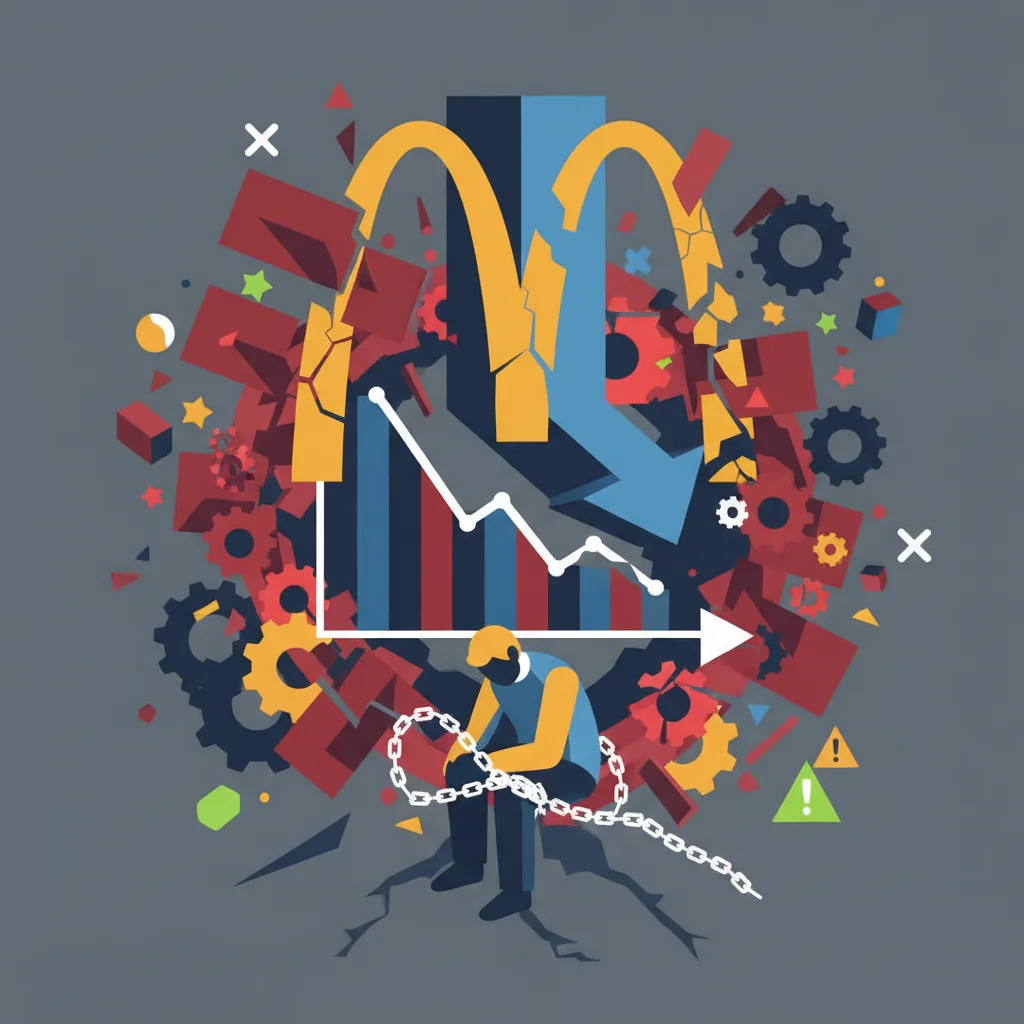
Beyond the Golden Arches: Why McDonald’s Labor Scandal is a Major Red Flag for Investors
The familiar glow of the Golden Arches has long been a symbol of consistency, convenience, and global economic might. For investors, McDonald’s Corporation (NYSE: MCD) has represented a blue-chip stalwart—a reliable dividend-payer seemingly immune to economic turbulence. However, a recent storm of allegations threatens to tarnish that golden reputation, providing a critical lesson for anyone involved in finance, investing, or corporate leadership. A recent BBC report has brought to light serious accusations from UK unions, claiming “repeated harassment” and a toxic work culture, particularly affecting its “mostly teenage” workforce. This isn’t just an internal HR matter; it’s a flashing red indicator of significant social and financial risk that could have lasting repercussions on the company’s stock market performance and long-term value.
These allegations are not an isolated incident. They echo the findings of a comprehensive BBC investigation from three years prior, which exposed a deeply troubling culture within the fast-food giant. The recurrence of such issues suggests a systemic problem, one that modern investors, increasingly guided by Environmental, Social, and Governance (ESG) principles, can no longer afford to ignore. In today’s hyper-transparent economy, the line between corporate culture and corporate valuation has been erased. This article will dissect the financial implications of McDonald’s labor crisis, explore its significance through the lens of ESG investing, and provide a framework for how business leaders and finance professionals should assess such non-financial risks.
The Anatomy of a Reputational Crisis
The core of the issue, as reported by unions and media, centers on a failure to protect the company’s most vulnerable employees. The allegations point to a pattern of misconduct that has been allowed to fester, creating an environment where young workers are allegedly subjected to harassment and abuse. For a brand that markets itself as a family-friendly, community-oriented business, the dissonance is stark and damaging. This is not merely a public relations challenge; it’s an erosion of the company’s most valuable intangible asset: its brand.
In the world of modern finance, brand value is a quantifiable metric that directly impacts shareholder equity. According to a Forbes analysis, a strong brand reputation can account for a significant portion of a company’s market capitalization. When that reputation is jeopardized by scandals related to employee welfare, the financial fallout can be multifaceted:
- Consumer Backlash: A growing segment of consumers makes purchasing decisions based on corporate ethics. Negative headlines can lead to boycotts and a tangible decline in sales.
- Employee Turnover: A toxic culture leads to higher attrition rates. For a company like McDonald’s, which employs over 200,000 people directly and millions more through its franchise model, the costs of constantly recruiting, hiring, and training new staff are astronomical.
- Regulatory and Legal Costs: These allegations will inevitably lead to investigations, lawsuits, and potentially hefty fines. These direct costs hit the bottom line and create an overhang of uncertainty that spooks the stock market.
This situation highlights a critical shift in economics: human capital is no longer just an expense on the income statement; it is a core driver of value. Mismanaging this asset is as financially irresponsible as letting a factory fall into disrepair.
The Investor’s Lens: Pricing Social Risk in an ESG Framework
The rise of ESG investing has transformed the landscape of asset management. It’s a framework that posits that companies with strong practices around environmental sustainability, social responsibility, and corporate governance are better long-term investments. They are less prone to catastrophic risks, better equipped to attract top talent, and more aligned with the values of modern consumers and regulators. The allegations against McDonald’s strike at the very heart of the ‘Social’ pillar.
Key ‘S’ factors that investors are now scrutinizing include:
- Labor Practices & Employee Relations: Fair wages, safe working conditions, and the right to organize.
- Human Capital Development: Investment in training, education, and career progression.
- Health and Safety: Policies and track record on protecting employees from physical and psychological harm.
- Diversity, Equity, and Inclusion (DEI): Representation and fair treatment for all employees.
The accusations of harassment place a significant black mark against McDonald’s on several of these criteria. For a sophisticated investor, this requires a re-evaluation of the company’s risk profile. The potential for reputational damage and financial loss is not a hypothetical; history provides a clear, data-driven warning. Major corporate scandals tied to social and governance failures have consistently led to significant destruction of shareholder value.
To illustrate this point, consider the stock market performance of other major corporations following significant ESG-related crises. The data shows a clear pattern of underperformance and long-term value destruction.
Table: Impact of ESG Scandals on Stock Performance
| Company & Scandal | Date of Peak Public Awareness | Stock Price Impact (Following 6 Months) | Long-Term Consequence |
|---|---|---|---|
| Wells Fargo (Account Fraud Scandal) | September 2016 | -15% and significant underperformance vs. banking sector | Years of regulatory oversight, massive fines, and loss of consumer trust. |
| Volkswagen (Dieselgate Emissions Scandal) | September 2015 | -35% in the first week alone | Over $30 billion in fines and recalls; forced a massive strategic pivot to EVs. |
| Boeing (737 MAX Crashes) | March 2019 | -20% and sustained volatility | Loss of market leadership, production halts, and a crisis of confidence in its safety culture. |
This historical data, supported by numerous academic and industry studies, demonstrates that the market does, in fact, punish companies for severe ESG failures. The initial stock drop is often just the beginning, followed by a prolonged period of rebuilding trust with investors, customers, and regulators.
The Role of Financial Technology in Uncovering Risk
In the past, assessing a company’s culture was a subjective exercise. Today, the world of **financial technology (fintech)** is providing investors with powerful new tools to get a clearer picture. AI-powered platforms can now scan millions of data points—from employee review websites and news sentiment analysis to internal company documents—to generate a real-time score of a company’s human capital health. This is a revolution in due diligence.
This data-driven approach allows fund managers and analysts to move beyond a company’s glossy Corporate Social Responsibility report and identify red flags before they escalate into a full-blown crisis. Some innovative **fintech** startups are even exploring how **blockchain** technology could be used to create immutable records of supply chain labor standards, though this application is still in its early stages. The direction of travel is clear: transparency is increasing, and there is nowhere for poor corporate culture to hide. This evolution in financial technology means that the risks highlighted in the McDonald’s case are more visible and more financially material than ever before.
The Path Forward: From Crisis to Competitive Advantage
For McDonald’s, the path forward requires more than a press release and a new training module. It demands a fundamental, board-level commitment to transforming its workplace culture. This involves transparent investigations, holding leadership accountable, empowering employees with safe and anonymous reporting channels, and investing heavily in management training focused on ethical leadership. Such a transformation is not an expense; it is an investment in the long-term sustainability of the business.
For investors and business leaders, the lessons are equally profound. A company’s treatment of its employees is a leading indicator of its operational excellence and future financial performance. When conducting due diligence, whether for an acquisition, a stock purchase, or a **banking** partnership, the analysis must go beyond the balance sheet. A thorough evaluation of a company’s culture, employee turnover rates, and any patterns of labor disputes is now an essential component of any sound **investing** or **trading** strategy.
Companies that proactively build a culture of respect, safety, and opportunity will not only mitigate the risks seen in the McDonald’s case but will also unlock a powerful competitive advantage. They will attract and retain the best talent, foster innovation, and build a resilient brand that can weather any economic storm. In the modern **economy**, a positive culture is a financial asset of the highest order.
The 2025 Market Paradox: How a Year of Volatility Forged a Remarkable Rally
In conclusion, the allegations against McDonald’s are a stark reminder that in the 21st-century **stock market**, ethics and profits are inextricably linked. The story is far more than a labor dispute; it is a case study in the financial materiality of social risk. Investors who ignore these warning signs do so at their own peril. The companies that will thrive in the decades to come will be those that understand that their greatest asset is not their product or their technology, but their people—and that protecting and nurturing that asset is the surest path to sustainable, long-term shareholder value.

Related Posts
Beyond the Burger: Why McDonald’s Harassment Allegations Are a Red Flag for Investors

The 3% Illusion: Why a Minor Correction in Sinochem’s Pirelli Stake Reveals Major Truths About Global Finance