America’s AI Edge Is on the Brink: A Microsoft Scientist’s Dire Warning About Gutting University Research
We’re living in the golden age of artificial intelligence. From the generative magic of ChatGPT to the complex algorithms powering cloud computing and automation, American innovation seems unstoppable. We see the logos—Google, Microsoft, OpenAI, NVIDIA—and assume the US has an unshakeable grip on the future of technology. But what if the very foundation of that leadership is more fragile than we think?
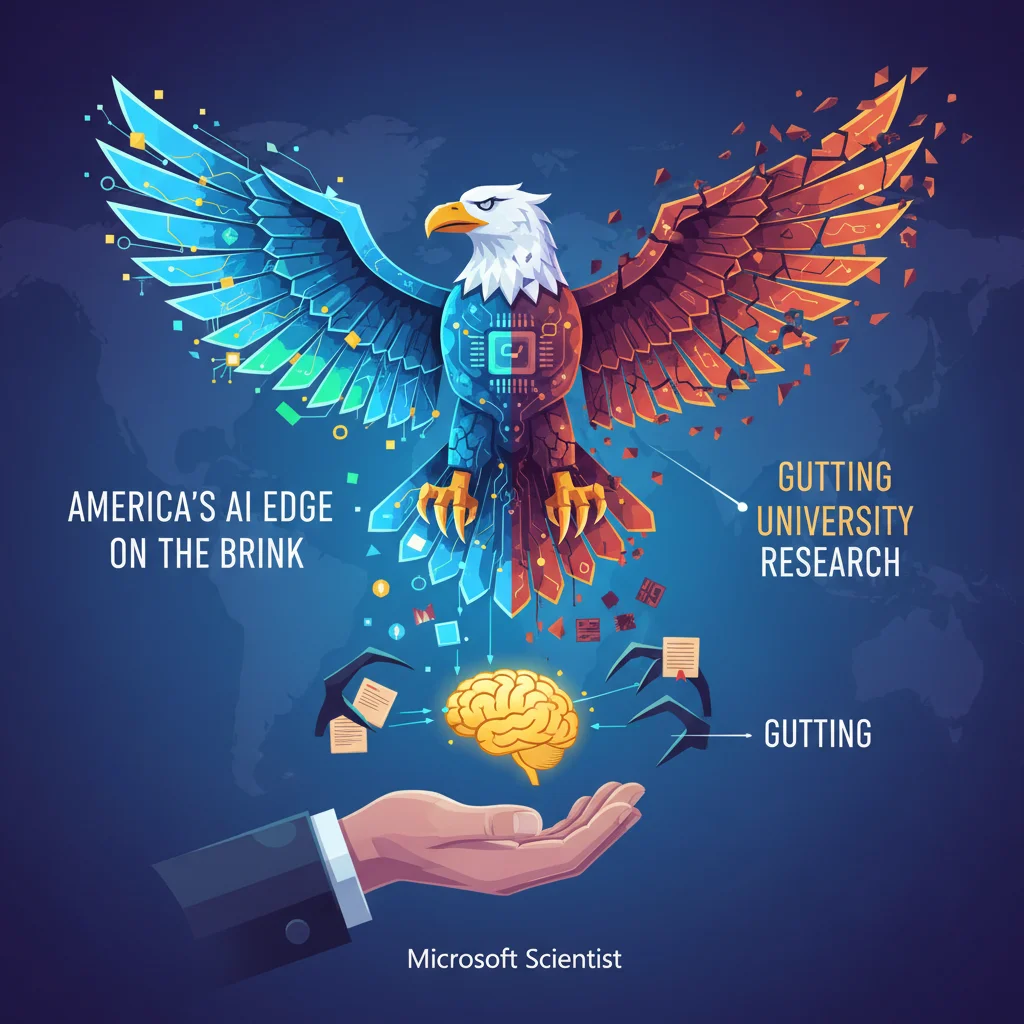
According to Eric Horvitz, Microsoft’s Chief Scientific Officer and a veteran of the AI field, a potential policy shift could shatter that foundation. In a stark warning, he argues that proposed cuts to academic research funding, particularly those associated with a potential Trump administration, could cause the United States to cede its global leadership in artificial intelligence. It’s a move he believes would trigger an exodus of talent and ideas, crippling the engine of American innovation for decades to come.
This isn’t just about budget line items or political debates. It’s about the intricate, delicate ecosystem that fuels everything from the next big SaaS platform to breakthroughs in national cybersecurity. Let’s unpack why this warning from a tech giant’s inner circle is a red alert for developers, entrepreneurs, and anyone invested in the future of technology.
The Unseen Engine: Why University Research is AI’s Bedrock
When we think of AI development, we often picture gleaming corporate campuses with massive server farms. While private industry is phenomenal at engineering and productization, it’s not where most foundational ideas are born. The true seedbed of innovation has long been the university lab, powered by federal research grants.
There’s a critical distinction between two types of research:
- Applied Research: This is what corporations excel at. It’s focused on solving a specific problem or creating a marketable product. Think: “How can we make our machine learning model 5% more efficient for our cloud service?” This work is essential for commercial success but is typically short-term and profit-driven.
- Basic Research: This is the domain of academia. It’s curiosity-driven, long-term, and explores fundamental principles without an immediate commercial goal. Think: “What are the mathematical underpinnings of neural networks?” or “Can we create a new programming paradigm for distributed computing?”
This “basic” research is anything but. It’s the high-risk, high-reward exploration that lays the groundwork for entire industries. The internet itself is the ultimate case study. It began as ARPANET, a project funded by the U.S. Department of Defense to connect university computers. There was no initial business plan for social media or e-commerce; it was a pure, government-backed exploration of resilient networking. That foundational investment created the landscape for every software and cloud company that exists today.
Cutting funding to universities severs this crucial first link in the innovation chain. It tells the brightest minds that their most ambitious, world-changing ideas have no home here. As Horvitz warns, that talent won’t just disappear—it will go to countries that are more than willing to invest in the future.
The Gold Phone That Wasn't: Why Building a Smartphone is a Startup's Ultimate Boss Battle
The Global AI Race is a Marathon, Not a Sprint
The United States is not innovating in a vacuum. The 21st century is defined by a fierce technological competition, with China emerging as a formidable, state-driven challenger. While the US has historically relied on a dynamic public-private partnership, China employs a top-down, nationally coordinated strategy, pouring immense resources into its goal of becoming the world’s AI leader by 2030.
A 2021 review by Georgetown University’s Center for Security and Emerging Technology highlighted the sheer scale of China’s ambition, noting its strategic focus on building a robust talent pipeline and integrating AI across its economy and military. Undermining our own academic institutions would be a unilateral disarmament in this critical race.
To understand the stakes, let’s compare the two innovation models.
| Aspect | United States Model (Current) | China Model |
|---|---|---|
| Primary Driver | Public-private partnership; private sector leads commercialization, public sector funds foundational research. | State-directed, centrally planned (e.g., “New Generation AI Development Plan”). |
| Funding Source | Mix of venture capital, corporate R&D, and significant government grants (NSF, DARPA, NIH). | Massive state funding, provincial government support, and state-owned enterprise investment. |
| Talent Pipeline | Relies heavily on top universities (public and private) attracting global talent. | Aggressive domestic cultivation and international recruitment programs (“Thousand Talents Plan”). |
| Key Strength | Dynamic, bottom-up innovation culture; strong startup ecosystem. | Ability to mobilize national resources for long-term strategic goals; massive data availability. |
| Key Vulnerability | Dependent on consistent public funding for basic research; political shifts can disrupt the ecosystem. | Can be rigid; may stifle the serendipitous, “out-of-the-box” innovation found in more open systems. |
This table illustrates a crucial point: America’s key advantage is its dynamic, decentralized innovation culture, which is born on university campuses. It’s the graduate student tinkering with a novel algorithm or the professor pursuing a “crazy” idea for a decade. If we starve that system, we’re not just losing research papers; we’re losing our core competitive edge in software development, automation, and cybersecurity, handing a strategic victory to our rivals.
The Ripple Effect: What This Means for the Tech Community
This isn’t an abstract policy debate. A decline in foundational AI research would have tangible consequences for everyone in the tech industry.
For Developers and Machine Learning Engineers
The open-source tools, foundational models, and programming languages you use every day often have roots in academic research. Think of the groundbreaking papers on transformers (the “T” in GPT) that came out of Google, but were built upon decades of public-funded university research in neural networks. A world with less academic research means:
- A Slower Pace of Innovation: Fewer new architectures, algorithms, and fundamental breakthroughs to build upon.
- A More Closed Ecosystem: Innovation becomes concentrated within a few tech giants, with less public-domain research to fuel open-source projects and broader community learning.
- A Talent Bottleneck: The pipeline that produces PhDs and highly skilled engineers—the people who become your senior colleagues and mentors—shrinks dramatically.
For Entrepreneurs and Startups
Startups are the lifeblood of the tech economy, often commercializing cutting-edge ideas that are too nascent for large corporations. This “tech transfer” from lab to market is a cornerstone of the US innovation model. Cutting university funding is a direct threat to this pipeline.
- Fewer “Deep Tech” Ideas: The well of foundational science that startups draw from begins to run dry, making it harder to build companies based on true technological moats.
- Increased Talent Costs: With fewer top graduates produced domestically, the competition for elite AI and software talent will become even more ferocious, favoring only the largest incumbents.
- Weakened Local Ecosystems: Universities are often anchor tenants for regional tech hubs. Weakening them weakens the entire network of startups, incubators, and venture capital that surrounds them. (source)
From Paralysis to Possibility: How AI is Rebuilding the Bridge Between Mind and Body
The Choice Ahead: Investing in the Foundation or Selling the Future
Eric Horvitz’s warning isn’t just a partisan critique; it’s a defense of the very system that has made American technological leadership possible. The progress we see in artificial intelligence, cloud computing, and automated systems is the final, visible stage of a long and complex process that begins with a simple, powerful idea: public investment in human curiosity.
To abandon that principle for the sake of short-term fiscal savings would be a catastrophic error. It would not only risk our economic and national security but also betray the spirit of exploration that has always defined American innovation.
The future of AI isn’t just about building better software or more powerful chips. It’s about investing in the people and institutions that ask the big, fundamental questions. The question for policymakers—and for all of us—is whether we still have the foresight to make that investment.