Trump’s Venezuelan Oil Gambit: A Deep Dive for Investors and Business Leaders
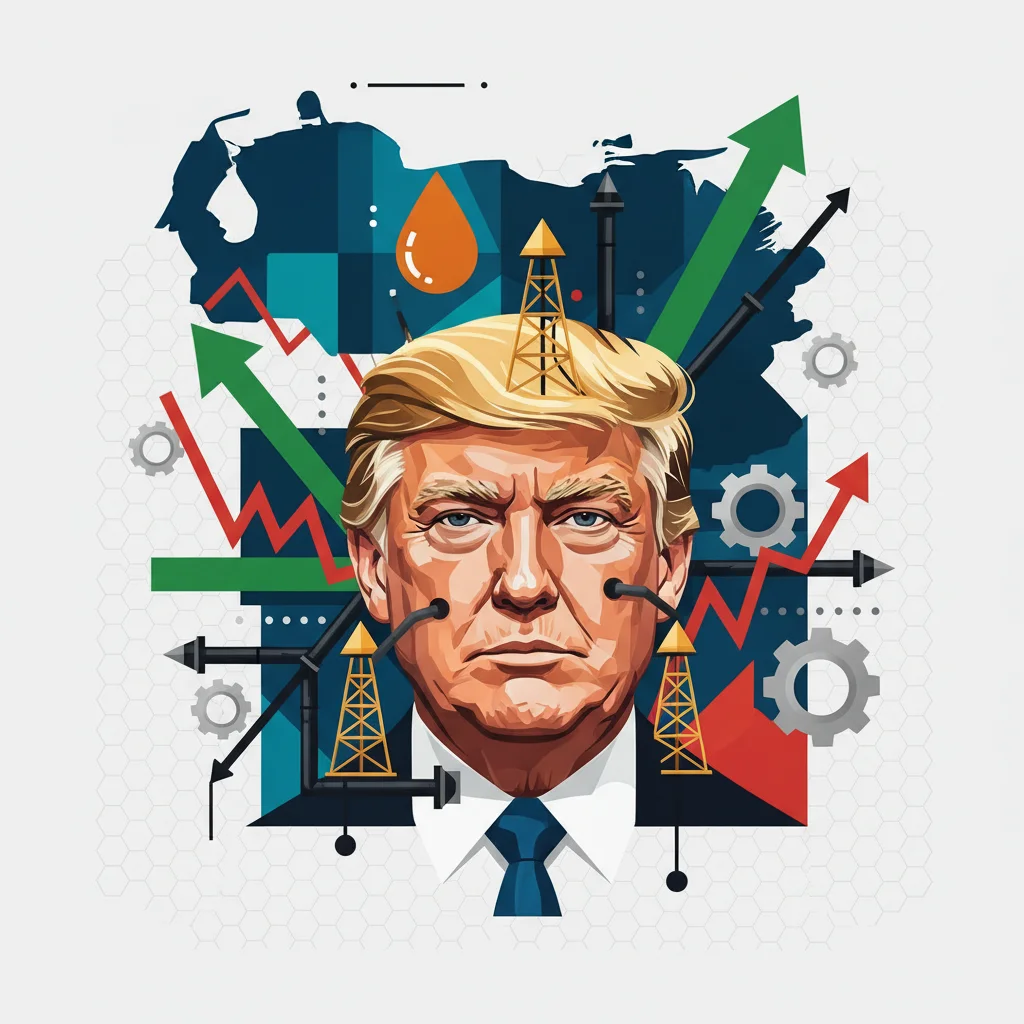
In the high-stakes world of geopolitics and global finance, statements from world leaders can send shockwaves through the markets. A recent comment from former President Donald Trump did just that, suggesting a potential seismic shift in the energy landscape. He claimed that, under his leadership, Venezuela would be “turning over” up to 50 million barrels of oil to the United States and that American oil firms could be “up and running” in the beleaguered nation within 18 months.
For the casual observer, this might sound like a straightforward transaction. For seasoned investors, finance professionals, and business leaders, it opens a Pandora’s box of questions. Is this a feasible economic proposal or pure political rhetoric? What would it take to untangle the web of sanctions and revive a crippled industry? And most importantly, what are the implications for the global economy, the stock market, and future investment strategies?
This article delves beyond the headline to provide a comprehensive analysis of the situation, exploring the historical context, the logistical hurdles, and the profound financial ramifications of potentially bringing Venezuela’s vast oil reserves back into the global fold.
The Troubled History: Sanctions and the Decline of an Oil Superpower
To understand the weight of Trump’s statement, one must first grasp the complex history between the United States and Venezuela. Once a stable economic partner and a major supplier of crude oil to the U.S., Venezuela’s relationship with Washington has deteriorated over the past two decades. This decline accelerated under the leadership of Hugo Chávez and his successor, Nicolás Maduro, leading to a series of escalating U.S. sanctions.
These sanctions, primarily targeting the state-owned oil company Petróleos de Venezuela, S.A. (PDVSA), were designed to cripple the Maduro regime’s main source of revenue. They effectively cut Venezuela off from the U.S. financial system, prohibited dealings with PDVSA, and severely restricted the country’s ability to export oil and import necessary equipment and diluents. According to a report from the Congressional Research Service, these measures have contributed significantly to the collapse of the nation’s oil output and a devastating humanitarian crisis.
The impact on Venezuela’s oil production has been nothing short of catastrophic. The country sits on the world’s largest proven oil reserves, estimated at over 300 billion barrels, yet its ability to extract and export that wealth has been decimated. Decades of mismanagement, corruption, and brain drain, compounded by the inability to access international capital and technology due to sanctions, have left its infrastructure in a state of near-total decay.
To illustrate this dramatic decline, consider the production data over the last two decades.
| Year | Average Crude Oil Production (Million Barrels per Day) |
|---|---|
| 2005 | 3.3 |
| 2010 | 2.8 |
| 2015 | 2.6 |
| 2020 | 0.5 |
| 2023 | ~0.8 |
Source: Data synthesized from OPEC and U.S. Energy Information Administration (EIA) reports.
This table starkly visualizes the challenge. Reviving this industry isn’t a matter of simply turning a key; it’s about rebuilding an entire ecosystem from the ground up.
The Swift Effect: How Female Artists Are Composing the Future of the Music Economy
Deconstructing the 18-Month Timeline: A Herculean Task
The claim that U.S. oil firms could be “up and running” in 18 months presents a highly optimistic, if not improbable, scenario. The logistical, financial, and political hurdles are immense. Revitalizing Venezuela’s oil fields would require tens of billions of dollars in new investment. Refineries, pipelines, and export terminals are dilapidated and require extensive repairs or complete replacement. The specialized workforce needed to operate this sophisticated machinery has largely fled the country.
Furthermore, any U.S. involvement would be predicated on a fundamental political change in Venezuela that leads to the complete lifting of sanctions. Even then, American companies like Chevron and ConocoPhillips, which have had assets expropriated in the past, would need ironclad legal and financial guarantees before committing the necessary capital. The economics of such a venture are also complicated by the nature of Venezuelan crude, which is predominantly heavy and sour, requiring specialized refining capabilities that are costly to operate.
The Ripple Effect: Implications for the Economy, Markets, and Trading
Despite the practical challenges, the mere suggestion of bringing Venezuelan oil back online has significant implications for various sectors of the economy and financial markets.
The Stock Market and Energy Sector
The most immediate impact would be on the stock market, specifically within the energy sector. Shares of major U.S. oil companies with a historical presence in Venezuela, such as Chevron (CVX) and ConocoPhillips (COP), would likely see significant volatility. A credible path to re-entry could be a massive boon, unlocking vast, low-cost reserves. Conversely, oilfield service giants like Halliburton (HAL) and Schlumberger (SLB) would be positioned to win massive contracts for rebuilding the country’s infrastructure, representing a huge potential revenue stream.
However, the broader effect on oil prices could be a double-edged sword. The prospect of millions of barrels of new supply hitting the market would put downward pressure on global crude prices (both WTI and Brent). This would be beneficial for consumers and energy-dependent industries but could hurt the profitability of producers operating in higher-cost regions, such as U.S. shale.
Global Economics and Commodity Trading
From an economics perspective, the reintegration of Venezuela into the global oil market would challenge the influence of the OPEC+ coalition, which has worked to manage supply to support prices. This could trigger a new dynamic in the world of commodity trading, introducing a new variable that traders would have to price in. The initial 50 million barrels mentioned would be a drop in the ocean of global consumption, but it would signal a long-term trend change. The ensuing price volatility would create significant opportunities and risks for those involved in energy derivatives and futures trading.
Finance, Banking, and Financial Technology
The financial architecture required to support such a revival would be colossal. It would involve complex project finance deals, syndicated loans from major banking institutions, and intricate debt restructuring for Venezuela’s outstanding obligations to countries like China and Russia. This represents a massive opportunity for investment banking.
Moreover, the role of modern financial technology (fintech) would be crucial. Managing cross-border payments, ensuring compliance with shifting regulations, and providing transparent platforms for capital flows would fall to advanced fintech solutions. While sanctioned regimes have sometimes flirted with blockchain and cryptocurrencies to bypass the traditional banking system, a normalized relationship would see Venezuela reintegrated into the SWIFT network, with fintech platforms providing the efficiency and security layers needed for large-scale international investing.
XRP's High-Stakes Tug-of-War: Why Macroeconomic Forces Are Overpowering Crypto Hype
Conclusion: A Political Statement with Profound Economic Undercurrents
Donald Trump’s statement about Venezuelan oil is far more than a simple remark. It is a politically charged proposition that touches on some of the most critical issues in modern finance, economics, and international relations. While the logistical and political realities make a rapid turnaround highly challenging, it forces a re-evaluation of the long-term energy map.
For investors and business leaders, the key takeaway is not to bet on an 18-month timeline, but to recognize the immense potential energy stored within Venezuela’s borders. Any credible move toward political stability and the lifting of sanctions would represent a paradigm shift for the energy sector. It would impact everything from the price at the pump to the valuation of the world’s largest corporations. The situation remains a complex geopolitical chessboard, but for those in the world of finance and investing, it is a game that demands close attention.