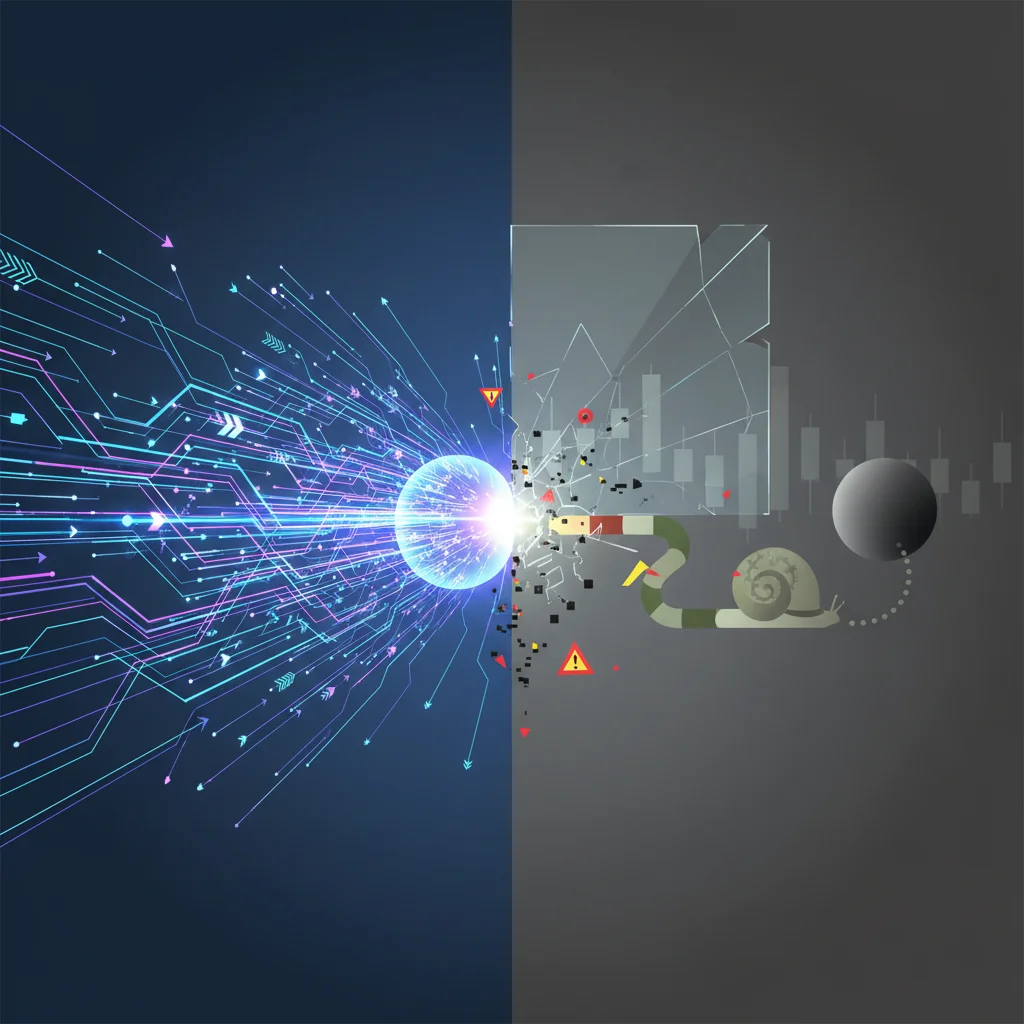
Trading at the Speed of Light, Reporting at a Snail’s Pace: The Data Lag Threatening Our Economy
In the world of modern finance, speed is everything. High-frequency trading algorithms execute millions of orders in microseconds. Retail investors can buy and sell stocks from their smartphones in the blink of an eye. News, both real and fabricated, moves across the globe instantly, causing stock market values to surge or plummet. We operate under the illusion of a perfectly synchronized, real-time financial ecosystem. But what if this is a dangerous façade?
A thought-provoking letter to the Financial Times by Niccolo Caldararo of San Francisco State University raises a critical, often-overlooked point: the significant and growing disconnect between the speed of financial transactions and the speed of the data that’s supposed to govern them. This isn’t just a minor technical issue; it’s a systemic vulnerability. This data lag creates a fog of uncertainty, fuels speculative bubbles, and may be quietly setting the stage for the next major economic crisis.
This deep dive explores the hidden dangers of data latency, examining how this information asymmetry distorts our markets, why historical precedents should serve as a stark warning, and whether emerging financial technology can be the cure rather than just the cause of the problem.
The Great Disconnect: Understanding Financial Data Latency
When we talk about the stock market, we often imagine a single, unified source of truth. In reality, the financial world runs on multiple clocks, all ticking at different speeds. The disconnect arises from the vast differences in the reporting timelines for various types of essential data.
The speed of trading is now measured in nanoseconds. Sophisticated fintech platforms and institutional players use co-located servers and fiber-optic cables to shave milliseconds off execution times. However, the official data that provides context and validates market activity lags far behind. This includes:
- Trade Settlement: For years, the standard settlement cycle for stock trades in the U.S. was “T+2,” meaning the official transfer of money and securities happened two business days after the trade. While this has recently been shortened to T+1, it’s still an eternity compared to the sub-second speed of the trade itself.
- Corporate Reporting: Companies report their earnings and financial health on a quarterly basis. This means for up to three months, investors are trading based on a snapshot of the company that could be wildly out of date.
- Economic Data: Key economic indicators that drive the entire market, like inflation (CPI) or employment figures, are typically released monthly.
This creates a perilous environment of information asymmetry, where a small group of sophisticated players with access to alternative, high-speed data (like satellite imagery of parking lots, credit card transaction data, or social media sentiment analysis) can act on market-moving trends long before the general public or even regulators see the official numbers. This isn’t just an unfair advantage; it’s a mechanism that fundamentally distorts asset prices.
How Delays Inflate Bubbles and Obscure Risk
Market bubbles form when asset prices detach from their underlying fundamental value. Data delays are a primary fuel for this detachment. When official corporate and economic data is stale, investors are forced to rely more on momentum, narrative, and speculation. A stock can soar for weeks based on hype, while the underlying company’s fundamentals are quietly deteriorating. The official confirmation of this decay—the quarterly earnings report—comes too late, after the bubble has already inflated and is poised to pop, leaving retail investors holding the bag.
To visualize the scale of this timing disconnect, consider the different speeds at which crucial market information becomes available.
| Data Type | Typical Latency / Reporting Cycle | Primary Users / Speed of Access |
|---|---|---|
| High-Frequency Trading (HFT) Execution | Microseconds to Milliseconds | Algorithmic Traders, Institutional Investors |
| U.S. Equity Trade Settlement (as of May 2024) | T+1 (One Business Day) | Brokers, Clearinghouses, Custodians |
| Key Economic Data (e.g., CPI, Jobs Report) | Monthly | Institutional Players (seconds after release), General Public (minutes/hours later) |
| Corporate Earnings Reports (10-Q) | Quarterly | Entire Market (simultaneously, but based on past performance) |
| Company Annual Reports (10-K) | Annually | Long-term Investors, Analysts |
This table starkly illustrates the gap. While a trading algorithm can react to a rumor in the time it takes you to blink, the official data verifying whether that rumor has any basis in reality might not arrive for another two months. This is the fertile ground where financial instability takes root.
Echoes of the Past: When Data Lags Led to Disaster
History is littered with examples of financial crises exacerbated by a lack of timely, transparent data. The 2008 Global Financial Crisis was a masterclass in this. The value of complex derivatives like mortgage-backed securities (MBS) and collateralized debt obligations (CDOs) was utterly opaque. The risk was hidden within layers of complexity, and by the time the true, disastrous state of the underlying assets became clear, the entire global banking system was on the brink of collapse.
A more direct example of speed and data disconnect is the “Flash Crash” of May 6, 2010. In a matter of minutes, the Dow Jones Industrial Average plunged nearly 1,000 points, temporarily wiping out almost $1 trillion in market value before recovering. In the aftermath, regulators were left scrambling. It took them nearly five months to piece together the sequence of events from a mountain of fragmented trading data. High-frequency algorithms, reacting to a large institutional sell order, had created a cascading feedback loop of selling. The market’s internal wiring operated too fast for human oversight or for the regulatory systems designed to monitor it. The data was there, but it couldn’t be assembled and understood in time to matter.
These events demonstrate a terrifying reality: our ability to create financial risk has far outpaced our ability to measure and report on it in real-time. Each new advance in trading technology widens this dangerous gap.
The 50/50 Gamble: What the Eurostar Breakdown Reveals About Our Brittle Global Economy
Can Financial Technology Be Both the Poison and the Antidote?
While fintech has driven the speed that creates this problem, it may also hold the key to the solution. The challenge is shifting the focus of innovation from pure speed to enhanced transparency and synchronicity. Several technologies and regulatory shifts are pointing the way forward.
1. Blockchain and Distributed Ledger Technology (DLT)
At its core, blockchain is a shared, immutable ledger. In the context of finance, this could be revolutionary. Imagine a system where corporate assets, liabilities, and transactions are recorded on a distributed ledger in real-time. Instead of waiting for a quarterly report, regulators and investors could have a continuously updated, cryptographically verified view of a company’s financial health. This would dramatically reduce information asymmetry and could make the traditional, backward-looking auditing process obsolete. The potential for real-time transparency in banking and economics is immense, though challenges of scalability and implementation remain significant.
2. The Move to T+1 Settlement
As mentioned, the transition to a T+1 settlement cycle, which the SEC implemented in May 2024, is a major step. By reducing the time between a trade and its final settlement, it lowers the credit, market, and liquidity risks lingering in the financial system. It forces firms to be more efficient and streamlines back-office processes. While it doesn’t solve the core data-lag problem, it reduces one key area of temporal risk in the trading lifecycle, making the overall system more resilient.
3. Advanced Regulatory Technology (RegTech)
Regulators are no longer trying to fight algorithmic wars with analog tools. The field of RegTech is exploding, with agencies employing AI and machine learning to analyze vast datasets from the stock market in real-time. These systems are designed to spot anomalies, detect market manipulation, and identify the build-up of systemic risk far faster than human analysts ever could. The goal is to create a supervisory system that can keep pace with the market it’s meant to police.
China's Economic Engine Sputters Back to Life: A Real Recovery or a False Dawn?
Conclusion: A Call for a More Synchronous Market
The illusion of an instantaneous financial market is seductive, but it masks a dangerous truth. Our global economy is increasingly built on a foundation where transactions fly at the speed of light, while the fundamental data that gives them meaning trickles in days, weeks, or months later. As Niccolo Caldararo’s letter suggests, this disconnect should be a primary source of worry for investors, regulators, and business leaders.
It creates an uneven playing field that favors a small cadre of high-tech players, it fuels the speculative manias that lead to destructive market bubbles, and it obscures risk until it’s too late to contain. Addressing this challenge requires a fundamental paradigm shift. We must move beyond the simple obsession with speed and demand a financial system built on synchronicity, where the flow of data keeps pace with the flow of capital.
Innovations like blockchain and the push for faster settlement are promising starts, but they are not enough. A broader, more urgent conversation is needed about how we can leverage technology to create a truly transparent, real-time economic reporting infrastructure. Failure to do so means we will continue to trade faster and faster into a future we can’t see clearly, with the risk of a catastrophic crash growing with every millisecond.