The Investor’s Crossword: Decoding the Clues of Today’s Complex Economy
There’s a unique satisfaction that comes from solving a complex puzzle. The intricate grid of a cryptic crossword, like the venerable FT Crossword Number 18,261, presents a web of interconnected clues. Each solved word provides a new letter, a new hint, that helps unlock the next. Slowly, through logic and insight, a complete picture emerges from the chaos of empty squares. This process is a powerful metaphor for what investors, business leaders, and finance professionals do every single day: they attempt to solve the world’s most complex, high-stakes puzzle—the global economy.
The modern financial landscape is not a simple, linear equation. It’s a dynamic grid of interlocking forces. A decision by a central bank (an “across” clue) can drastically alter the trajectory of technology startups (a “down” clue). A geopolitical tremor in one corner of the world can create cryptic ripples across the entire **stock market**. To succeed, one must not only understand each individual clue but also appreciate how they intersect and influence one another. In this analysis, we will use the framework of a crossword puzzle to decode the key trends shaping our financial world, from macroeconomic certainties to the disruptive potential of **financial technology**.
The “Across” Clues: Foundational Macroeconomic Trends
In any crossword, the “across” clues often form the backbone of the puzzle, providing the horizontal structure upon which everything else is built. In the world of **economics**, these are the macroeconomic megatrends—the broad, sweeping forces that define the current environment and dictate the rules of the game for nearly every market participant.
The most dominant “across” clue of the past few years has undoubtedly been inflation and the subsequent global response from central banks. After a prolonged period of low interest rates, a confluence of supply chain disruptions, geopolitical tensions, and shifting consumer demand led to a surge in inflation not seen in decades. Central banks, from the U.S. Federal Reserve to the European Central Bank, responded with aggressive monetary tightening. This wasn’t just a minor adjustment; it was a fundamental shift in the financial climate. According to the International Monetary Fund, while global inflation is forecast to decline, it remains above target in most economies, forcing a “higher-for-longer” interest rate environment. This single macro-clue has profound implications for corporate borrowing costs, consumer spending power, and asset valuations across the board, from real estate to growth stocks.
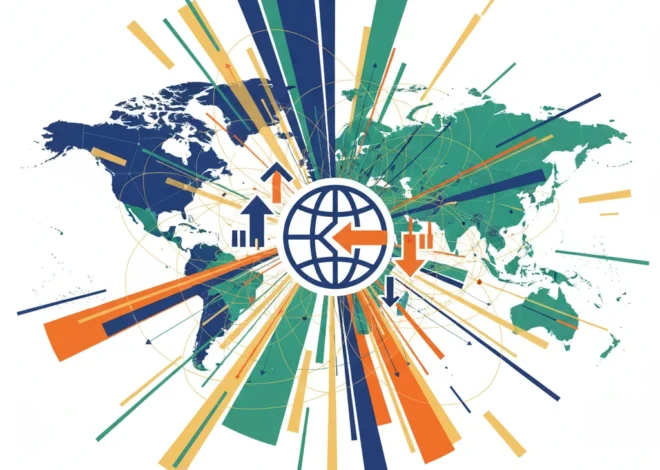
Another crucial “across” clue is the shifting nature of globalization. The post-Cold War era of hyper-globalization is giving way to a more fragmented and regionalized world. Geopolitical rivalries and a renewed focus on national security are leading to concepts like “friend-shoring” and the re-shoring of critical supply chains. This restructuring of global **trading** networks creates both risks and opportunities. While it can increase costs and reduce efficiency in the short term, it also drives massive investment in domestic manufacturing, logistics, and technology, creating new hubs of economic activity.
The “Down” Clues: Intersecting Sectoral Disruptions
If macro trends are the “across” clues, then sector-specific innovations and disruptions are the “down” clues. They intersect with the broader economic environment, creating unique challenges and opportunities. Nowhere is this more apparent than in the world of **banking** and finance, which is being fundamentally reshaped by **fintech**.
**Financial technology** is not just about mobile banking apps anymore. It represents a ground-up reimagining of how capital is stored, moved, and allocated. Technologies like **blockchain** are at the heart of this revolution. Initially famous for powering cryptocurrencies, blockchain’s potential as a secure, transparent, and decentralized ledger is now being explored for everything from trade finance and supply chain management to digital identity and asset tokenization. A recent report from Grand View Research projects the global blockchain technology market to grow at a compound annual growth rate (CAGR) of 87.7% from 2023 to 2030, highlighting the immense investment and innovation pouring into the space.
This technological shift is enabling the rise of Decentralized Finance (DeFi), which aims to create a financial system that is open, permissionless, and free from traditional intermediaries like banks. While still in its nascent stages and fraught with regulatory and security challenges, DeFi offers a glimpse into a future where **trading**, lending, and borrowing can occur directly between peers on a global scale. This directly challenges the traditional business models that have dominated finance for centuries.
Beyond Bitcoin: 3 Altcoins Poised for a Potential Breakout
To better understand the paradigm shift underway, consider the differences between the old and new worlds:
| Feature | Traditional Finance (TradFi) | Decentralized Finance (DeFi) |
|---|---|---|
| Intermediaries | Relies on banks, brokers, and clearinghouses | Peer-to-peer transactions via smart contracts |
| Accessibility | Often restricted by geography, wealth, and identity | Open and permissionless, accessible with an internet connection |
| Transparency | Largely opaque, operations are internal to institutions | Radically transparent; all transactions are on a public blockchain |
| Operational Hours | Limited to market hours and business days | 24/7/365, global and always-on |
| Core Technology | Centralized databases and legacy systems | Distributed ledger technology (Blockchain) |
This table illustrates not just a technological upgrade but a fundamental philosophical divergence in how financial services can be delivered. The “down” clue of fintech is intersecting with the “across” clue of a changing global **economy** to create a completely new section of the puzzle.
XRP's High-Stakes Tug-of-War: Why Macroeconomic Forces Are Overpowering Crypto Hype
The “Cryptic” Clues: Black Swans and Hidden Meanings
The most challenging and rewarding parts of a crossword are often the cryptic clues—the ones where the surface meaning is intentionally misleading. In finance and **investing**, these are the “black swan” events, the unforeseen risks, and the non-obvious correlations that can upend even the most carefully constructed portfolio.
The COVID-19 pandemic was a cryptic clue of global proportions. On the surface, it was a public health crisis. But its solution revealed a complex anagram of interconnected consequences: massive government stimulus, unprecedented supply chain breakdowns, a dramatic acceleration of digitalization, and a fundamental reassessment of the nature of work. An investor who only saw the health crisis missed the far larger economic and social puzzle that was unfolding. According to a study published by the National Institutes of Health, the pandemic caused the most significant drop in global stock markets since 1987, yet was followed by one of the fastest recoveries, fueled by technological adaptation and fiscal stimulus.
Navigating these cryptic clues requires more than just analysis; it requires resilience and a deep understanding of risk management. Diversification across asset classes, geographies, and strategies remains the most potent tool. However, modern risk management also involves scenario analysis—gaming out the potential impacts of low-probability, high-impact events. What is the financial impact of a major cyberattack on the **banking** system? What happens to the **economy** if a breakthrough in artificial intelligence automates a significant percentage of white-collar jobs? These are the cryptic clues lurking in the corners of the grid, and solving them requires imagination as much as calculation.
Rial in Ruins: Iran's Economic Crisis Reaches a Boiling Point, What Investors Must Understand
Conclusion: The Never-Ending Puzzle
Viewing the world of **finance**, **investing**, and **economics** through the lens of a crossword puzzle provides a valuable perspective. It reminds us that every piece of data, every trend, and every event is interconnected. The “across” clues of macroeconomics provide the context for the “down” clues of technological and sectoral change. And the “cryptic” clues of unforeseen events remind us that the puzzle is always full of surprises.
Unlike a newspaper crossword, however, the financial puzzle is never truly finished. As soon as one section is filled in, new clues emerge. The grid expands, the rules evolve, and the final picture is constantly changing. The goal is not to find a final, definitive solution, but to engage in the continuous, intellectually rigorous process of solving. By embracing curiosity, maintaining a multi-disciplinary perspective, and respecting the intricate connections between all the clues, we can navigate the complexities of the modern economy with greater clarity and confidence.