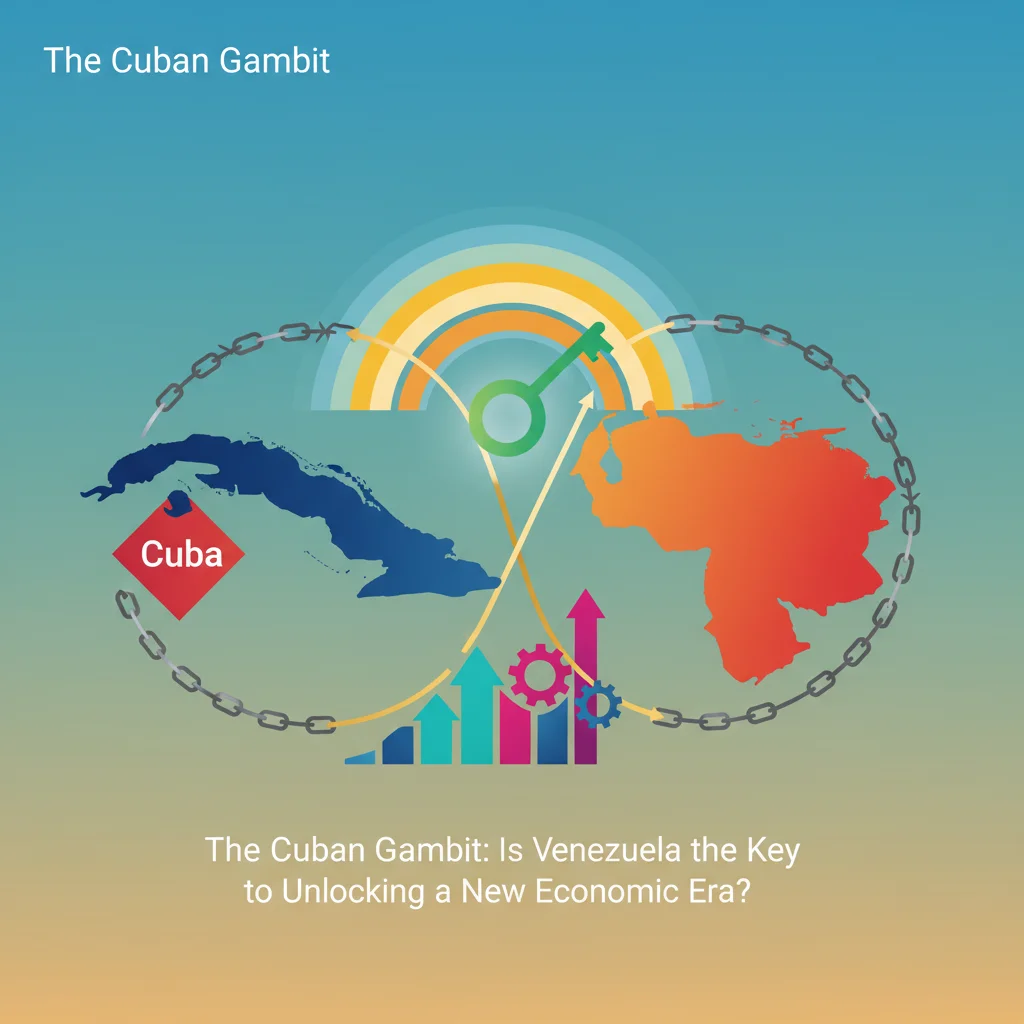
The Cuban Gambit: Is Venezuela the Key to Unlocking a New Economic Era?
In the high-stakes world of international relations, few relationships are as historically fraught and politically charged as that between the United States and Cuba. For decades, the island nation has stood as a bastion of communism just 90 miles from American shores, a persistent thorn in Washington’s side. Now, a new chapter in this long saga is unfolding, centered on a complex geopolitical gambit: the belief that the key to destabilizing Havana lies 1,300 miles away, in Caracas. The strategy, intensified under the Trump administration, posits that by squeezing Venezuela’s socialist government under Nicolás Maduro, the U.S. can sever a critical economic lifeline to Cuba, thereby hastening the collapse of its “ossified communist regime.”
This approach represents a high-stakes bet on a geopolitical domino theory, one with profound implications for the Cuban economy, regional stability, and the future of foreign investing in Latin America. For investors, finance professionals, and business leaders, the unfolding situation is more than just a political headline; it’s a case study in geopolitical risk, the economic impact of sanctions, and the potential emergence of a frontier market. The central question is no longer just political, but deeply financial: What is the economic endgame in Cuba, and can its weathered system truly be toppled by proxy?
The Venezuelan Lifeline: A Strategy of Economic Strangulation
To understand Washington’s strategy, one must first grasp the symbiotic, albeit lopsided, relationship between Cuba and Venezuela. For nearly two decades, Venezuela, buoyed by its vast oil reserves, served as Cuba’s principal patron. This support was not merely ideological; it was a tangible economic subsidy that kept the Cuban economy afloat. Under a “doctors-for-oil” program, Cuba sent tens of thousands of medical professionals to Venezuela in exchange for an estimated 100,000 barrels of subsidized crude oil per day at its peak (source). This oil was a critical energy source and a valuable commodity that Cuba could refine and re-export for hard currency.
The U.S. strategy is therefore one of calculated economic strangulation. By imposing crippling sanctions on Venezuela’s state-owned oil company, PDVSA, and targeting shipping companies that transport its oil, Washington has aimed to cut this vital flow. The logic is simple: starve the Maduro regime of resources, and you simultaneously starve its Cuban ally. The effects have been stark. Venezuelan oil shipments to Cuba have plummeted, forcing the island into a severe energy crisis, with widespread blackouts and fuel shortages becoming the new normal.
The table below illustrates the dramatic decline in support and its immediate impact on Cuba’s economic reality.
| Economic Indicator | Pre-Crisis (Approx. 2014) | Post-Sanctions (Approx. 2020-2022) |
|---|---|---|
| Venezuelan Oil Shipments to Cuba (barrels per day) | ~100,000 | <40,000 and inconsistent |
| Cuba’s Annual GDP Growth | Averaged 2-3% | Contracted by over 11% in 2020 (source) |
| Availability of Basic Goods | Stable but limited | Severe shortages, long queues |
| Tourism Revenue (pre-COVID) | $3.3 billion (2018) | Significantly impacted by sanctions and travel restrictions |
This pressure campaign has been coupled with the full implementation of the Helms-Burton Act’s Title III, a controversial law that allows U.S. nationals to sue foreign companies using property confiscated after Cuba’s 1959 revolution. This has had a chilling effect on foreign investing, making international banks and corporations wary of any engagement with the island, further isolating its economy from global finance.
The 50/50 Gamble: What the Eurostar Breakdown Reveals About Our Brittle Global Economy
Beyond Oil: The Modern Cuban Economy and Avenues of Survival
While the loss of Venezuelan oil is a body blow, the Cuban economy is not a monolith dependent on a single benefactor. It has developed other, albeit strained, sources of income and resilience that complicate Washington’s calculus.
The Rise of Remittances and Fintech’s Potential Role
One of the most critical economic pillars is remittances—money sent home by the Cuban diaspora, primarily from the United States and Europe. These funds, estimated to be in the billions annually, provide a direct infusion of capital to Cuban families, fueling a nascent private sector and creating consumer demand. However, the U.S. has also targeted this channel, placing restrictions on remittance transfers and sanctioning the Cuban military-linked entities that processed them.
This is where the worlds of geopolitics and financial technology collide. The crackdown on formal banking channels has inadvertently created a massive use case for alternative transfer mechanisms. Cubans are increasingly turning to informal networks and cryptocurrency to receive funds from abroad. This dynamic highlights a potential, albeit high-risk, opening for blockchain and fintech solutions designed to facilitate peer-to-peer transfers in sanctioned environments. While regulatory hurdles are immense, the demand for secure and accessible cross-border payments is undeniable and represents a fascinating intersection of technology and economics.
The “Cuentapropistas”: A Glimmer of Private Enterprise
Over the past decade, Cuba has cautiously allowed for the growth of a private sector, known as cuentapropistas. These small businesses—from restaurants (paladares) and B&Bs (casas particulares) to software developers and designers—now employ a significant portion of the workforce. While they are constrained by government control and a lack of access to traditional finance and wholesale markets, their existence represents a fundamental shift in Cuba’s economic DNA.
These entrepreneurs are remarkably resourceful, but they are being squeezed from all sides. The collapse of tourism due to the pandemic and U.S. travel restrictions, combined with domestic shortages, has hit them hard. Yet, their survival is key to any future economic opening. For potential investors, this private sector, however small, is the seed from which a market-based economy could one day grow. Monitoring its health and the regulatory environment surrounding it is crucial for anyone looking at the long-term potential of the Cuban market.
China's Economic Engine Sputters Back to Life: A Real Recovery or a False Dawn?
The Investor’s Dilemma: Navigating Geopolitical Risk and Opportunity
For the international finance community, the situation in Cuba is a masterclass in geopolitical risk. The island represents the quintessential high-risk, high-reward frontier market. On one hand, the potential is enormous: a highly educated workforce, a strategic location, and untapped markets in tourism, agriculture, and biotechnology. On the other hand, the obstacles are monumental: a U.S. embargo, a repressive and unpredictable government, a dual-currency system undergoing painful reforms, and a crumbling infrastructure.
The current U.S. strategy adds another layer of complexity. Will it succeed in forcing a rapid political transition, potentially unlocking the market overnight? Or will it push Cuba further into the arms of other global powers like China and Russia, leading to a different kind of economic integration? The answer has significant implications for global trading patterns and the balance of power in the Western Hemisphere. As one European diplomat noted, the U.S. approach is a “big gamble” that could backfire by creating a failed state and a humanitarian crisis on its doorstep.
For now, direct investment in Cuba remains largely off-limits for U.S. entities and extremely risky for others. However, savvy investors and business leaders should be watching for key signals of change:
- Economic Reforms: Any genuine moves by Havana to empower the private sector, unify its currency successfully, and provide legal protections for foreign investors.
- U.S. Policy Shifts: A potential return to the Obama-era policy of engagement, which could ease restrictions on travel, trade, and investing.
- Debt Restructuring: Cuba’s relationship with its international creditors, such as the Paris Club, will be a key indicator of its integration into the global finance system.
Conclusion: A Waiting Game with an Uncertain Prize
The U.S. strategy of toppling Cuba by targeting Venezuela is a bold and aggressive move that has succeeded in inflicting severe economic pain on the island. It has accelerated a crisis, but it has not yet produced the desired political outcome. The Cuban government, for all its flaws and fragility, has proven its ability to endure immense pressure.
For the financial world, Cuba remains a tantalizing but forbidden fruit. The narrative of its collapse is compelling, but the reality is likely to be far messier and more prolonged. The ultimate outcome of this geopolitical chess match is uncertain. Will the pressure campaign lead to a democratic, market-oriented Cuba, creating a once-in-a-generation opportunity for the stock market and direct investment? Or will it entrench the current regime, leading to further isolation and hardship? The answer lies not only in Washington and Havana but also in the failing state of Venezuela. For now, the world of finance can only watch, analyze the risks, and wait for the dust to settle on America’s Cuban gambit.

Related Posts
Geopolitical Chess: Why a Squeeze on Venezuela’s Oil Has China—and Global Investors—on Edge

The Billion-Dollar Phantom: How an Alleged Crime Lord’s Arrest Exposes the Dark Side of Global Finance