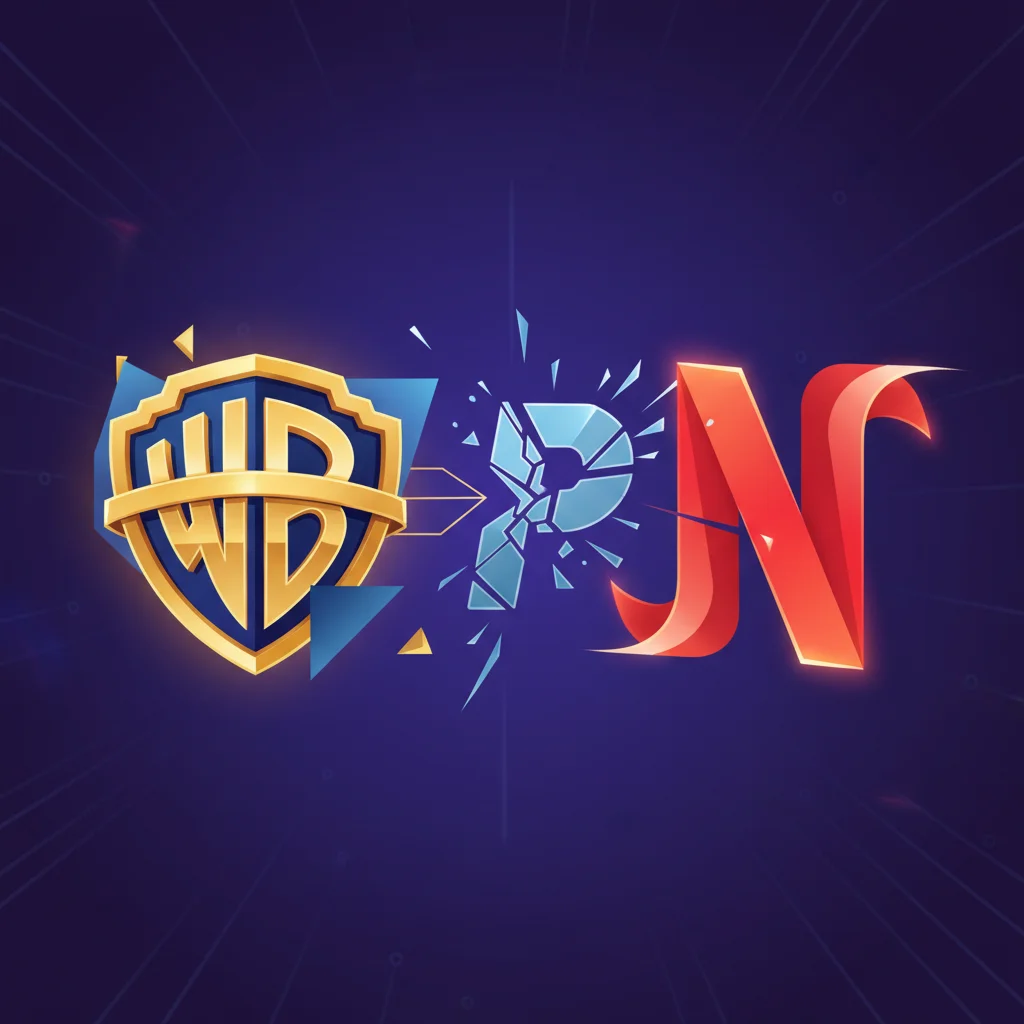
Hollywood’s High-Stakes Choice: Why Warner Bros. is Betting its Future on Netflix, Not Paramount
In a move sending shockwaves through the global entertainment and finance sectors, the board of Warner Bros. Discovery has publicly and unanimously urged its shareholders to reject a merger offer from rival Paramount Global. Instead, they are championing what they deem a superior, forward-looking deal with streaming titan Netflix. This decision isn’t just a corporate maneuver; it’s a profound statement on the future of media, a high-stakes bet on digital distribution over traditional consolidation, and a pivotal moment for investors navigating the turbulent waters of the modern stock market.
The announcement, which called the Paramount offer “inferior,” sets the stage for a dramatic showdown that will redefine the entertainment landscape for decades to come. At its core, this is a battle of two competing visions for survival and growth in an industry grappling with seismic shifts in consumer behavior, technological disruption, and economic uncertainty. For investors, finance professionals, and business leaders, understanding the nuances of this decision is crucial for anticipating the next chapter in the streaming wars and the broader media economy.
The Tale of Two Titans: Deconstructing the Offers
To grasp the weight of the Warner Bros. board’s decision, one must first understand the divergent paths presented by the two suitors. While the exact financial details remain under wraps, industry insiders have pieced together the strategic intent behind each proposal. The choice is less about the immediate dollar value and more about the long-term philosophy for creating shareholder value.
Here’s a comparative breakdown of the two hypothetical offers on the table:
| Feature | Paramount Global’s Proposal (The “Legacy” Play) | Netflix’s Proposal (The “Disruptor” Play) |
|---|---|---|
| Deal Structure | Likely an all-stock merger of equals, creating a media behemoth with a massive library and studio infrastructure. | A strategic acquisition or majority-stake investment, focusing on integrating WBD’s content pipeline into Netflix’s global platform. |
| Strategic Focus | Consolidating legacy assets (film studios, cable networks like CNN and CBS) to achieve massive cost synergies and scale. | Leveraging WBD’s premier IP (DC Comics, Harry Potter, HBO) to supercharge Netflix’s content engine and solidify streaming dominance. |
| Primary Synergy | Cost-cutting and operational efficiency. Aims to reduce overhead from redundant studio and distribution networks. | Revenue growth and user acquisition. Aims to attract and retain subscribers globally with an unparalleled content library. |
| Implied Vision | The future of media is about owning the largest library and squeezing efficiency from a declining but still profitable linear model. | The future of media is a direct-to-consumer, data-driven global streaming model. Content is king, but the distribution platform is the kingdom. |
| Key Risk | Saddling the combined entity with significant debt and tying its future to the diminishing returns of cable television. As noted by industry analysts, Paramount’s own debt load is already a significant concern for investors (source). | Potential culture clash between a legacy studio and a tech-first company, and the risk of over-reliance on a purely subscription-based model. |
The Paramount Predicament: Why Consolidation Isn’t Always King
On the surface, a Warner Bros. and Paramount merger seems logical. It’s a classic consolidation play rooted in the principles of industrial economics. Combining two of the legendary “Big Five” Hollywood studios would create an entity with unparalleled scale. The combined library would be staggering, featuring everything from The Godfather and Top Gun to Batman and Game of Thrones. The potential for cost-cutting, particularly in marketing, distribution, and administration, could theoretically unlock billions in value.
However, the Warner Bros. board sees this as a move that doubles down on the past, not the future. The primary assets being consolidated are those facing the strongest secular headwinds. Linear television networks, the cash cows of yesterday, are experiencing a steady decline in viewership and advertising revenue. According to recent data, the number of pay-TV households in the U.S. has been consistently falling, a trend that shows no sign of reversing (source). A merger would essentially combine two melting ice cubes in the hope of creating a slower-melting iceberg.
Furthermore, the financial engineering required for such a deal is fraught with peril. Both companies carry substantial debt loads, and a merger would create a highly leveraged entity vulnerable to interest rate fluctuations and shifts in the broader economy. For shareholders, this translates to higher risk and a business model tethered to legacy assets in a world rapidly embracing new financial technology and distribution models.
Navigating the Bitcoin Maze: A Strategic Outlook for Investors Through 2026
The Netflix Gambit: A Symbiotic Leap into the Streaming Future
The endorsement of the Netflix offer represents a radical reimagining of Warner Bros.’ identity. Instead of merging with a peer, it’s choosing to partner with the very disruptor that upended its business model. The logic is compelling: if you can’t beat them, join them in a way that fundamentally reshapes the market.
A Warner Bros.-Netflix entity would be an absolute juggernaut. Netflix brings a global subscriber base of over 260 million users and a sophisticated, data-driven engine for content recommendation and creation (source). Warner Bros. brings a century of filmmaking excellence and some of the most valuable intellectual property on the planet. This isn’t just about putting HBO Max content on Netflix; it’s about creating a vertically integrated pipeline from creative inception to global distribution, powered by cutting-edge financial technology and analytics.
For investors, the appeal lies in the focus on growth. The combined entity would be poised to:
- Dominate Global Markets: Leverage Netflix’s unparalleled international footprint to monetize WBD’s IP in emerging economies.
- Enhance Pricing Power: An unmatched content library could justify higher subscription tiers, directly boosting revenue and margins.
- Leverage Data for Content Creation: Use Netflix’s sophisticated trading-desk-like analytics to make smarter, data-informed decisions on which movies and shows to greenlight, optimizing the return on investment for WBD’s massive production budget.
This move also has fascinating implications for the world of finance and fintech. The valuation of such a deal would be based not on traditional metrics like EBITDA from cable networks, but on forward-looking indicators like subscriber growth, churn rate, and lifetime customer value. The financing for the deal would likely involve complex instruments managed by top-tier investment banking firms, showcasing the intricate connection between media, technology, and modern capital markets.
Beyond the Delay: The Hidden Financial Shockwaves of the Eurostar Disruption
The Economic Ripple Effect: Shareholders, Consumers, and the Market
The Warner Bros. board’s recommendation will have far-reaching consequences beyond the company’s stock price. It’s a bellwether for the entire media and technology sector.
For investors and the stock market, this signals a clear preference for tech-centric growth models over industrial-era consolidation. It suggests that Wall Street is increasingly willing to reward companies that embrace disruption. The trading activity around WBD, PARA, and NFLX stocks in the coming weeks will be a referendum on these competing visions. A successful deal could trigger a new wave of M&A activity, as other media players like Disney and Comcast are forced to re-evaluate their own long-term strategies.
For the broader economy, this level of consolidation raises important questions about competition and innovation. A combined Netflix-WBD would wield immense power, potentially leading to less variety in content and higher prices for consumers. Regulators will undoubtedly scrutinize the deal, weighing the potential for an anti-competitive monopoly against the realities of a fiercely competitive global market that includes giants like Amazon, Apple, and Google.
There’s even a potential, albeit distant, role for emerging technologies like blockchain. In a future dominated by a few massive content platforms, blockchain could offer a transparent and decentralized way to manage intellectual property rights, track royalties for creators, and even enable new models of content financing and distribution, challenging the centralized power of the new media titans.
The 2025 Market Paradox: How a Year of Volatility Forged a Remarkable Rally
Conclusion: A Defining Moment for a Storied Studio
Warner Bros. stands at a crossroads, and its board has chosen the path of radical adaptation. By rejecting the perceived safety of a merger with Paramount in favor of a bold alliance with Netflix, they are making a definitive statement: the future of entertainment will be written in code and streamed globally, not broadcast through cables. This decision prioritizes the principles of financial technology, data analytics, and direct-to-consumer relationships over the traditional economics of scale.
For shareholders, the choice is now clear: ratify a deal that merges with the past or approve one that acquires the future. The outcome of this corporate drama will not only determine the fate of a 100-year-old studio but will also provide a masterclass in strategy, finance, and corporate governance for a generation of business leaders and investors. The curtain is rising on a new era in Hollywood, and the world is watching to see who will be left standing when it falls.

Related Posts
Fiscal Froth: Why a Modest Pub Tax Tweak Signals Major Shifts in the UK Economy

The $1 Billion Playbook: Why Josh Harris is Betting Big on the Future of Sports