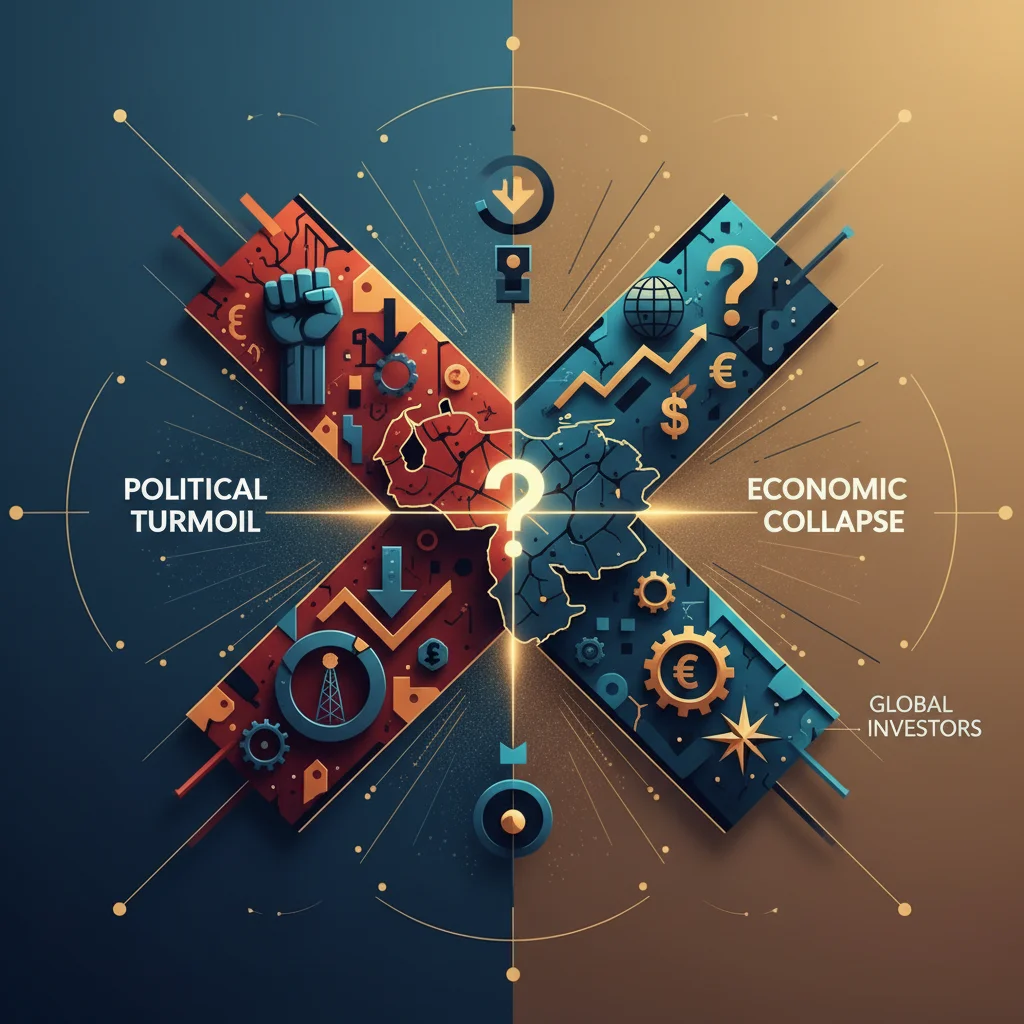
Venezuela at a Crossroads: Political Turmoil, Economic Collapse, and What It Means for Global Investors
Venezuela, a nation sitting atop the world’s largest proven oil reserves, is once again at a critical inflection point. The political landscape is a tinderbox, with opposition leader María Corina Machado reportedly planning a return to the country “as soon as possible,” while incumbent President Nicolás Maduro faces a litany of international pressures, including a significant narco-terrorism indictment in a New York court. This high-stakes confrontation is more than just a domestic power struggle; it’s a pivotal moment with profound implications for the global energy market, international finance, and the future of foreign investing in a nation ravaged by economic mismanagement.
For finance professionals, investors, and business leaders, the situation in Venezuela represents a complex case study in geopolitical risk. The country’s trajectory will influence everything from oil prices to regional stability and the appetite for emerging market debt. Understanding the interplay between the political standoff, the shattered economy, and the potential paths forward is crucial for anyone navigating the volatile waters of global markets.
The Political Powder Keg: A Standoff with Global Consequences
At the heart of the current crisis are two opposing figures. On one side is Nicolás Maduro, who has maintained a firm grip on power despite a catastrophic economic collapse, widespread social unrest, and crippling international sanctions. His administration’s legitimacy has been consistently challenged both at home and abroad, a situation exacerbated by the U.S. Department of Justice’s charges against him for narco-terrorism, to which he has pleaded not guilty. These legal challenges severely complicate his ability to govern and engage with the international financial community.
On the other side is María Corina Machado, a prominent and unyielding figure in the Venezuelan opposition. Her potential return signals a renewed push to challenge the status quo, potentially re-energizing a fragmented opposition and creating a new focal point for domestic and international pressure against the Maduro regime. The success or failure of her efforts could be the catalyst that either maintains the current stalemate or forces a dramatic shift in the country’s political direction.
An Economy in Ruins: Hyperinflation and the Collapse of Traditional Banking
To appreciate the stakes, one must grasp the sheer scale of Venezuela’s economic devastation. What was once Latin America’s wealthiest nation has endured one of the worst economic collapses in modern history outside of wartime. Years of hyperinflation have rendered the national currency, the bolívar, virtually worthless, wiping out savings and destroying the traditional banking system’s ability to function as a credible intermediary of capital.
The following table provides a stark illustration of this decline, comparing key economic indicators from a decade ago to more recent estimates.
| Economic Indicator | Approx. 2013 Level | Approx. 2023 Level |
|---|---|---|
| Annual GDP (Nominal) | ~$372 Billion | ~$85 Billion |
| Annual Inflation Rate | ~56% | ~398% (IMF Estimate) |
| Crude Oil Production (bpd) | ~2.5 Million | ~750,000 |
| Population Below Poverty Line | ~30% | ~80-90% (Varies by source) |
This economic implosion, driven by price controls, expropriations, and a collapse in oil production, has had a chilling effect on every aspect of finance and economics in the country. The formal financial sector has been hollowed out, with the stock market in Caracas becoming a shadow of its former self. U.S. sanctions, intended to pressure the Maduro government, have further isolated the nation from global financial systems, making international trading and investment nearly impossible through conventional channels.
India in 2025: A Deep Dive into the Economic Juggernaut's Next Chapter
Innovation from Desperation: Crypto, Fintech, and the Shadow Economy
In the vacuum left by the collapse of the formal financial system, a fascinating and chaotic alternative has emerged. The Venezuelan crisis has become an unintentional, real-world laboratory for peer-to-peer financial technology. Faced with a worthless currency, citizens have sought refuge in more stable stores of value.
This has led to a de facto dollarization of the economy, where U.S. dollars are used for everyday transactions. However, accessing physical dollars is difficult, which has fueled a massive adoption of cryptocurrencies, particularly stablecoins like Tether (USDT). For many Venezuelans, blockchain is not an abstract investment; it is a vital tool for survival, enabling them to receive remittances, preserve savings, and conduct business beyond the state’s dysfunctional control. This grassroots adoption of fintech stands in stark contrast to the government’s own failed attempt at a state-backed cryptocurrency, the Petro, which never gained public trust or utility (source). This dynamic highlights a powerful trend where decentralized finance can thrive in environments where centralized institutions have failed.
Geopolitical Shockwaves: How US-Iran Tensions Could Reroute the Global Economy
The Investor’s Dilemma: Navigating Unparalleled Risk and Opportunity
For the global investment community, Venezuela is the ultimate high-risk, high-reward proposition. The risks are glaringly obvious:
- Political Instability: The ongoing power struggle creates a deeply unpredictable environment.
- Lack of Rule of Law: There is no credible legal protection for foreign assets against potential expropriation.
- Sanctions Risk: Navigating the complex web of U.S. and international sanctions is a legal minefield.
- Defaulted Debt: Venezuela and its state-owned oil company, PDVSA, are in default on billions of dollars of sovereign debt, making any new lending exceptionally risky.
Yet, the potential upside is equally staggering. A stable, pro-market government that re-engages with the international community could unlock immense value. With the world’s largest oil reserves, significant natural gas deposits, and vast mineral wealth, a revitalized Venezuela could trigger a boom in the energy, mining, and infrastructure sectors. Speculative trading in defaulted Venezuelan bonds often surges on news of potential political change, demonstrating that a sliver of hope for recovery remains priced into these distressed assets. A political transition could lead to a debt restructuring process that offers massive returns for patient and risk-tolerant investors who bought in at the bottom.
The Friendship Portfolio: Deconstructing the ROI of Sweden's Radical Bet on Employee Wellness
Future Scenarios and What to Watch For
As the situation unfolds, observers should monitor several key signposts that will signal Venezuela’s future direction. Three broad scenarios seem plausible:
- The Status Quo Grinds On: Maduro retains power, the opposition remains fractured, and the economy continues to stagnate under the weight of sanctions and mismanagement. This scenario implies continued hardship for the Venezuelan people and a high-risk environment for any residual foreign business operations.
- A Negotiated Transition: Internal and external pressures lead to a political negotiation, resulting in free and fair elections and a new government. This is the most optimistic scenario, which could lead to the gradual lifting of sanctions, an influx of international aid and investment, and the beginning of a long, slow economic recovery.
- Chaotic Escalation: The political standoff intensifies, leading to increased repression, social unrest, or a complete breakdown of state functions. This would deepen the humanitarian crisis and create even greater uncertainty for the region and global energy markets.
The outcome of this complex struggle will not be contained within Venezuela’s borders. It will directly impact global economics through its effect on oil supply, influence geopolitical dynamics in Latin America, and serve as a crucial test case for the international community’s ability to address failed states. For now, the world watches, waiting to see if a nation with so much potential can finally pull itself back from the brink.