Trump’s Venezuelan Gambit: A High-Stakes Plan to Underwrite Big Oil’s Return
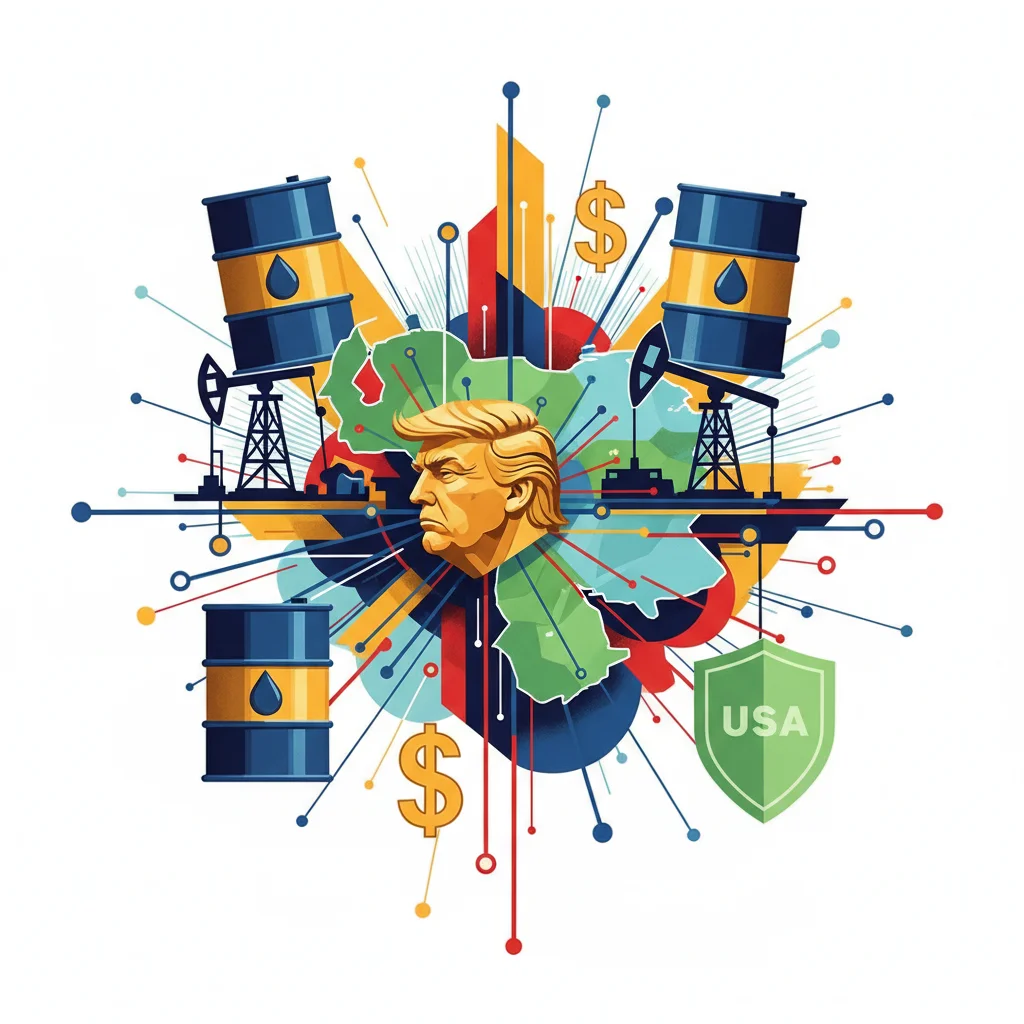
In a move that blurs the lines between geopolitics and high-finance, a potential blueprint for Venezuela’s economic future has emerged, proposing a radical idea: the U.S. government could reimburse American and international oil companies for reinvesting in the nation’s dilapidated energy sector. This ambitious strategy, contingent on the removal of Nicolás Maduro’s regime, aims to lure skeptical businesses back to a nation sitting on the world’s largest proven oil reserves. As reported by the Financial Times, this proposal represents a dramatic, market-driven approach to foreign policy, one that could reshape the global energy landscape and present a monumental, if perilous, opportunity for investors.
The plan essentially positions the U.S. Treasury as a massive insurance policy against the inherent political and operational risks of doing business in a post-conflict state. For years, Venezuela has been a no-go zone for major capital investment, paralyzed by political instability, crippling U.S. sanctions, and the systematic decay of its state-owned oil company, PDVSA. This proposal seeks to break that stalemate by de-risking the investment equation for the private sector. But is this a masterstroke of economic statecraft or a fiscal Pandora’s Box? This analysis will delve into the mechanics of the proposal, the immense challenges involved, and the profound implications for the global economy, finance, and the energy stock market.
The Fall of an Oil Titan: Understanding Venezuela’s Collapse
To grasp the magnitude of this proposal, one must first understand the depth of Venezuela’s economic tragedy. Less than a generation ago, Venezuela was an economic powerhouse in Latin America, its fortunes built on a sea of oil. With proven reserves estimated at over 300 billion barrels (OPEC), it surpasses even Saudi Arabia. However, years of mismanagement, cronyism, and the nationalization of foreign assets under Hugo Chávez and his successor, Nicolás Maduro, systematically dismantled this engine of prosperity.
The state-run oil company, Petróleos de Venezuela, S.A. (PDVSA), once a world-class operator, became a hollowed-out shell, starved of the capital and technical expertise needed for maintenance, let alone expansion. The consequences have been catastrophic for the country’s economy and its oil output, as illustrated below.
This table highlights the dramatic decline in Venezuela’s crude oil production, a direct result of political and economic decay.
| Year | Average Crude Oil Production (Million Barrels Per Day) |
|---|---|
| 1998 | 3.3 |
| 2008 | 2.5 |
| 2018 | 1.3 |
| 2023 | ~0.75 |
Source: Data compiled from reports by OPEC and the U.S. Energy Information Administration (EIA).
This collapse in production, exacerbated by stringent U.S. sanctions designed to isolate the Maduro regime, has plunged the nation into a humanitarian crisis and removed a significant player from the global energy supply chain. Reversing this trend would require hundreds of billions of dollars in investment and a level of political stability that seems almost unimaginable today.
The Investor's Blind Spot: From Boiling Lobsters to Your Portfolio's Bottom Line
Deconstructing the Deal: A New Model for Geopolitical Investing?
The proposal reported by the Financial Times is essentially a public-private risk-sharing model applied to foreign policy. The logic is straightforward: the cost of rebuilding Venezuela’s oil infrastructure is too high and the risks too great for any single company to bear alone. By offering to reimburse investments, the U.S. government would effectively be socializing the risk while privatizing the execution and potential profits.
This approach has several potential benefits for the U.S. and the global economy:
- Stabilizing Energy Markets: Bringing millions of barrels of Venezuelan oil back online could act as a powerful counterbalance to production cuts from OPEC+ and stabilize volatile energy prices, a key factor in global economics.
- Countering Adversarial Influence: A democratic, U.S.-aligned Venezuela would dramatically shift the geopolitical landscape in Latin America, reducing the influence of rivals like China, Russia, and Iran in the region.
- Economic Opportunity: The reconstruction would be a massive boon for U.S. energy and engineering firms, creating a multi-decade project that would ripple through the stock market and various sectors of the economy.
However, the mechanics of such a reimbursement program are fraught with complexity. Would it be a direct subsidy? A loss-guarantee? Would it be managed through the U.S. International Development Finance Corporation or a new entity altogether? The potential for misuse, corruption, and political favoritism is enormous, and any such plan would face intense scrutiny from Congress and taxpayers. The banking sector would also play a crucial role in facilitating these massive capital flows, requiring a complete lifting of sanctions and the re-establishment of correspondent banking relationships.
Beyond Infinite Growth: Why Planetary Limits Are the New Frontier for Finance and Investing
The Investor’s Calculus: Balancing Unprecedented Risk and Reward
For finance professionals and corporate leaders, this proposal transforms Venezuela from an untouchable pariah state into a speculative, high-beta investment play. The central question for any boardroom would be whether a U.S. government backstop is sufficient to offset the staggering array of risks. A clear-eyed assessment reveals a stark dichotomy.
Here is a breakdown of the primary risks and potential rewards for companies considering a return to Venezuela.
| Potential Risks | Potential Rewards |
|---|---|
| Renewed Political Instability & Civil Unrest | First-Mover Access to World’s Largest Oil Reserves |
| Rule of Law Vacuum & Contract Uncertainty | Massive, Multi-Decade Revenue Streams |
| Physical Security Threats to Personnel & Assets | U.S. Government Financial Backstop (Reduces Capital Risk) |
| Completely Decayed Infrastructure Requiring Massive CAPEX | Significant Positive Impact on Company Stock Valuations |
| Legacy Legal Claims & Environmental Liabilities | Geopolitical Alignment with U.S. Foreign Policy Goals |
Success in Venezuela could catapult a company’s stock market valuation into a new stratosphere. The scale of the opportunity is difficult to overstate. Yet, failure could mean billions in write-downs and a logistical and security nightmare. The market’s reaction would be immediate. News of a credible, U.S.-backed plan would likely send shares of oil majors and service companies like Halliburton and Baker Hughes soaring, while oil futures trading would become intensely focused on the timeline for restoring Venezuelan production.
Beyond Oil: Can FinTech and Blockchain Rebuild an Economy?
While the focus is on oil, the complete reconstruction of Venezuela presents a unique opportunity to leapfrog legacy systems. The country’s traditional banking and financial infrastructure is in ruins, decimated by years of hyperinflation and isolation. This is where modern financial technology could play a transformative role.
Imagine a scenario where foreign investment and oil revenues are tracked with full transparency on a distributed ledger. The use of blockchain technology could be a powerful anti-corruption tool, ensuring that funds are allocated to their intended projects rather than being siphoned off. As one expert from the Atlantic Council noted, such technology could help restore desperately needed trust.
Furthermore, fintech solutions could be deployed to manage aid distribution, provide digital wallets to a largely unbanked population, and create new platforms for commerce in a post-hyperinflation economy. This forward-thinking approach could make Venezuela a case study in 21st-century economic reconstruction, integrating cutting-edge financial technology from the ground up.
The £60 Billion What-If: How Joining the Euro Could Have Funded the NHS and Reshaped the UK Economy
Conclusion: A Bold Vision Fraught with Peril
The proposal to use U.S. funds to underwrite the private sector’s return to Venezuela is one of the boldest foreign policy ideas in recent memory. It is a high-stakes fusion of finance, economics, and statecraft that views corporate investment as a primary tool of geopolitical influence. It offers a tantalizingly fast path to reviving a failed state and reshaping global energy markets.
Yet, the chasm between concept and reality is vast. The plan’s success hinges on a stable political transition within Venezuela—a monumental uncertainty. For investors, it represents the ultimate risk/reward scenario, a bet not just on geology and engineering, but on the very possibility of national rebirth. Whether this gambit is ever seriously pursued, it forces a critical conversation about the future role of public-private partnerships in tackling the world’s most complex geopolitical and economic challenges. The world of finance will be watching very, very closely.

Related Posts
Geopolitical Chess: Why a Squeeze on Venezuela’s Oil Has China—and Global Investors—on Edge
From Brinkmanship to Boardroom: Decoding the Trump-Petro Détente and Its Impact on Global Markets