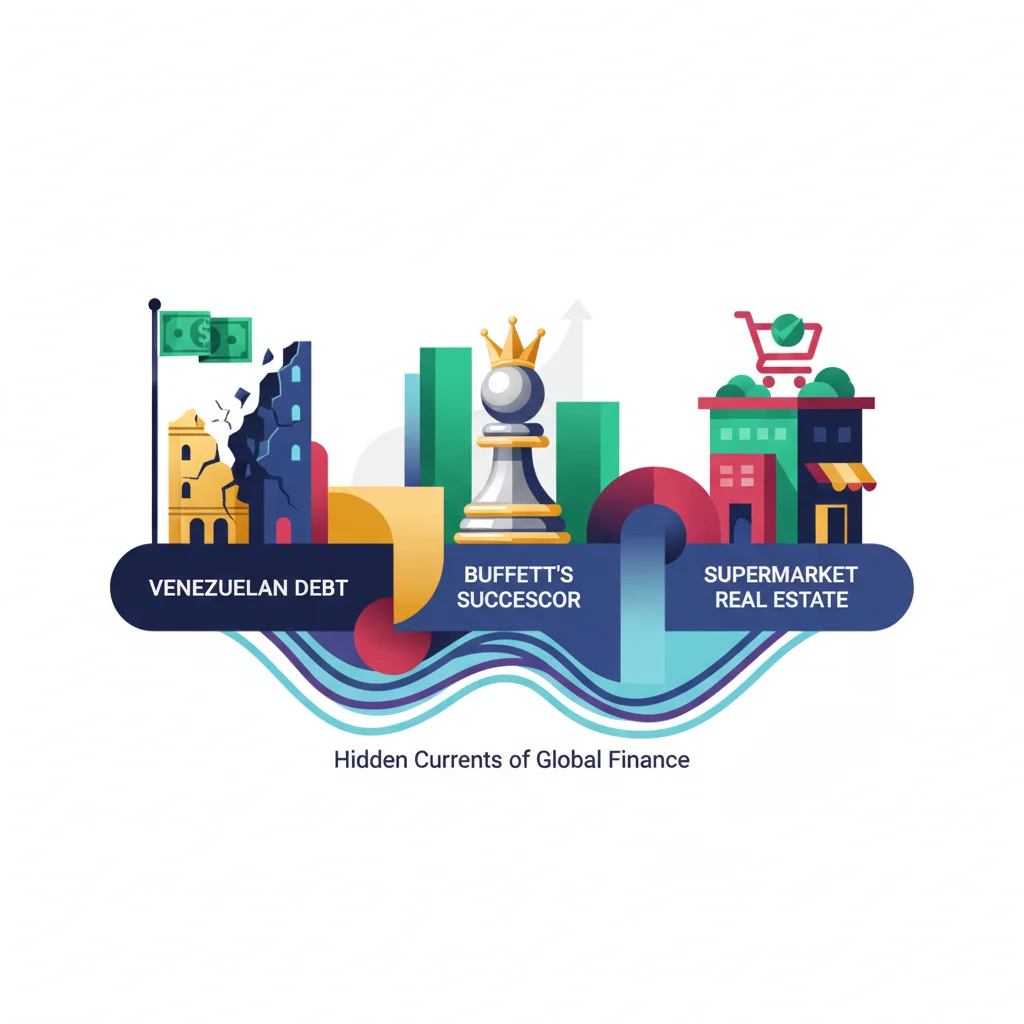
The Contrarian’s Playbook: Inside High-Stakes Bets on Venezuelan Debt, Buffett’s Successor, and Supermarket Real Estate
Introduction: The Hidden Currents of Global Finance
Beneath the daily churn of the stock market and economic headlines, a different game is being played. It’s a world of high-stakes wagers, long-term strategic positioning, and unconventional value extraction. In this arena, investors don’t just follow trends; they anticipate seismic shifts in politics, leadership, and corporate strategy. This is the world of contrarian finance, where fortunes are made by seeing value where others see only risk.
Today, we pull back the curtain on three seemingly disconnected stories that reveal the intricate and often audacious strategies shaping the future of global investing. We’ll journey to the tumultuous world of Venezuelan sovereign debt, where hedge funds are making a daring bet on political upheaval. We’ll then step into the hallowed halls of Berkshire Hathaway to dissect the monumental task of succeeding a living legend, Warren Buffett. Finally, we’ll land in the aisles of UK supermarkets, where a quiet revolution in real estate is unlocking billions in capital. Each story offers a masterclass in modern finance, economics, and the art of the calculated risk.
The Venezuelan Gamble: Distressed Debt and a Bet on Regime Change
In the high-octane world of international finance, few plays are as bold as investing in the debt of a defaulted nation. Venezuela, a country grappling with economic collapse and political turmoil, has become the latest frontier for a select group of audacious hedge funds. These firms are quietly accumulating billions of dollars in defaulted government and state-owned oil company (PDVSA) bonds, often for a fraction of their face value.
This is the classic playbook of distressed debt investing. The strategy hinges on a single, monumental catalyst: political change. Funds like Contrarian Capital Management and Pharo Management are not betting on the current regime’s ability to pay, but on the emergence of a new, more US-friendly government. The thesis is that a new administration, seeking to re-enter global capital markets, will need to restructure its old debts and will offer creditors a deal far more valuable than the bonds’ current rock-bottom prices. According to the Financial Times, some of these bonds have been trading for as little as 20 cents on the dollar, signaling the immense risk—and potential reward—involved.
The complexity is enormous. There are different types of bonds, issued by the government and by PDVSA, each with different legal standings and claims. The outcome depends entirely on geopolitics, the timing of any political transition, and the specific terms of an eventual debt restructuring. It’s a multi-year chess match where patience is as crucial as capital.
To better understand the dynamics at play, consider the core components of this high-risk investment strategy:
| Factor | Potential Upside (The Bull Case) | Potential Downside (The Bear Case) |
|---|---|---|
| Political Outcome | A new, market-friendly government takes power and seeks to normalize relations with international creditors, leading to a favorable restructuring. | The current regime remains in power indefinitely, or a new government proves hostile to foreign bondholders, offering a “low-ball” deal or repudiating the debt. |
| Economic Recovery | Venezuela’s vast oil reserves are revitalized with foreign investment, creating the revenue needed to service restructured debt. | The country’s infrastructure is too damaged for a quick recovery, prolonging the default and diminishing the value of any settlement. |
| Legal Framework | US sanctions are lifted, and US courts uphold creditor rights, providing a strong negotiating position for bondholders. | A chaotic restructuring process with competing creditor claims leads to years of litigation and erodes the value of the investment. |
This is not an investment for the faint of heart. It is a pure-play on macroeconomic and political forecasting, blending the disciplines of economics and international relations. The success of this trade will be a defining case study in sovereign distressed debt for years to come.
The Great Self-Sale: Why Private Equity is Becoming Its Own Biggest Customer
The Oracle’s Shadow: Navigating the Post-Buffett Era at Berkshire Hathaway
From the high-risk frontiers of emerging markets, we turn to the bedrock of American capitalism: Berkshire Hathaway. For decades, the company has been synonymous with one man, Warren Buffett. His wisdom, folksy charm, and unparalleled track record in capital allocation have built an empire and a cult-like following. But as the “Oracle of Omaha” prepares for his eventual departure, the financial world is holding its breath, asking one question: What happens next?
The designated successor, Greg Abel, is a highly respected operator who has successfully managed Berkshire’s vast non-insurance businesses for years. Yet, the challenge he faces is monumental. It’s not just about managing assets; it’s about inheriting a culture and filling the shoes of an icon. The core of the issue revolves around capital allocation. Berkshire Hathaway is famous for its massive cash pile, which stood at over $130 billion in early 2023. Buffett’s genius has been his ability to deploy that cash into shrewd, large-scale investments at opportune moments.
Can Abel replicate this? While he is a brilliant manager, his public record as a dealmaker on the scale of Buffett is less established. The market assigns a “Buffett premium” to Berkshire’s stock, an intangible value tied to the founder’s presence. Preserving that premium will be Abel’s greatest test. He must prove that Berkshire’s unique advantage—a decentralized structure combined with a centralized, rational approach to capital deployment—can outlive its architect.
The succession plan involves a division of labor, with Ajit Jain continuing to run the all-important insurance operations. Here’s a simplified look at the transition challenge:
| Leadership Trait | Warren Buffett (The Legend) | Greg Abel (The Successor) |
|---|---|---|
| Primary Skillset | Master capital allocator, public-facing philosopher of value investing, master of the “big deal.” | World-class operational manager, expert in energy and regulated industries, known for efficiency and execution. |
| Public Persona | Global icon, teacher, the face and brand of the company. | Low-profile, respected executive, more of a classic CEO than a public guru. |
| Core Challenge | Finding “elephant-sized” acquisitions to deploy massive amounts of cash effectively. | Proving he can be a world-class capital allocator in addition to an operator, and maintaining the unique Berkshire culture. |
The future of Berkshire Hathaway is a fascinating case study in corporate governance and the economics of leadership. It tests the very idea of whether a founder’s unique genius can be institutionalized. The transition will be one of the most closely watched events in modern financial history.
The 2026 Horizon: Ukraine, Russia, and the Economic Endgame for Investors
Check-Out Value: How UK Supermarkets Are Cashing In on Their Real Estate
Our final stop takes us from the complexities of sovereign debt and CEO succession to the seemingly mundane world of grocery stores. Yet, here too, a sophisticated financial strategy is unfolding. Major UK supermarket chains, facing intense pressure from discount rivals like Aldi and Lidl, are turning to their biggest and most underappreciated asset: their own property.
Companies like Sainsbury’s and Asda are increasingly using a corporate finance tool known as a “sale-and-leaseback.” The mechanism is simple in concept: a company sells the physical real estate it owns (its stores, warehouses) to an investor, such as a real estate investment trust (REIT) or a private equity fund. Simultaneously, it signs a long-term lease to continue operating in those same locations. This maneuver instantly converts illiquid real estate into a massive infusion of cash on the balance sheet.
Why do this? The primary motivation is to free up capital. This cash can be used to pay down debt, invest in price cuts to compete with discounters, upgrade technology and logistics, or return money to shareholders. For instance, Sainsbury’s has engaged in such deals, unlocking significant value from its property portfolio to strengthen its financial position (source). It’s a strategic pivot from being a property owner to being a pure-play retailer.
However, this financial technology is not without its risks. The company trades the security of property ownership for a long-term lease obligation, which is a fixed cost that can become burdensome during economic downturns. If the retailer’s business falters, it is still on the hook for decades of rent payments. It’s a strategic trade-off: short-term liquidity and flexibility in exchange for long-term fixed costs and the loss of a core asset.
The decision to pursue a sale-and-leaseback is a calculated one, balancing immediate strategic needs with future financial obligations. It represents a fundamental shift in how legacy businesses view their assets in a rapidly changing economy.
The End of an Era: How Khaleda Zia's Death Reshapes Bangladesh's Economic Future
Conclusion: The Universal Language of Value and Risk
From the chaos of a sovereign default to the quiet corridors of a corporate dynasty and the competitive aisles of a supermarket, the principles of advanced finance remain constant. Each of these stories is about identifying, pricing, and capitalizing on hidden value. The hedge funds in Venezuela are pricing geopolitical risk. Berkshire Hathaway is navigating the intangible value of legendary leadership. UK supermarkets are converting physical capital into financial firepower.
These are not just isolated events; they are indicators of broader trends in the global economy. They show that the most sophisticated investing goes far beyond the stock market ticker. It requires a deep understanding of politics, psychology, and strategy. For investors, finance professionals, and business leaders, the lesson is clear: the greatest opportunities often lie in the most complex and overlooked corners of the market, waiting for those with the courage and insight to make the contrarian play.

Related Posts

Financial Paternalism: Why Old Rules of the Road Won’t Work for the New Generation of Digital Investors

Solana’s Critical Stand: Why the Rebound from $117 is More Than Just a Price Spike