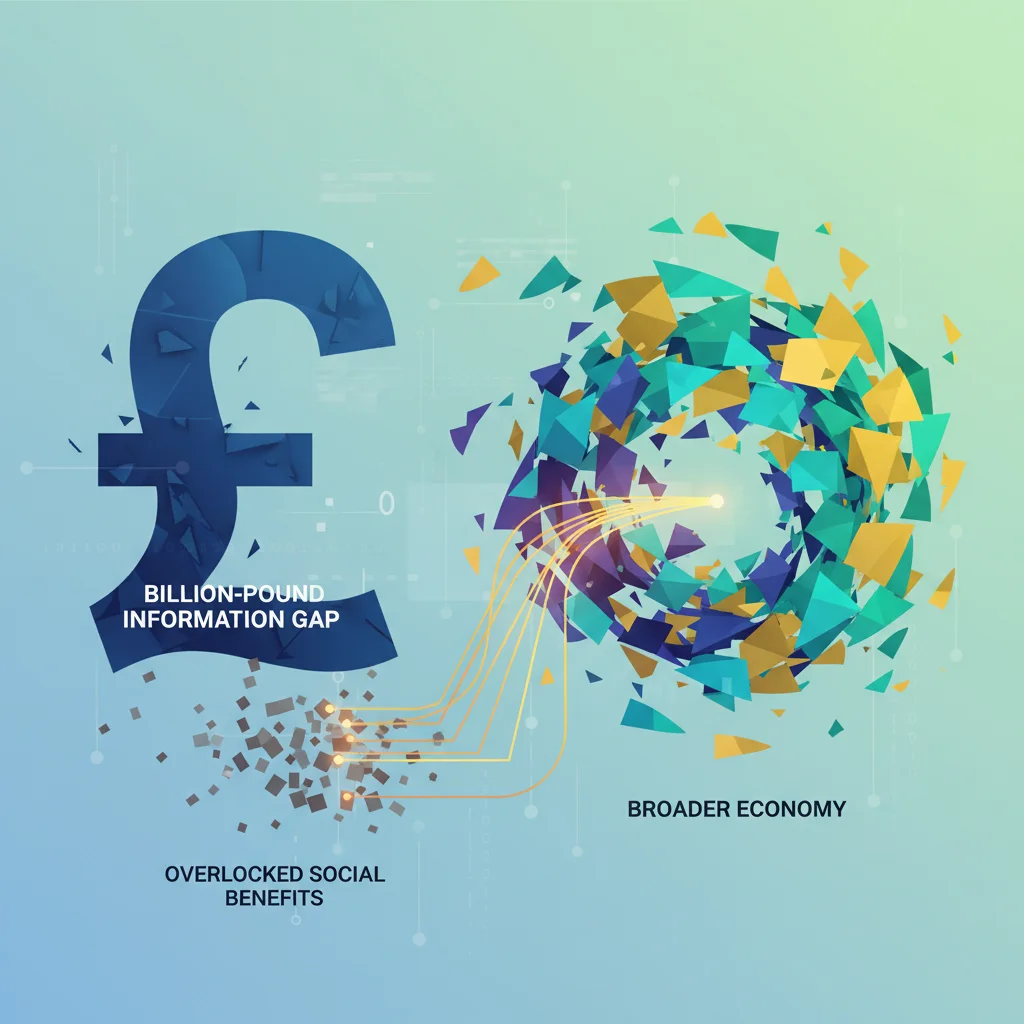
The Billion-Pound Information Gap: How Overlooked Social Benefits Impact the Broader Economy
In the complex world of modern finance, it’s easy to focus on high-frequency trading, intricate stock market fluctuations, and the disruptive power of fintech. We analyze quarterly earnings reports and scrutinize central banking policies. Yet, sometimes the most significant economic indicators are hidden in plain sight, revealed in seemingly minor news items. A recent report from a UK charity, highlighted by the BBC, uncovered a simple but profound inefficiency: many families are completely unaware they qualify for the government’s Winter Fuel Payment.
On the surface, this is a story about social welfare. But dig a little deeper, and it becomes a case study in communication failure, economic friction, and a missed opportunity for both household financial stability and macroeconomic stimulus. For investors, finance professionals, and business leaders, understanding these undercurrents is crucial. They reveal vulnerabilities in the consumer base, inefficiencies in government spending, and, most importantly, vast opportunities for technological innovation. This isn’t just about keeping homes warm; it’s about the flow of capital, the health of the consumer economy, and the future of financial technology.
The Winter Fuel Payment: More Than Just a Handout
To grasp the full economic picture, we must first understand the mechanism itself. The Winter Fuel Payment is a tax-free, annual payment from the UK government designed to help older people with their heating costs. Established in 1997, it has become a cornerstone of the UK’s social safety net, particularly for a demographic vulnerable to fuel poverty.
From a national finance perspective, this is not a trivial program. The UK government’s own statistics show that expenditure on the Winter Fuel Payment was approximately £2.1 billion for the 2022/2023 winter season, reaching over 11 million people. This figure, often augmented by additional cost of living payments, represents a significant fiscal outlay. In the grand scheme of the national budget, it’s a direct injection of capital into the economy at a specific time of year. This acts as a targeted, seasonal fiscal stimulus. The money doesn’t go into complex financial instruments or long-term investing; it goes directly toward essential spending—utility bills—freeing up other household income for retail, food, and other goods and services.
Below is a breakdown of the standard eligibility and payment rates, which can be supplemented by other government support schemes.
| Circumstance | Born between 25 Sept 1943 and 24 Sept 1957 | Born on or before 25 Sept 1943 |
|---|---|---|
| Live alone (or with no one else who qualifies) | £500 | £600 |
| Live with someone under 80 who also qualifies | £250 | £350 |
| Live with someone 80 or over who also qualifies | £250 | £300 |
| Live in a care home (and do not receive certain benefits) | £250 | £300 |
Note: These figures reflect the 2023/2024 payment rates which included a Pensioner Cost of Living Payment. Sourced from GOV.UK.
When eligible individuals fail to claim this benefit, the intended economic stimulus is blunted. The money remains on the government’s balance sheet, but the real-world effect—stabilized household finances and predictable consumer spending—is diminished. This is a classic example of economic friction, where a policy’s potential is lost in the final mile of execution.
The Hidden Bull Market: Why UK Entrepreneurs Are Ignoring the Economic Gloom
From Household Budgets to Stock Market Ripples
The microeconomic impact on a single family is clear: a missed payment of several hundred pounds can mean the difference between a warm home and a winter of financial distress. This stress directly impacts a household’s ability to participate in the broader economy. Discretionary spending is the first casualty, affecting retail, hospitality, and leisure sectors. Savings and long-term investing goals are put on hold, as immediate needs take precedence.
For a finance professional or an investor analyzing the stock market, this dynamic is critical. The health of consumer-facing companies, from energy suppliers to high-street retailers, depends on the financial stability of their customer base. A system where billions in allocated support fail to reach their destination creates unpredictability. It suggests that a segment of the population is more financially fragile than headline economic data might indicate. This hidden vulnerability can lead to surprise downturns in consumer spending, impacting corporate revenues and, consequently, stock valuations.
Furthermore, this situation highlights the growing importance of financial literacy and access. An individual struggling with energy bills is unlikely to be engaging in active trading or building a diversified investment portfolio. The foundation of a healthy investment culture is a population with its basic financial needs met. When systemic communication failures prevent this, it limits the total addressable market for banking, wealth management, and investment services.
The Fintech and Blockchain Opportunity: Automating Trust and Delivery
This is where the conversation pivots from a problem of economics to a solution rooted in technology. The information gap highlighted by the charity is precisely the kind of inefficiency that the financial technology sector is built to solve. The potential for innovation is immense, touching on open banking, digital identity, and even blockchain.
1. Open Banking and Data Aggregation: The Open Banking framework allows individuals to securely share their financial data with trusted third parties. Imagine a scenario where a government-accredited fintech app could, with user consent, analyze an individual’s financial situation (e.g., receipt of a state pension, age verification) and automatically flag their eligibility for programs like the Winter Fuel Payment. This transforms the process from a scavenger hunt through complex government websites into a simple, proactive notification.
2. GovTech and Proactive Engagement: The “GovTech” sub-sector of fintech focuses on modernizing public services. Companies in this space could develop platforms that integrate various government databases to create a single, unified view of a citizen. This would enable automated eligibility checks across a wide range of benefits, ensuring support reaches those who need it without the friction of manual applications. This improves the efficiency of government spending and provides a more stable financial floor for millions.
3. Blockchain for Identity and Transparency: A more forward-looking solution involves the use of blockchain. One of the biggest administrative hurdles for government payments is verifying identity and preventing fraud. A self-sovereign digital identity system, secured on a blockchain, could allow a citizen to prove their age and living situation instantly and securely without repeatedly submitting sensitive documents. For the government, this would create an immutable and transparent audit trail for payments, drastically reducing administrative overhead and building public trust in the financial integrity of social programs. The distribution of funds could be executed via smart contracts, ensuring payments are sent automatically once eligibility criteria are met on the blockchain.
The End of an Era: How Khaleda Zia's Death Reshapes Bangladesh's Economic Future
Why Investors and Business Leaders Should Pay Attention
The implications of this seemingly small issue are far-reaching for the investment community. Understanding these dynamics offers a more nuanced view of the economy and uncovers unique opportunities.
- Market Stability: A more efficient distribution of social benefits leads to a more financially stable consumer base. This reduces volatility in consumer-staple and utility sectors and provides a more predictable foundation for economic growth.
- Investment in Fintech and GovTech: The inefficiency of current systems represents a massive market opportunity. Investors should be watching the financial technology companies that are building the infrastructure to bridge this G2C gap. These are the businesses that will power the next generation of public services, a multi-billion-pound market ripe for disruption.
- ESG and Social Impact: For funds and investors focused on Environmental, Social, and Governance (ESG) criteria, this is a critical social issue. Investing in technologies that improve access to essential benefits is a measurable and impactful social good that also carries the potential for strong financial returns.
- Informing Trading Strategies: For those involved in active trading, understanding the real-time flow of government funds can inform short-term strategies. Knowing that billions are about to be injected into the pockets of a specific demographic can signal potential upticks in spending in related sectors.
The story of unclaimed Winter Fuel Payments is a microcosm of a larger economic truth: efficiency, communication, and technology are as important in public finance as they are in the private sector. A failure in one area creates ripple effects that touch everything from individual household finance to the performance of the stock market. By viewing these challenges through the lens of economics and technology, we can move beyond simply identifying the problem and begin investing in the solutions that will build a more resilient and prosperous economy for all.
The 2026 Horizon: Ukraine, Russia, and the Economic Endgame for Investors
Ultimately, the health of an economy is not just measured by its GDP or the value of its stock exchanges, but by its ability to effectively and efficiently circulate capital to all its participants. When the system fails, it’s a loss for everyone. When it works, it creates a rising tide of stability and opportunity.

Related Posts

Financial Paternalism: Why Old Rules of the Road Won’t Work for the New Generation of Digital Investors

Solana’s Critical Stand: Why the Rebound from $117 is More Than Just a Price Spike