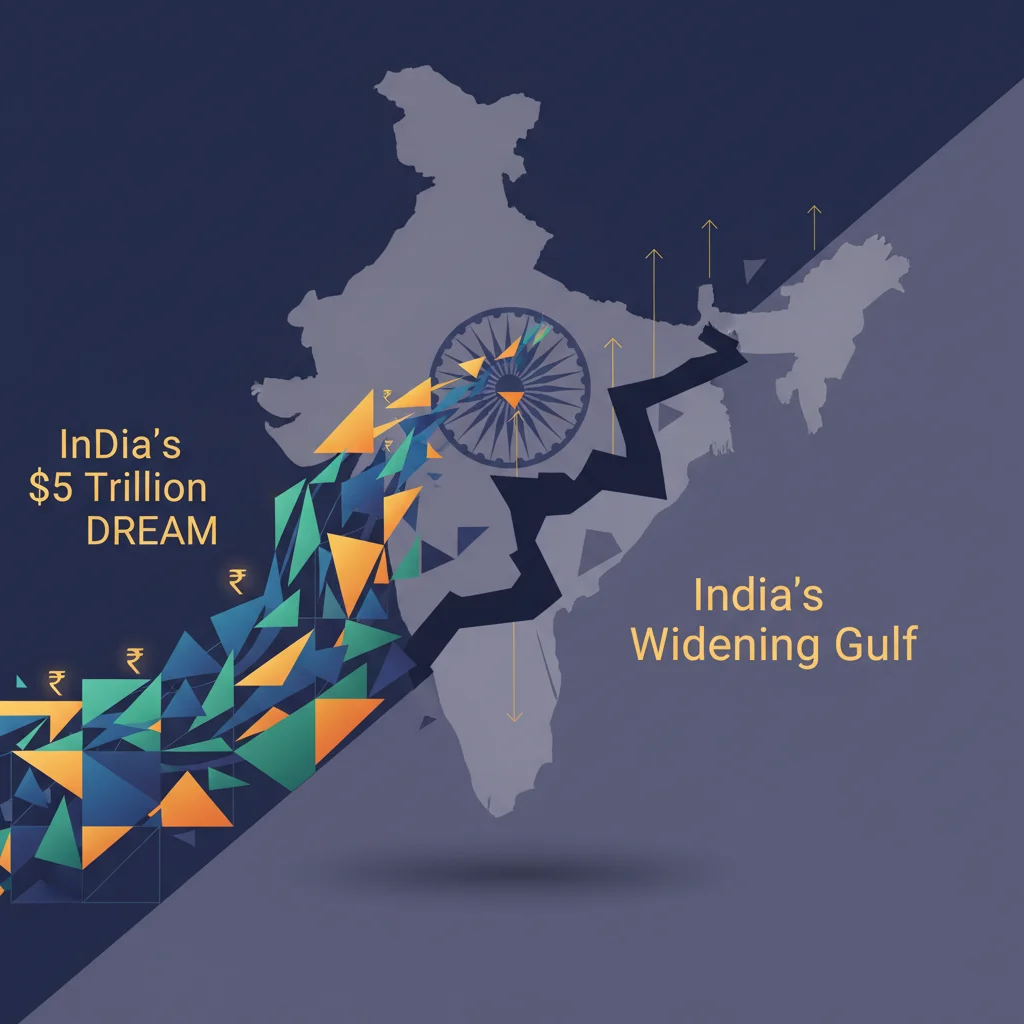
India’s $5 Trillion Dream: A Rising Tide or a Widening Gulf?
India stands at a fascinating and complex crossroads. On one hand, the headlines are ablaze with bullish sentiment. Projections point towards a powerhouse economy on track to exceed $5 trillion, the stock market is scaling unprecedented heights, and a digital revolution is reshaping the nation’s financial landscape. On the other hand, a quieter, more sobering narrative persists—one of unequal growth, persistent unemployment, and the gnawing question posed by the Financial Times: India’s economy will grow, but will Indians be better off?
For investors, business leaders, and finance professionals, this duality isn’t just an academic debate; it’s the central risk and opportunity factor in one of the world’s most dynamic markets. To truly understand the future of investing in India, we must look beyond the aggregate numbers and dissect the two powerful, competing forces shaping its destiny.
The Unstoppable Bull: Decoding India’s Growth Engine
The macroeconomic picture for India is, by most accounts, incredibly robust. The nation has emerged as the fastest-growing major economy globally, a title it’s expected to hold for the foreseeable future. This momentum isn’t accidental; it’s fueled by a confluence of powerful drivers.
First, there’s the government’s aggressive infrastructure push. Massive investments in roads, railways, ports, and digital networks are creating tangible assets that reduce logistical friction and boost productivity. This “capex-led” growth strategy is designed to create a virtuous cycle, attracting private investment and generating jobs.
Second, India’s demographic dividend remains a potent, long-term advantage. With a vast, young population, the potential for sustained consumption and labor force growth is immense. This contrasts sharply with the aging populations of many other major economies, positioning India as a unique hub for future growth.
Finally, the digital transformation, spearheaded by the Unified Payments Interface (UPI), has been nothing short of revolutionary. This leap in financial technology has brought tens of millions into the formal banking system, democratized digital payments, and created a fertile ground for a booming fintech ecosystem. The sheer volume of digital transactions—reportedly accounting for nearly half of the world’s real-time digital payments—is a testament to this paradigm shift. This digital backbone is not just about convenience; it’s a critical piece of infrastructure for the modern economy.
Beyond Infinite Growth: Why Planetary Limits Are the New Frontier for Finance and Investing
The Elephant in the Room: A “K-Shaped” Recovery and Its Perils
While the view from 30,000 feet is sunny, the reality on the ground is far more nuanced. The most significant concern plaguing India’s growth story is its uneven nature, often described by economists as a “K-shaped recovery.”
What does this mean? In simple terms, it describes an economic trajectory where different segments of the population recover at vastly different rates. The upward-sloping arm of the ‘K’ represents the affluent, skilled professionals, and large corporations who have benefited immensely from the formal, digital economy. Their incomes have risen, their investments have soared with the stock market, and their access to credit and opportunities has expanded.
The downward-sloping arm of the ‘K’ represents a much larger segment: the informal workforce, small-scale farmers, and low-skilled urban laborers. This group has faced stagnant wages, high inflation for essential goods, and a precarious job market. The data paints a stark picture of this divide. While luxury car sales and high-end real estate are booming, sales of entry-level consumer goods and two-wheelers—barometers of rural and lower-middle-class demand—have been sluggish (source). This divergence is the central challenge to the sustainability of India’s growth.
This isn’t just a social issue; it’s a critical economic one. An economy where a large portion of the population lacks purchasing power cannot sustain high growth indefinitely. It creates a cap on domestic consumption, which has historically been the bedrock of India’s economic resilience.
Bridging the Divide: Can Technology and Finance Be the Great Equalizers?
Amidst these challenges, the domains of finance and technology offer a powerful potential solution. The rapid evolution of fintech in India is not just about convenient payment apps; it’s about fundamentally rewiring access to capital and financial services.
Micro-lending platforms are reaching small entrepreneurs who were previously unbanked. Insurtech startups are offering affordable insurance products to rural populations. And the vast trove of data generated by digital transactions is allowing for more sophisticated credit scoring, enabling loans to individuals without a traditional credit history. While still in its early days, the use of technologies like blockchain could further enhance transparency and efficiency in supply chains and land records, directly benefiting those in the informal economy.
The formal banking sector, now on a much stronger footing after years of balance sheet cleanup, is also pivotal. The challenge for banks and regulators is to channel the nation’s high savings rate into productive investments that create jobs beyond the high-skill tech and finance sectors. Effective capital allocation into manufacturing, agriculture, and small and medium-sized enterprises (SMEs) is essential for creating the broad-based prosperity India needs.
To better understand the contrasting forces at play, consider the following summary:
| Indicators of Growth (The Bull Case) | Indicators of Concern (The Bear Case) |
|---|---|
| GDP Growth: Forecasted to be the highest among major economies. | Youth Unemployment: Persistently high, especially among educated youth. |
| Stock Market Performance: Indices like Sensex and Nifty reaching all-time highs. | Rural Wage Growth: Stagnant or lagging behind inflation, hurting consumption. |
| Digital Infrastructure: World-leading digital payment systems (UPI) and data consumption. | Income Inequality: A widening gap between the top 10% and the bottom 50% of earners. |
| Foreign Direct Investment: Strong inflows driven by geopolitical shifts and market potential. | Private Consumption: Weakness in mass-market segments, indicating widespread stress. |
Meta's Newest Gambit: Why the Manus AI Acquisition is a Major Signal for Investors
The Investor’s Compass: Navigating Opportunities and Risks
So, how should one approach investing and trading in this complex environment? The answer lies in a nuanced, sector-specific strategy that acknowledges both sides of the K-shaped reality.
The Opportunities are Clear:
- Infrastructure & Capital Goods: Companies benefiting directly from the government’s capex cycle are in a sweet spot.
- Premium Consumption: Businesses catering to the upper arm of the ‘K’—luxury goods, travel, high-end real estate, and premium services—will likely continue to thrive.
- Financial Services & Fintech: The formalization of the economy, rising incomes, and the digital push create a long runway for growth in banking, insurance, asset management, and innovative financial technology platforms.
The Risks are Structural:
- Mass-Market Consumption: Companies reliant on broad-based, rural, and lower-middle-class demand may face continued headwinds until incomes at the bottom rise meaningfully.
- Social & Political Volatility: High inequality and unemployment can lead to social unrest and policy shifts that could impact the business environment. An investor must factor in this political risk.
- Valuation Concerns: The Indian stock market is not cheap. Current valuations price in a lot of optimism, making the market vulnerable to corrections if growth fails to become more inclusive. A key challenge is distinguishing hype from sustainable value (source).
The Investor's Blind Spot: From Boiling Lobsters to Your Portfolio's Bottom Line
Conclusion: The Path to Shared Prosperity
India’s economic journey is one of the most compelling stories of the 21st century. The nation possesses the scale, the demographics, and the technological dynamism to become a true global superpower. The headline growth is real, and the opportunities for investors are immense.
However, the ultimate success of this journey will not be measured by the height of its stock market indices or its GDP ranking alone. It will be defined by its ability to translate macroeconomic growth into microeconomic well-being for the majority of its 1.4 billion citizens. The challenge for policymakers and business leaders is to build a bridge across the two sides of the ‘K’—to ensure that the rising tide of the Indian economy does, in fact, lift all boats. For investors, the most rewarding long-term strategy will be to identify the companies and sectors that are not just profiting from the boom, but are actively contributing to building that bridge.

Related Posts

The Unseen Potholes: How New Driving Regulations Could Stall the Youth Economy

Financial Paternalism: Why Old Rules of the Road Won’t Work for the New Generation of Digital Investors