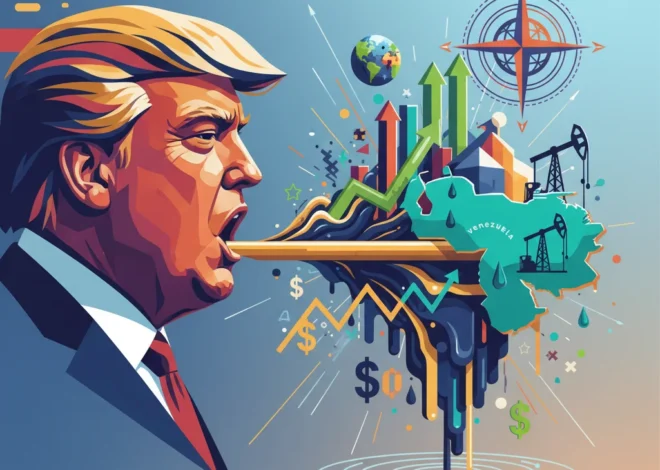
Bitcoin’s Real-Time Reflex: How Crypto Outpaced Wall Street on the Venezuela Shock
The Financial World’s Ticking Clock
In the intricate dance of global finance, timing is everything. Markets are vast, interconnected systems designed to process information and translate it into value. But what happens when a market-moving event occurs after the closing bell? For traditional markets, the answer involves a tense waiting game, a buildup of pressure that releases in a volatile surge when trading resumes. However, a recent geopolitical development in Venezuela provided a fascinating real-world experiment, pitting the deliberate pace of the traditional stock market against the relentless, 24/7 pulse of the crypto economy. The results offer a profound glimpse into the future of financial technology and investing.
On an otherwise ordinary Wednesday evening, the U.S. Treasury Department announced a significant policy shift: a six-month easing of sanctions on Venezuela’s oil, gas, and gold sectors. This was monumental news with far-reaching implications for energy markets, international relations, and the South American economy. Yet, for Wall Street, the news landed in a vacuum. The New York Stock Exchange had closed hours earlier. Traders, algorithms, and institutional investors would have to wait until 9:30 AM the next day to react, leaving a multi-hour gap where uncertainty could fester.
But one market didn’t sleep. The global Bitcoin market, a decentralized network that never closes, began processing the information almost instantly. As news wires lit up, trading volumes on crypto exchanges surged. Bitcoin’s price, often seen as a barometer for global liquidity and risk, began to move, absorbing the shockwave in real-time. This event wasn’t just another day in the trading world; it was a live demonstration of how blockchain technology is fundamentally challenging the operating principles of traditional finance.
The Old Guard: A World of Gates and Gaps
To fully appreciate the significance of Bitcoin’s reaction, it’s essential to understand the structure of the traditional financial system. Markets like the NYSE or NASDAQ operate on fixed schedules, a legacy of a pre-digital era. This structure has its benefits, including providing “cooling off” periods and allowing institutions to process trades and settle accounts. However, it also creates inherent inefficiencies in our hyper-connected world.
When major news breaks “after hours,” several things happen:
- Information Asymmetry: Professionals with access to after-hours or pre-market trading have an advantage. The average investor is left waiting, often seeing a significant price “gap” at the next day’s open.
- Delayed Price Discovery: The true market price, reflecting the new information, isn’t found until the market officially reopens. The intervening hours are filled with speculation rather than actual trading.
- Systemic Bottlenecks: The entire process, from trade execution to settlement (which can still take days, T+1 or T+2), is fragmented and delayed.
The Venezuela news was a classic example. An analyst quoted in the original report noted the stark contrast, stating, “While traditional markets were sleeping, Bitcoin was wide awake, pricing in the new geopolitical reality.” (source). This delay is a feature, not a bug, of the old system—a system built for a world that moved at the speed of paper, not the speed of light.
Beyond the Balance Sheet: The Battle for the Soul of Accounting
A Tale of Two Markets: A Comparative Look
The incident provides a perfect case study for comparing the operational mechanics of traditional finance (TradFi) and the emerging world of decentralized finance (DeFi), of which Bitcoin is the foundational asset. The differences in their ability to absorb market shocks are not just incremental; they are architectural.
Here is a breakdown of how each system responded to the same stimulus:
| Feature | Traditional Markets (e.g., Stock Market) | Bitcoin Market |
|---|---|---|
| Operating Hours | Fixed hours (e.g., 9:30 AM – 4:00 PM ET), closed on weekends/holidays. | 24/7/365, continuous global operation. |
| Reaction to News | Delayed until the next market open, leading to price gaps. | Immediate, real-time price discovery as news breaks. |
| Price Discovery | Occurs in bursts during trading sessions and pre-market/after-hours. | Continuous and fluid, reflecting a global consensus at any moment. |
| Geographic Access | Fragmented by region and time zone, with different exchanges. | Borderless and globally unified, with a single fungible asset. |
| Settlement | T+1 or T+2 (Takes 1-2 business days for a trade to officially settle). | Near-instantaneous final settlement on the blockchain (minutes to an hour). |
The immediate price drop in Bitcoin following the news was a textbook example of an efficient market in action. As the original analysis highlighted, the logic was that easing sanctions could stabilize Venezuela’s economy, potentially reducing local demand for Bitcoin as a hedge against hyperinflation and instability (source). Whether this logic is perfect is secondary to the fact that the market was able to debate and price it in immediately, a process that traditional economics textbooks dream of.
The Hidden Bull Market: Why UK Entrepreneurs Are Ignoring the Economic Gloom
Bitcoin as a Macroeconomic Barometer
This event further solidifies a growing trend: Bitcoin’s evolution from a niche tech curiosity into a legitimate macroeconomic asset. For years, investors and finance professionals have debated its role. Is it a currency? A commodity? A technology stock? The answer is becoming clearer: it is a unique instrument that reflects global liquidity, geopolitical risk, and sentiment about the stability of the entire financial system.
We’ve seen it react to:
- Central Bank Policies: Responding to interest rate decisions and quantitative easing announcements from the Fed and other central banks.
- Geopolitical Conflicts: Surges in trading volume and price movement during the onset of regional conflicts.
- Banking Crises: The 2023 regional banking crisis in the U.S. saw Bitcoin’s price rally as it was perceived as an alternative outside the traditional banking system (source).
The Venezuela incident adds another layer to this thesis. It demonstrates Bitcoin’s sensitivity not just to broad global events, but to specific, regional policy changes that have macroeconomic consequences. This responsiveness is a sign of a maturing asset class, one that sophisticated investors and business leaders can no longer afford to ignore. It is becoming an essential part of the modern investing and economics toolkit for gauging real-time global sentiment.
The Future of Finance: Always On, Always Ready
The story of the Venezuela sanctions and Bitcoin is more than just a headline. It is a powerful illustration of the technological paradigm shift underway in finance. The rigid, time-gated systems that have powered our economy for a century are being challenged by a new model built on blockchain technology—one that is global, transparent, and perpetually active.
This doesn’t mean the stock market will disappear overnight. But it does signal an urgent need for innovation within traditional finance. The fintech revolution is not just about slicker apps; it’s about re-engineering the core infrastructure of our financial world. The expectation of real-time responsiveness is growing, and systems that operate on a 24-hour delay will increasingly seem archaic.
For investors, the takeaway is clear: the digital asset space is not a separate universe but an increasingly integrated part of the global macroeconomic landscape. For business leaders and finance professionals, it’s a call to action. Understanding the mechanics and implications of this new financial technology is no longer optional. The market that never sleeps is here, and it is setting a new standard for speed, efficiency, and responsiveness in the global economy.