The Python’s Portfolio: Why “Trust in Me” is the Most Dangerous Song in Finance
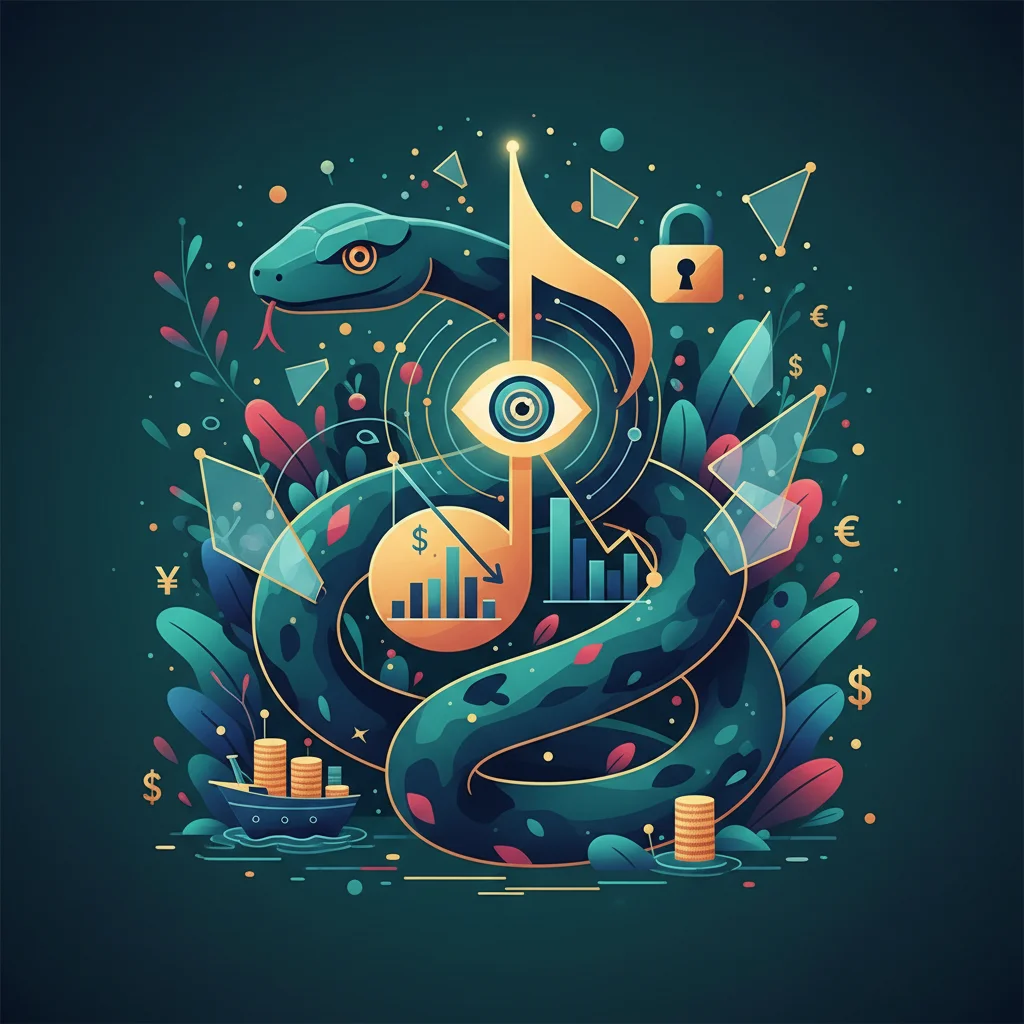
In the lush, vibrant world of Disney’s 1967 classic, The Jungle Book, a hypnotic melody slithers through the trees. It’s the sound of Kaa, the Indian python, lulling his unsuspecting prey into a state of blissful vulnerability. His song, “Trust in Me,” is a masterclass in seductive deception, promising safety and comfort while masking predatory intent. As noted in the Financial Times, this seemingly simple ditty has mesmerized musicians for decades, from jazz ensembles to the avant-garde Grace Jones. But its most powerful and chilling resonance lies far beyond the world of music—it serves as a perfect allegory for the most potent and perilous force in the global economy: trust.
In the world of finance, investing, and financial technology, we are all Mowgli, the naive “man-cub,” navigating a complex jungle teeming with opportunity and danger. And everywhere we turn, we hear a version of Kaa’s song. It’s in the whisper of a “can’t-miss” stock tip, the siren call of a crypto project promising 100x returns, and the reassuring purr of a charismatic CEO unveiling a revolutionary new business model. The promise is always the same: “Ssslip into silent ssslumber. Sssail on a sssilver mist. Ssslowly and surely, your sssensses will cease to resist.”
This melody is not just a tune; it’s a financial strategy. It’s the sound of risk being cloaked in the language of security. It’s the hypnosis of market euphoria that precedes every major crash. Understanding this song—how it works, who sings it, and how to build an immunity to its spell—is the most critical skill for any investor, business leader, or participant in the modern economy.
The Seductive Melody of Irrational Exuberance
Kaa’s power doesn’t come from his physical strength, but from his ability to manipulate perception. He convinces Mowgli that vulnerability is safety. The financial markets have their own powerful hypnotists who leverage a similar psychological phenomenon known as “herd behavior” or, as former Fed Chair Alan Greenspan famously termed it, “irrational exuberance.”
Consider the dot-com bubble of the late 1990s. The “song” was the promise of a new digital economy where traditional metrics of profitability and revenue no longer applied. Investors, mesmerized by soaring valuations of companies with no clear path to profit, poured trillions into the stock market. The chorus was, “This time it’s different.” Skepticism was dismissed as old-fashioned. The result? The Nasdaq Composite index lost nearly 78% of its value from its peak in 2000 to its low in 2002, wiping out an estimated $5 trillion in market value.
More recently, the siren song was heard in the crypto boom. The promise of decentralized finance (DeFi) and the revolutionary potential of blockchain technology were intoxicating. Figures like Sam Bankman-Fried of FTX became the charismatic conductors of this new orchestra, assuring investors that their complex financial instruments were safe. Yet, as with Kaa, the promise of trust was a facade, leading to catastrophic losses for millions who were lulled into a false sense of security. The collapse of FTX alone resulted in an estimated $8 billion in missing client funds.
The Elephant in the Room: Could a UK Return to the EU Customs Union Redefine its Economic Future?
Identifying the “Kaa” in Your Portfolio
The pythons of modern finance are not always so obvious. They are masters of disguise, often cloaked in the respectable attire of innovation and progress. Recognizing their song is key to protecting your capital.
1. The Charismatic Visionary
History is filled with leaders whose charisma hypnotized investors and boards alike. From Adam Neumann at WeWork, who sold a real estate rental business as a world-changing tech company, to Elizabeth Holmes at Theranos, who promised to revolutionize medicine with technology that never existed. They excel at storytelling, painting a picture so compelling that investors forget to ask the hard questions. Their song is one of vision and destiny, making due diligence feel like a cynical betrayal of a beautiful dream.
2. The Opaque “Black Box”
In the era of high-frequency trading and complex derivatives, many investment products are essentially “black boxes.” Their inner workings are known only to their creators. The song here is one of technological superiority and intellectual exclusivity: “This is too complex for you to understand, but trust us, it works.” This was the melody of the collateralized debt obligations (CDOs) that precipitated the 2008 financial crisis. Investors bought these products without fully understanding the risky subprime mortgages bundled inside, hypnotized by their triple-A credit ratings.
3. The “Revolutionary” Technology
Fintech and blockchain have an incredible potential to reshape the financial landscape. However, the hype surrounding them can also be a hypnotic force. The promise of decentralization, of a “trustless” system, can lull participants into ignoring the new centralization of power in exchanges, “whales,” and developers. The song is that technology itself eliminates the need for old-fashioned trust. But trust is never eliminated; it is merely transferred. In the crypto world, you may not have to trust a bank, but you have to trust the code, the platform, and the anonymous founders—a far more volatile proposition.
Building a Portfolio That Resists Hypnosis
So how does Mowgli survive the jungle? Not by avoiding snakes altogether, but by learning to recognize their song and having a healthy dose of skepticism. For investors, this translates into a disciplined, principles-based approach to managing wealth.
The following table contrasts the hypnotic promises of “Kaa” with the prudent counsel of a “Bagheera”—the cautious panther who consistently saved Mowgli from danger.
| Characteristic | The Hypnotic “Kaa” Approach | The Prudent “Bagheera” Approach |
|---|---|---|
| The Promise | Guaranteed, easy, and quick high returns. “This changes everything.” | Realistic, long-term growth based on fundamentals. “Wealth is built slowly.” |
| Risk Disclosure | Risks are downplayed, dismissed, or hidden in complex jargon. | Risks are highlighted, quantified, and form the basis of the strategy. |
| Source of Trust | Based on charisma, hype, social proof (FOMO), and complexity. | Based on transparency, track record, clear regulations, and fiduciary duty. |
| Due Diligence | Discouraged as “pessimism” or “not getting it.” | Mandatory. “Trust, but verify.” Involves reading, questioning, and analysis. |
| Key Question | “How much can I make?” | “How much can I lose, and how does this work?” |
Adopting Bagheera’s mindset means prioritizing due diligence. It means understanding that the foundation of the global economy isn’t just numbers on a screen; it’s a complex web of trust. This trust is institutionalized through regulations, enforced by bodies like the SEC, and embodied in concepts like fiduciary duty—the legal obligation for a financial professional to act in their client’s best interest. According to a 2023 report from the SEC, its enforcement division filed 784 actions, obtaining orders for over $4.9 billion in financial remedies, acting as a crucial, if imperfect, guardian against the jungle’s predators.
The Week in Review: 5 Critical Market Signals and What They Mean for Your Portfolio
The Future of Trust in a Digital Jungle
As we move deeper into a digital-first world, the nature of financial hypnosis is evolving. Algorithmic trading, AI-powered financial advisors, and the continued development of financial technology are changing the players and the rules of the game. The new Kaa may not be a person, but a piece of software promising optimized returns with no human error.
The fundamental challenge remains the same: how do we build and maintain trust? The answer lies not in finding a single, perfectly trustworthy entity, but in building a resilient system. This includes:
- Radical Transparency: Leveraging technology like blockchain not for speculative assets, but for its original promise of creating transparent, immutable ledgers for real-world assets and transactions.
- Smarter Regulation: Regulators must evolve as quickly as the technology, moving from a reactive to a proactive stance to protect consumers without stifling innovation.
- Financial Education: The single greatest defense against hypnosis is knowledge. An educated populace is better equipped to ask the right questions and spot the red flags.
The song “Trust in Me” is timeless because the temptation it represents is a fundamental part of human nature. We all want to believe in an easy path, a safe harbor in a complex world. In finance, as in the jungle, such promises are rarely what they seem. The true path to security is not found by closing your eyes and trusting a hypnotic song, but by opening them wider, questioning everything, and navigating the terrain with the wisdom and caution of one who knows that pythons are always present.
The £200 Micro-Miracle: How a Community Shop Rewrites the Rules of Economics and Investing
Ultimately, trust is the bedrock of our entire financial system, from the local banking branch to the global stock market. But it must be earned through consistent, transparent, and accountable action—not through a seductive melody. The next time you hear a financial promise that sounds too good to be true, listen closely. You might just hear the faint, sibilant hiss of a familiar tune, and you’ll know it’s time to walk away.

Related Posts
The Investor’s Crossword: Decoding the Clues of Today’s Complex Economy
Beyond the Headlines: The Economic Toll and Investment Signals in the UK’s New Road Safety Overhaul