The Billion-Dollar Diet: Decoding the Financial Fallout of the UK’s Junk Food Ad Ban
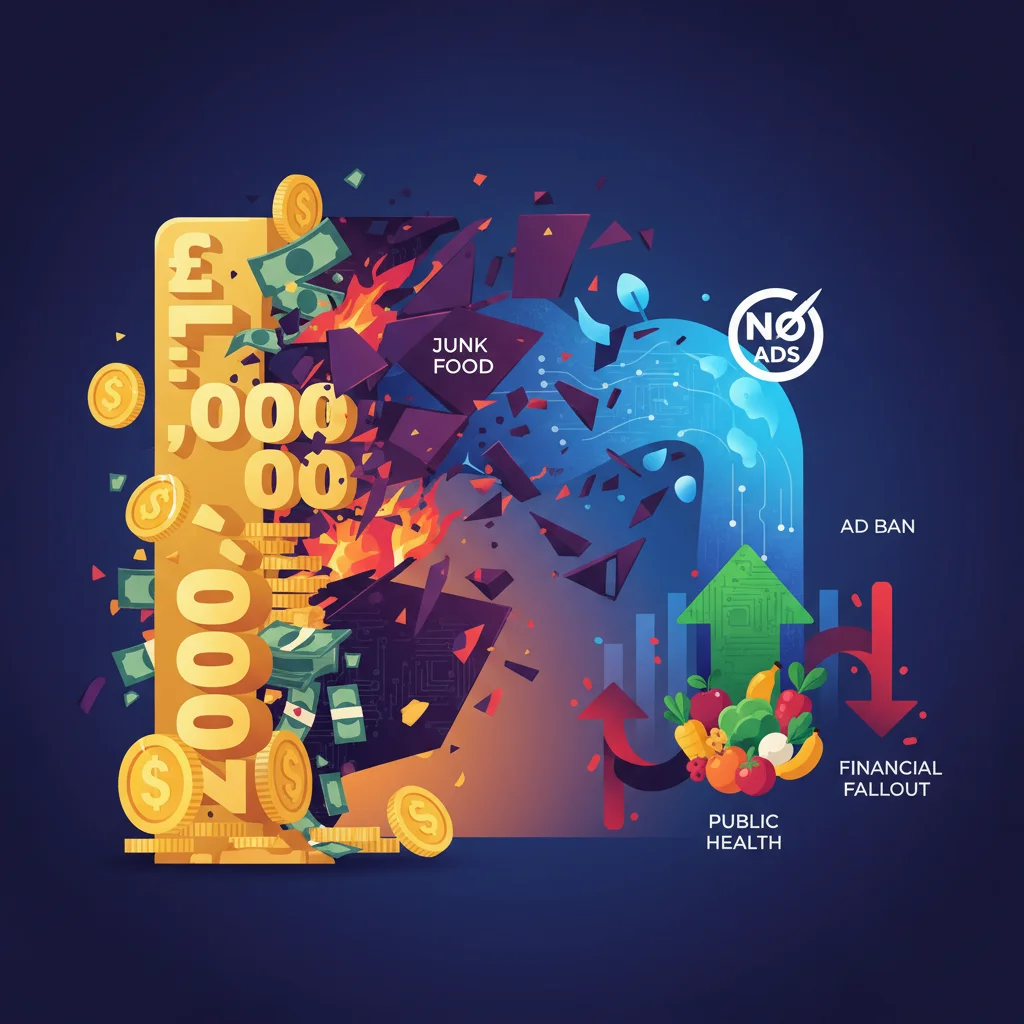
In what appears on the surface to be a straightforward public health initiative, the UK government is set to implement a sweeping ban on junk food advertising. The stated goal is simple: to encourage manufacturers to reformulate their products with healthier ingredients. However, beneath this public health veneer lies a significant economic event, one poised to send powerful ripples across the stock market, reshape corporate strategies, and create a new landscape for investors. This isn’t just about what we eat; it’s about the flow of capital, the future of multi-billion-dollar industries, and the evolving relationship between regulation, the economy, and modern finance.
The new regulations, as outlined by government sources, will prohibit advertisements for foods high in fat, salt, or sugar (HFSS) on television before 9 p.m. and entirely online. This move, which the government hopes will prompt a wave of healthier product development (source), represents one of the most significant regulatory interventions in the UK’s food and advertising sectors in a generation. For business leaders, finance professionals, and investors, ignoring this shift would be a critical oversight. The ban is a catalyst, set to re-draw the lines of competition, profitability, and market valuation for years to come.
The Regulatory Ripple Effect: A Macroeconomic Perspective
To fully grasp the financial implications, one must first understand the economic theory underpinning the ban. This policy is a classic example of “nudge economics,” a concept popularized by Nobel laureate Richard Thaler. The government is not outright banning the products themselves but is altering the choice architecture to “nudge” consumers towards healthier options and producers towards healthier formulations. The long-term economic prize is substantial: reducing the immense strain of obesity on the national economy.
The UK’s National Health Service (NHS) currently spends an estimated £6.5 billion per year on treating obesity-related ill health, a figure projected to rise. The wider cost to the economy is even more staggering, estimated to be around £58 billion annually, factoring in lost productivity and workforce challenges (source). From a purely fiscal standpoint, this advertising ban is a calculated investment, aiming to curb future liabilities that weigh heavily on the public purse and, by extension, the entire UK economy.
However, this intervention is not without its own economic costs. The UK’s advertising market is a powerhouse, and the food and beverage sector is one of its largest contributors. A 2021 report projected that the HFSS ad restrictions could remove over £200 million in annual revenue from the market (source). This directly impacts the revenue streams of broadcasters, digital platforms, and advertising agencies, creating a significant headwind for companies within these sectors.
The Silent Crash: How Japan's Demographic Crisis Will Reshape the Global Economy
Sector-by-Sector Analysis: Winners, Losers, and New Battlegrounds
The ad ban will not affect all companies equally. It will create a clear divergence in the market, rewarding adaptive, innovative firms while punishing those slow to pivot. For investors, understanding this divergence is key to capitalizing on the shifting dynamics.
The Consumer Packaged Goods (CPG) Giants
For decades, titans like Nestlé, Unilever, Mondelēz, and Pepsico have built empires on the back of mass-market advertising for their most popular (and often least healthy) products. This ban directly attacks their primary tool for driving demand. The immediate financial impact comes in two forms:
- Revenue at Risk: Sales of flagship HFSS products could decline without the constant reinforcement of advertising.
- Increased Costs: Companies will be forced to invest heavily in Research & Development (R&D) to reformulate products, a costly and time-consuming process that doesn’t guarantee consumer acceptance.
The stock market will be watching closely. Analysts will re-evaluate earnings forecasts based on the percentage of a company’s portfolio that falls under the HFSS classification. Those with a diversified portfolio and a strong, pre-existing pipeline of healthy alternatives are best positioned to weather the storm.
Media and Advertising
Broadcasters like ITV and digital platforms that rely on advertising revenue will face a direct hit. The loss of a major advertising category will create a revenue hole that must be filled. This could lead to increased competition for ad slots from other sectors, potentially depressing ad prices in the short term. For advertising holding companies like WPP and Publicis, the challenge is to pivot their creative strategies. They must now help their CPG clients build brands through channels that are not restricted, such as in-store promotions, experiential marketing, and sophisticated influencer partnerships—a more complex and fragmented approach.
The Investor’s Playbook: ESG, Fintech, and Trading the Transition
This regulatory shift is a quintessential ESG (Environmental, Social, and Governance) event. The ‘Social’ pillar of ESG investing directly concerns a company’s impact on society, including public health. The ad ban serves as a state-sanctioned litmus test, separating companies that are contributing to a societal problem from those that are actively working to solve it.
Modern investors are increasingly leveraging financial technology (fintech) platforms to screen their portfolios based on ESG metrics. These platforms can now be programmed to flag companies with high revenue exposure to HFSS products, automatically identifying them as carrying higher regulatory and reputational risk. As this trend accelerates, we could see a tangible impact on the cost of capital for non-compliant companies, as ESG-focused funds and investors may choose to divest.
Below is a high-level overview of the potential market redistribution for investors navigating this new environment.
| Sector | Potential Losers (Illustrative Examples) | Potential Winners (Illustrative Examples) | Key Investment Thesis |
|---|---|---|---|
| CPG / Food Manufacturing | Companies with heavy reliance on legacy HFSS products (e.g., traditional confectionary & sugary soda brands). | Companies with strong “health & wellness” brands, plant-based alternatives, and proven reformulation capabilities. | The market will reward companies that can successfully pivot their product portfolios toward healthier options without sacrificing taste or brand loyalty. |
| Media & Advertising | Traditional broadcasters and digital platforms with high exposure to food & beverage ad revenue. | Experiential marketing agencies, specialist health & wellness PR firms, and platforms strong in non-traditional advertising. | Marketing budgets will be reallocated, not eliminated. The winners will be those who can capture this redirected spending. |
| Food-Tech & Health-Tech | N/A | Startups in alternative proteins, natural sweeteners, personalized nutrition apps, and “healthy” snack subscription services. | The ban creates a powerful tailwind for challenger brands and technologies that are inherently aligned with the new regulatory landscape. |
| Retail & Supermarkets | Retailers heavily dependent on promotional sales of HFSS products at checkouts and end-of-aisle displays. | Retailers with strong own-brand healthy lines and effective in-store layouts that promote healthier choices. | Supermarkets that position themselves as partners in public health could win significant consumer trust and market share. |
The Bardot Economy: Timeless Lessons in Branding, Disruption, and Asset Valuation
The Technological Frontier: Blockchain for Trust and AI for Strategy
Beyond the immediate market reaction, this regulatory pressure will accelerate the adoption of advanced technology within the food sector. As companies reformulate products, consumer trust will become their most valuable asset. How can a brand definitively prove its new “healthy” snack is made with sustainably sourced, high-quality ingredients? This is where blockchain technology enters the conversation.
A blockchain-based supply chain ledger can provide an immutable, transparent record of a product’s journey from farm to shelf. Consumers could scan a QR code on a package and see exactly where the oats in their granola bar were grown or verify that the cocoa in their “healthy” chocolate is ethically sourced. In a market where health claims are under intense scrutiny, using blockchain for radical transparency is no longer a gimmick; it’s a powerful tool for building brand equity and a defensible competitive advantage.
Simultaneously, the C-suites of these CPG giants will be leaning heavily on sophisticated financial technology and AI-powered modeling. The complex task of reallocating a global marketing budget, predicting the sales impact of reformulation, and optimizing pricing strategies across thousands of product lines is a perfect use case for machine learning. The future of corporate finance and strategy in this sector will involve less gut instinct and more data-driven, predictive economics, managed through advanced fintech platforms.
Conclusion: A New Economic Recipe
The UK’s junk food ad ban is far more than a footnote in public health policy. It is a market-shaping event that serves as a compelling case study in modern economics, finance, and corporate strategy. It underscores the growing power of regulation to influence capital allocation and highlights the increasing importance of ESG factors in any robust investment thesis.
For investors, the ban creates a clear call to action: re-evaluate holdings in the CPG, media, and retail sectors, and identify the innovative companies—from established players to nimble food-tech startups—that are poised to thrive in this new, health-conscious paradigm. For business leaders, it is a stark reminder that long-term profitability and societal well-being are becoming inextricably linked. The companies that successfully navigate this transition will be those that view it not as a regulatory burden, but as an opportunity to innovate, build trust, and align their balance sheets with the future of consumer demand. The financial markets, in their relentless pursuit of growth, will ultimately reward those who get the recipe right.

Related Posts
Crude Politics: Deconstructing the Plan to Seize Venezuelan Oil and Its Impact on Global Finance
Beyond the Headlines: The Economic Toll and Investment Signals in the UK’s New Road Safety Overhaul