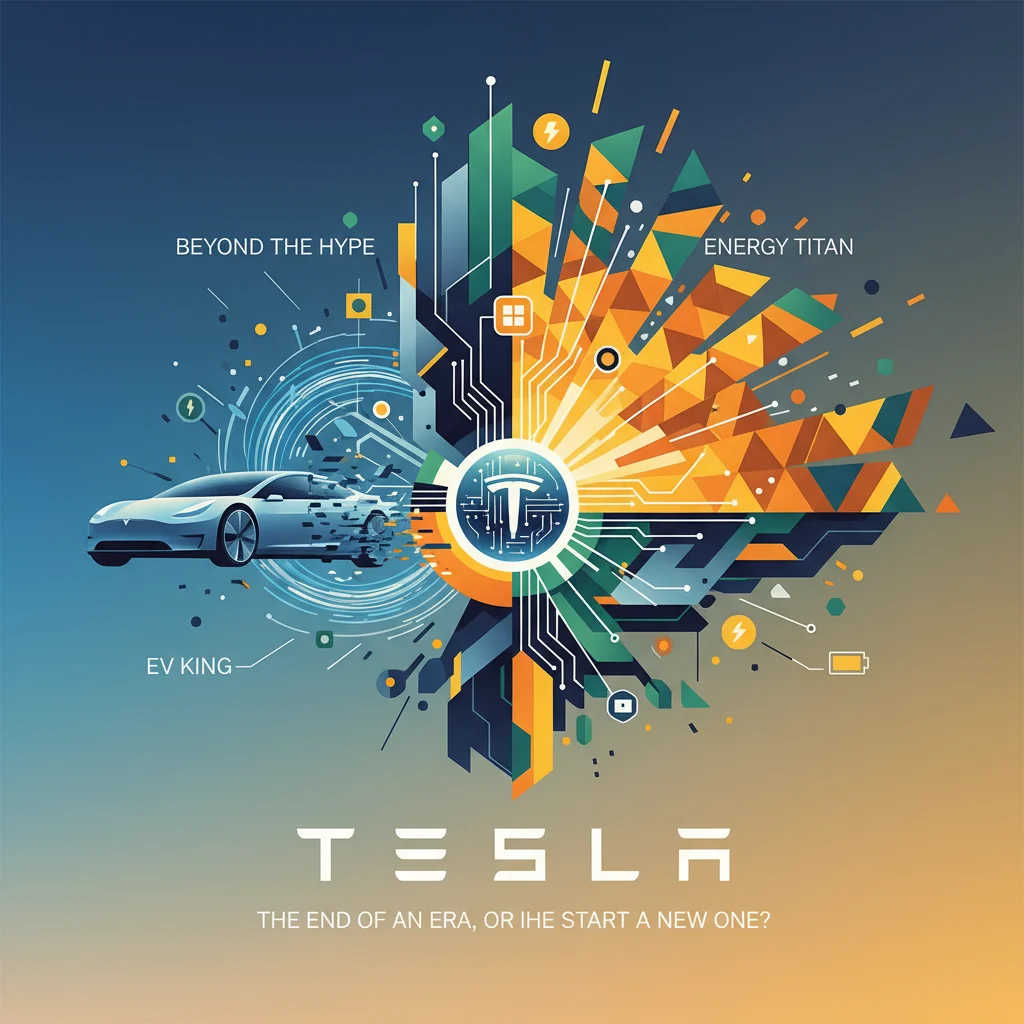
Beyond the Hype: Tesla’s Pivot from EV King to Energy Titan
The End of an Era, or the Start of a New One?
For years, the narrative in the electric vehicle space has been straightforward: Tesla leads, and everyone else follows. The company, led by the enigmatic Elon Musk, didn’t just pioneer the modern EV; it became synonymous with it. For investors and market watchers, Tesla’s quarterly delivery numbers were a bellwether for the entire industry, a key metric influencing the stock market and shaping conversations about the future of transportation. But in the final quarter of 2023, the script was flipped. Chinese automaker BYD sold more all-electric cars than Tesla for the first time, a symbolic dethroning that sent ripples through the global finance community.
While headlines declared a new king of EVs, a myopic focus on car sales misses a much larger, and arguably more significant, battle being waged behind the scenes. The real war isn’t just about the cars we drive; it’s about the fundamental infrastructure that will power our future. As Tesla appears to cede ground on one front, it is aggressively opening another in the colossal market for grid-scale energy storage. This strategic pivot suggests that while the EV skirmish is captivating, the war for battery dominance—and the future of energy itself—is far from over.
From Roadways to Power Grids: The Megapack Offensive
While the automotive division grapples with intensified competition, Tesla’s energy division has been quietly building a powerhouse. The company’s energy generation and storage business saw its revenues surge by 50 percent in 2023, reaching $6 billion, with deployments of its flagship product, the Megapack, doubling over the previous year. But what exactly is a Megapack, and why is it so critical to Tesla’s long-term strategy?
A Megapack is essentially a giant, utility-scale battery designed to store massive amounts of energy and feed it back into the electrical grid when needed. This solves the biggest challenge of renewable energy sources like solar and wind: intermittency. The sun doesn’t always shine, and the wind doesn’t always blow. Megapacks act as a buffer, storing excess energy during peak production and releasing it during peak demand or when renewable sources are offline. This capability is essential for creating a stable, reliable, and green power grid, a cornerstone of the global economy’s transition away from fossil fuels.
Tesla’s ambition in this space is monumental. The company is constructing a new Megapack factory in Shanghai, a move that will dramatically increase its production capacity and signal its intent to dominate this burgeoning market. This isn’t just about selling a product; it’s about becoming an indispensable part of the world’s energy infrastructure.
Echoes from the Archive: Timeless Lessons on Power, Innovation, and Risk for Today's Investor
To understand the magnitude of this strategic shift, it’s helpful to compare Tesla’s two primary battlegrounds:
| Metric | Electric Vehicles (EV) | Energy Storage (Megapack) |
|---|---|---|
| Primary Market | Consumer Automotive | Utility Companies, Grid Operators, Industrial |
| Key Product | Model 3/Y, Cybertruck | Megapack, Powerwall |
| Primary Competitors | BYD, Volkswagen, Ford, Legacy Automakers | CATL, BYD (Energy Storage Div.), Fluence |
| Growth Driver | Consumer adoption of EVs, government incentives | Renewable energy deployment, grid modernization |
| Strategic Value | Brand recognition, data collection, mass-market scale | Infrastructure integration, long-term contracts, energy market control |
The LFP Advantage: China’s Ace in the Hole
At the heart of this global competition—for both cars and grid storage—is the battery cell itself. The dominant technology emerging for both applications is Lithium Iron Phosphate, or LFP. Unlike traditional nickel-cobalt-manganese (NCM) chemistries, LFP batteries are cheaper to produce, have a longer lifespan, and are safer as they are less prone to thermal runaway. Crucially, they do not rely on cobalt, a metal fraught with ethical and supply chain challenges.
This is where the plot thickens. Chinese companies, led by giants like CATL (Contemporary Amperex Technology Co. Limited) and BYD, have mastered LFP technology. They control a significant portion of the global supply chain, from raw material processing to cell manufacturing. This gives them a formidable cost and scale advantage. According to the Financial Times article, this dominance is a key reason why Chinese EV makers can offer more affordable vehicles, directly challenging Tesla’s market share (source).
Tesla, recognizing this technological reality, has already pivoted. It uses LFP cells from CATL in its entry-level vehicles and is increasingly adopting the chemistry for its energy storage products. This creates a fascinating dynamic of “co-opetition,” where a key supplier is also a primary competitor. The intricate web of supply chains, intellectual property, and manufacturing capacity forms the complex battlefield of the modern battery war. The use of advanced financial technology and even blockchain for supply chain verification is becoming increasingly relevant to ensure transparency and ethical sourcing in this high-stakes environment.
Red Oceans and Red Ink: Decoding Meituan's Costly War for China's Instant Retail Crown
Geopolitics, Economics, and the New Energy Order
This corporate rivalry does not exist in a vacuum. It is playing out against a backdrop of intense geopolitical competition between the United States and China. Both nations view dominance in green technology not just as an economic opportunity but as a matter of national security and global influence. Policies like the U.S. Inflation Reduction Act (IRA) are designed to onshore manufacturing and build domestic supply chains, directly countering China’s established lead.
For those engaged in finance and economics, this creates a complex investment landscape. On one hand, the growth potential is undeniable. The transition to a green economy requires staggering levels of investment in everything from battery factories to grid upgrades. Traditional banking institutions and venture capital are pouring billions into the sector. On the other hand, the geopolitical risks are significant. Tariffs, trade disputes, and technological decoupling could disrupt supply chains and alter the competitive dynamics overnight.
The success of Tesla’s Shanghai Megapack factory will be a key test case. It represents a deep integration with the Chinese supply chain, even as political tensions simmer. Navigating this complex terrain will require not just technological innovation but also shrewd geopolitical and financial maneuvering.
Conclusion: The Long Game
Losing the top spot in EV sales was undoubtedly a psychological blow to Tesla and its investors. However, to frame this as the end of Tesla’s dominance is to miss the forest for the trees. The company is strategically diversifying its efforts, leveraging its brand and technological expertise to attack the foundational layer of the new energy economy: storage.
The real story isn’t about one quarter’s car sales. It’s about a fundamental realignment of a global giant from a high-growth automaker to a diversified industrial and technology company at the heart of the energy transition. The battle with BYD, CATL, and others will continue to be fierce, fought in factories, research labs, and the halls of government. For investors, business leaders, and anyone interested in the future of our economy, the message is clear: look beyond the chrome and horsepower. The real power play is in the batteries, and that war has just begun.