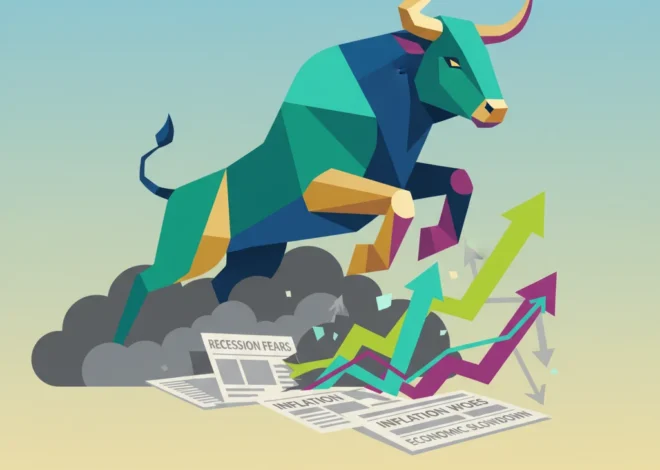
The Economic Inheritance: Why a Looming UK Recovery Could Redefine the Next Government
For months, the narrative surrounding the UK economy has been one of persistent gloom. Stagnant growth, a historically high tax burden, and the lingering specter of double-digit inflation have painted a bleak picture for citizens, investors, and business leaders alike. The consensus seems to be that any incoming government, likely led by Keir Starmer, will inherit a poisoned chalice—a set of economic challenges so profound they leave almost no room for maneuver. But what if that consensus is missing a critical turn in the road ahead?
Beneath the surface of the daily headlines, a different story is beginning to unfold. Key macroeconomic indicators are starting to shift, suggesting that the UK might be on the cusp of a surprisingly positive economic cycle. Falling inflation and the consequent prospect of interest rate cuts could provide an unexpected tailwind, transforming the narrative from one of crisis management to one of recovery. This potential “upside surprise,” as noted by financial analysts, could dramatically reshape the political and economic landscape, with its full effects potentially cresting around 2026—a timeline with profound implications for the next government’s legacy.
The Weight of the Present: Acknowledging the Headwinds
To appreciate the potential for a positive shift, we must first acknowledge the gravity of the current situation. The UK’s economic performance post-pandemic has been sluggish, constrained by a combination of global shocks and domestic challenges. Businesses have grappled with rising costs, supply chain disruptions, and a tight labor market. Households have faced the most severe cost of living crisis in a generation, with energy prices and food costs eroding real incomes.
The government’s fiscal position is equally tight. Public services are under immense strain, yet the national debt and the cost of servicing it limit the scope for significant new investment. This is the difficult inheritance that awaits the next Prime Minister—a complex web of constraints that has led many to predict a term defined by painful trade-offs and limited ambition. This environment has created significant uncertainty in the stock market and made long-term strategic investing a challenging proposition.
Unraveling a Legacy: The Financial Knot Strangling Iran's Persian Carpet Trade
The Turning Tide: Inflation’s Retreat and Its Ripple Effect
The first and most significant silver lining is the rapid decline in the UK’s inflation rate. After peaking in late 2022, the Consumer Prices Index (CPI) has been on a downward trajectory, falling faster than many economists had initially forecast. The Bank of England’s 2% target, which seemed a distant dream just a year ago, is now within sight.
This is not merely an abstract statistic; it is the foundational piece for a broader economic recovery. For consumers, falling inflation means their wages go further, easing the pressure on household budgets. For businesses, it translates to more predictable input costs and a more stable environment for planning and investment.
The most crucial consequence of falling inflation, however, lies in its influence on monetary policy. The Bank of England’s aggressive series of interest rate hikes was a necessary but painful medicine to tame inflation. With the beast seemingly back in its cage, the central banking authority now has the room to consider reversing course. The prospect of interest rate cuts in the near future is no longer a distant hope but a central expectation in financial markets.
To illustrate the tangible impact of potential rate cuts, consider the effect on borrowing costs for households and businesses.
| Scenario | Impact on a £200,000 Mortgage (Variable Rate) | Impact on a £100,000 Business Loan (Variable Rate) |
|---|---|---|
| Current Rate (e.g., 5.25%) | Higher monthly repayments, reduced disposable income. | Increased debt servicing costs, delayed investment. |
| Future Rate (e.g., 4.00%) | Significant reduction in monthly payments, boosting consumer spending power. | Lower borrowing costs, making new projects and expansion more viable. |
As the table shows, even a modest reduction in the base rate can unlock substantial capital across the economy, creating a virtuous cycle of increased spending, investment, and confidence.
The 2026 Tailwind: Why Timing is Everything
The core of this optimistic thesis lies in the timeline. The full benefits of lower inflation and reduced interest rates are not instantaneous. It takes time for these macroeconomic shifts to filter through the complex machinery of the economy and be felt in the pockets of ordinary people and on the balance sheets of businesses.
- Monetary Policy Lags: Changes in interest rates typically take 12-18 months to have their maximum impact. Rate cuts in late 2024 or early 2025 would therefore mature economically in 2026.
- Consumer Confidence: It takes time for households to feel secure enough to start spending again after a major financial shock. A sustained period of falling mortgage rates and stable prices is needed to rebuild that confidence.
- Business Investment: Companies plan major capital expenditures years in advance. A more stable economic outlook in 2025 would likely trigger a new wave of investment that comes online in 2026 and beyond.
This timeline is politically potent. A new government taking office in late 2024 would spend its first year grappling with the residual effects of the downturn. However, by 2026, the economic environment could be looking significantly brighter (source). This would provide a powerful narrative of progress and competence just as the government hits its mid-term, setting a positive stage for the subsequent general election campaign.
Political Fault Lines & Market Tremors: Why Investors Can't Ignore America's Partisan Divide
Navigating the Fiscal Straitjacket
However, this potential economic upswing does not solve all problems. The “silver lining” is monetary, not fiscal. Any new government will still be bound by a very tight fiscal straitjacket. Years of slow growth and crisis spending have left public finances in a precarious state. The demand for better-funded public services—from the NHS to schools—is immense, but the money simply isn’t there without either tax rises or further borrowing, both of which a new government will be reluctant to pursue.
Therefore, the central challenge will be to manage expectations and make difficult choices. An improved economic backdrop might increase tax revenues slightly, but it won’t be enough to fix the deep structural deficits in public services. This is where innovation in public finance and a relentless focus on pro-growth policies will be paramount. A government might need to explore how emerging financial technology (fintech) can make public sector payments more efficient, or even how distributed ledger technologies like blockchain could streamline supply chains and reduce administrative waste. The improved economic mood must be translated into a credible long-term plan for sustainable growth and fiscal responsibility.
Implications for Investors and Business Leaders
For those involved in investing and corporate strategy, this potential shift requires a recalibration of outlooks.
- Look Beyond the Noise: The prevailing narrative may remain negative for some time. Astute investors will look past this to the underlying fundamentals, such as the direction of inflation and interest rates. Sectors sensitive to consumer spending and lower borrowing costs, such as retail, hospitality, and housebuilding, could be poised for a rebound.
- Re-evaluate UK Assets: After years of underperformance, UK equities and assets may present a value opportunity if this more optimistic economic scenario plays out. A stable political environment combined with economic recovery could attract renewed international investment.
- Plan for Growth: For business leaders, the prospect of a more stable 2025-2026 provides a window to plan for future investment. As the cost of capital falls, projects that were previously unviable may become attractive. Strategic planning for expansion, hiring, and technological adoption should begin now.
The world of trading will be closely watching the Bank of England’s communications for signals on the timing and pace of rate cuts, as these will be key drivers of market movements in the coming 18 months. The key takeaway is that the economic tide may be turning, even if the shoreline still looks messy.
The Architecture of Alpha: Unlocking Portfolio Value in Forgotten Masterpieces
Conclusion: An Inheritance of Opportunity?
The economic inheritance awaiting the next UK government is undeniably one of the most challenging in modern history. The fiscal constraints are real and the structural problems are deep. Yet, to focus solely on the negatives is to miss the powerful cyclical forces that are beginning to align in the UK’s favor.
The fall in inflation and the anticipated easing of monetary policy represent more than just a silver lining; they are a potential game-changer. They offer the prospect of a restored sense of stability, a recovery in real incomes, and a return to business investment. While this will not be a panacea for all the UK’s economic ills, it could provide a crucial tailwind that transforms a narrative of managed decline into one of renewed optimism. For a new Prime Minister, this economic turn of the tide could be the single most important factor in determining whether their term is defined by the crises of the past or the opportunities of the future.