China’s High-Stakes Gamble: Can an Export Blitz Revive a Stagnant Economy?
In the intricate world of global economics, China is making a move that has investors, policymakers, and business leaders holding their breath. Faced with sputtering domestic growth, a deep-seated property crisis, and persistent deflationary pressures, Beijing is not turning inward. Instead, it’s doubling down on the very strategy that powered its meteoric rise: an aggressive, export-led growth model. But this isn’t your grandfather’s “Made in China” playbook. This time, the focus is on high-tech dominance, a strategy that could either be a masterstroke for its economy or the catalyst for a new era of global trade wars.
For anyone involved in finance, investing, or international business, understanding this pivot is critical. It’s a high-stakes gamble that will create significant ripples across the global stock market, influence international trading relationships, and redefine supply chains for years to come. Let’s dissect China’s audacious plan, the risks involved, and what it means for the world.
The Cracks in the Foundation: Why China is Pushing Exports Harder Than Ever
To understand China’s outward push, one must first look at its internal struggles. For years, the engine of the Chinese economy has shown signs of strain. The most significant is a debilitating crisis in the property sector, which once accounted for roughly a quarter of the country’s GDP. The defaults of giants like Evergrande have sent shockwaves through the financial system, eroding household wealth and shattering consumer confidence.
This has led to a second, more insidious problem: deflation. Unlike the inflationary battles being fought in the West, China is grappling with falling prices. When consumers expect prices to drop further, they delay purchases, causing demand to plummet and creating a vicious cycle of economic stagnation. This weak domestic demand is the central challenge facing Chinese policymakers.
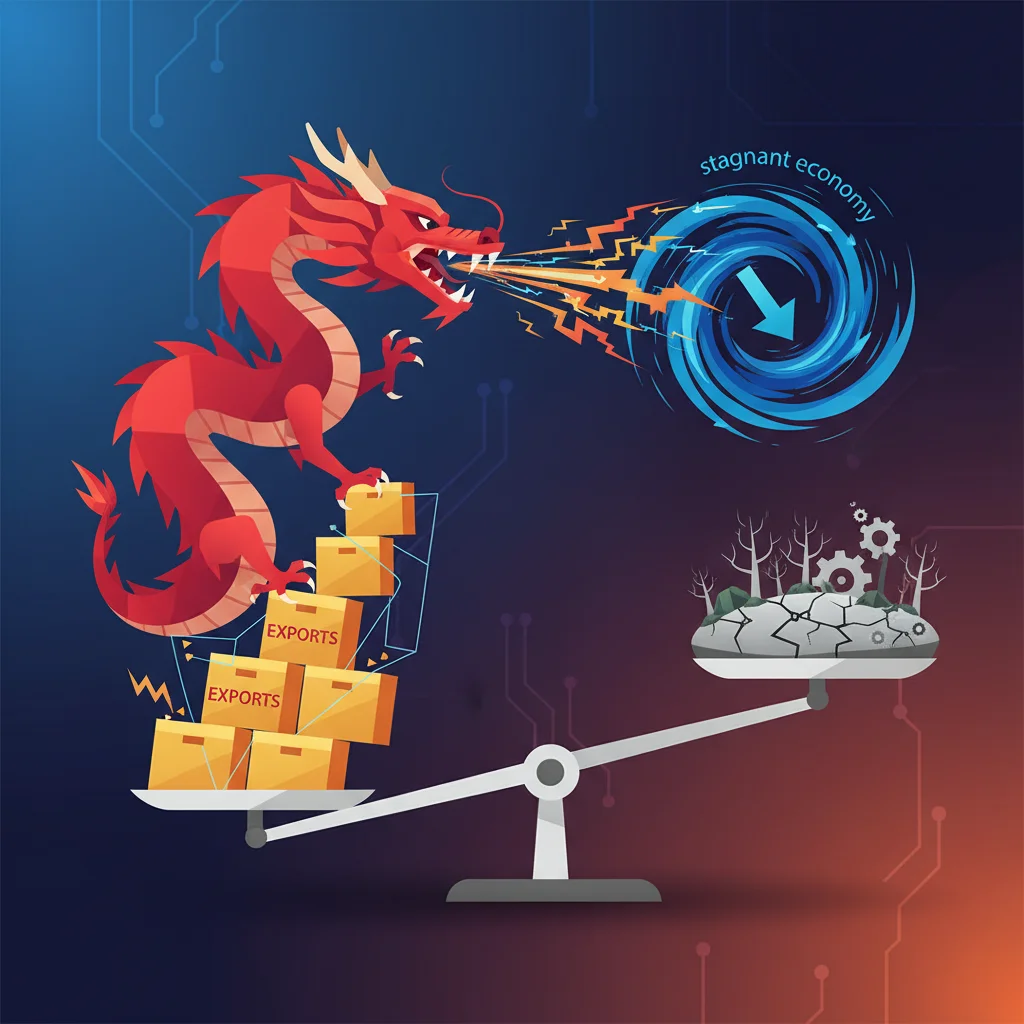
The conventional economic prescription would be to stimulate domestic consumption—put more money into the pockets of citizens to encourage spending. However, Beijing has shown a clear reluctance to pursue large-scale consumer stimulus. Instead, it is reverting to a familiar, state-controlled strategy: channeling massive investment into manufacturing to produce goods for the rest of the world. The logic appears to be: if Chinese consumers won’t buy, someone else will. This has pushed China’s investment as a share of GDP to around 44 percent, a figure extraordinarily high for a major economy and a sign of a profound internal imbalance.
Canned Cocktails, Canned Profits? The Beverage Industry's High-Stakes Bet on Ready-to-Drink
The “New Three”: Upgrading the Export Engine
This new export drive is not about cheap textiles and toys. China is aiming squarely at the industries of the future. The government is directing enormous state-backed capital and subsidies into what it calls the “new three”: electric vehicles (EVs), lithium-ion batteries, and solar panels. This represents a strategic pivot from low-cost manufacturing to high-value, technology-intensive industries where China believes it can establish unassailable dominance.
The results are already staggering. In 2023, exports of these “new three” products surpassed Rmb1tn ($140bn) for the first time, a clear indicator of the strategy’s initial success (source). By flooding the global market with affordable, high-quality green technology, China aims to solve its overcapacity problem while simultaneously achieving its geopolitical goal of becoming a leader in the next industrial revolution.
To better understand this strategic shift, consider the evolution of China’s export focus:
| Aspect | Old Export Model (c. 1990-2010) | New Export Model (c. 2020-Present) |
|---|---|---|
| Primary Sectors | Textiles, apparel, furniture, toys, basic electronics assembly | Electric Vehicles (EVs), lithium-ion batteries, solar panels, advanced semiconductors |
| Key Advantage | Low-cost labor | Massive state subsidies, economies of scale, integrated supply chains |
| Technology Level | Low to medium | High-tech, R&D intensive |
| Global Perception | “The world’s factory” for cheap goods | A dominant force in green technology and advanced manufacturing |
| Economic Goal | Job creation and basic economic development | Global market dominance and moving up the value chain |
The Global Backlash: A Collision Course with the West
China’s strategy is not happening in a vacuum. Leaders in Washington and Brussels are watching with growing alarm. They see a tsunami of state-subsidized goods heading their way, threatening to decimate their own strategic industries, particularly in the automotive and green energy sectors. The fear is that China is not just exporting EVs and solar panels; it’s exporting its deflation and unemployment problems.
The response is already taking shape. The European Commission has launched an anti-subsidy investigation into Chinese EVs, which could result in punitive tariffs. In the U.S., officials are considering raising tariffs on a range of Chinese goods, extending the trade war that began under the previous administration. As one analyst noted, allowing this flood of goods to continue unabated would be “politically suicidal” for Western leaders (source).
This sets the stage for a dangerous escalation in trade tensions. The global trading system, already fragile, could fracture further. For businesses, this means increased uncertainty, supply chain disruptions, and the rising cost of geopolitical risk. The era of frictionless globalization that defined the past three decades appears to be definitively over, replaced by a new paradigm of strategic competition and economic nationalism.
Beyond the Ticker: Why Investors Must Understand the 'Groyper' Phenomenon
An Investor’s Guide to Navigating China’s Gambit
For those involved in investing and finance, this complex situation presents both immense risks and niche opportunities. A one-size-fits-all approach to the Chinese market is no longer viable. Here’s how to think about the landscape:
- Risk for Western Industrials: Companies in the automotive, solar, and battery sectors in Europe and North America are in the direct line of fire. The pressure on their margins and market share will be intense. Investors in these sectors should brace for volatility and closely monitor the stock market for signs of competitive strain.
- Opportunity in Chinese Tech Leaders: For investors with a high-risk tolerance, the Chinese companies leading this export charge (like BYD in EVs or CATL in batteries) are receiving the full backing of the state. While they face geopolitical headwinds, their scale and cost advantages are formidable. However, the threat of foreign tariffs remains a significant and unpredictable risk.
- The Supply Chain Ecosystem: Beyond the headline industries, opportunities exist in the enabling infrastructure. Think about global shipping and logistics companies that will transport these goods, or the commodity producers supplying the raw materials like lithium and cobalt. The world of financial technology and cross-border payment systems will also be crucial in facilitating this new wave of trade. Innovations in blockchain could even play a role in providing transparency and security to these increasingly scrutinized supply chains.
- The Domestic Consumption Story (or Lack Thereof): The biggest red flag for the Chinese economy remains its weak domestic consumer. Any company, foreign or domestic, that relies on the Chinese middle class for growth faces a challenging environment. This strategy of prioritizing production over consumption signals that a near-term rebound in consumer-facing sectors is unlikely.
Ultimately, navigating this requires a nuanced understanding of economics and geopolitics. The key is to distinguish between the sectors China is championing for export and those reliant on a domestic recovery that may not materialize soon.
Political Fault Lines & Market Tremors: Why Investors Can't Ignore America's Partisan Divide
Conclusion: An Unbalanced World
China stands at a critical juncture. By choosing to address its deep-seated economic imbalances with an even greater reliance on the global market, it is embarking on a path fraught with peril. This strategy effectively makes the world’s trade imbalances—specifically China’s massive surplus and the West’s corresponding deficit—the central battleground of international economics.
The success of this plan depends entirely on the world’s willingness to absorb its massive industrial output. With protectionist sentiment rising globally, that is anything but guaranteed. For investors, businesses, and governments worldwide, the message is clear: brace for impact. China’s solution to its internal problems is about to become a global challenge, and the shockwaves will reshape the landscape of international finance and trade for the next decade.