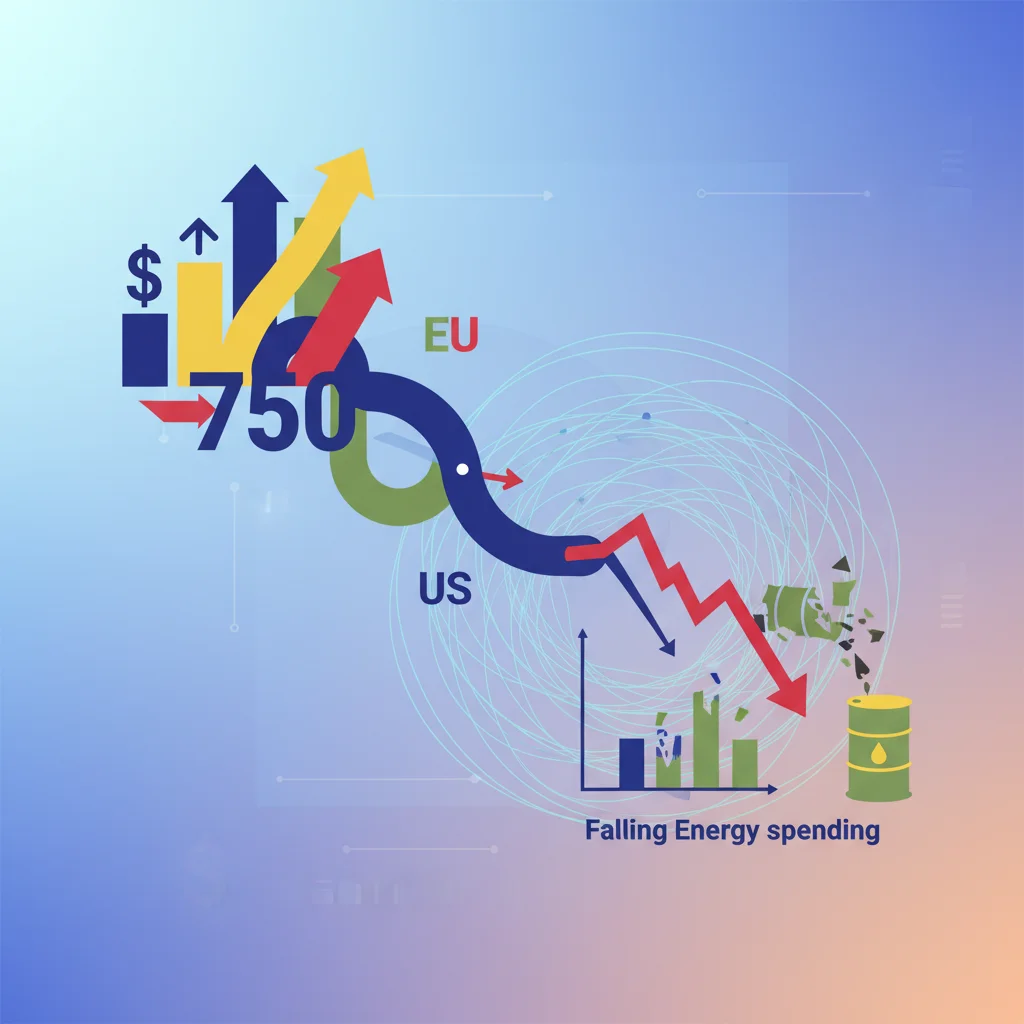
The $750 Billion Paradox: Why a Landmark US-EU Trade Deal Saw Energy Spending Fall
The Surprising Downturn: Unpacking the EU’s Reduced Spending on US Energy
In the high-stakes world of international trade and finance, landmark deals are announced with fanfare, promising to reshape economic landscapes and bolster strategic partnerships. One such agreement was the ambitious $750 billion trade deal brokered by the Trump administration, designed to significantly increase the European Union’s procurement of American goods, particularly in the energy sector. The expectation was clear: a surge in US oil and gas exports to the continent. However, the reality that unfolded was a lesson in the complex interplay of politics, market forces, and global events. In a surprising twist, EU member states’ spending on US oil and gas actually fell by 7 per cent in the four months following the deal’s announcement.
This counterintuitive outcome raises critical questions for investors, policymakers, and business leaders. Was the deal flawed from the start? Were there more powerful economic currents at play? Or does this reveal a deeper truth about the limits of political agreements in the face of an unpredictable global economy? This analysis will delve into the context of the trade deal, dissect the potential reasons behind the spending decline, and explore the lasting implications for the transatlantic energy relationship and the broader financial markets.
A Deal Forged in Tension: The Backstory of the Transatlantic Agreement
To understand why the results defied expectations, we must first revisit the climate in which the deal was made. The years leading up to the agreement were characterized by escalating trade tensions between the United States and the European Union. The Trump administration had imposed tariffs on European steel and aluminum, prompting retaliatory measures from Brussels. The threat of further tariffs on European automobiles loomed large, creating significant uncertainty for a cornerstone of the European economy.
The deal was framed as a de-escalation, a “Phase One” agreement intended to rebalance trade and avert a full-blown trade war. A key component was a commitment from the EU to purchase more American products, with a heavy emphasis on liquefied natural gas (LNG) and crude oil. For the US, this was a strategic move to bolster its burgeoning energy export industry and reduce its trade deficit. For the EU, it was a way to appease Washington and protect its vital industries from punitive tariffs. Yet, as the data shows, a political commitment does not always translate directly into market action. India's "Goldilocks" Moment: Why the RBI is Keeping Rates Low and What It Means for Your Investments
Deconstructing the 7% Decline: Market Realities vs. Political Ambitions
A 7% drop in spending, though seemingly modest, is significant when it directly contradicts the primary objective of a multi-billion dollar agreement. The decline wasn’t due to a single, isolated factor but rather a confluence of powerful forces that overshadowed the political pact. Let’s examine the key drivers.
1. The Unforgiving Logic of Global Energy Markets
At its core, the energy sector is a global commodity market driven by price, supply, and demand. While long-term contracts and political alliances play a role, buyers will almost always gravitate toward the most economically viable option. During the period following the deal, global energy markets were in flux. Competing suppliers, such as Qatar and, at the time, Russia, may have offered more competitive pricing or more favorable delivery terms for LNG.
Below is a simplified look at the factors that influence a nation’s energy purchasing decisions, illustrating how a trade deal is just one piece of a much larger puzzle.
| Influencing Factor | Description | Impact on US-EU Deal |
|---|---|---|
| Global Spot Prices | The real-time price of commodities like LNG and crude oil on the open market. | If US energy was priced higher than alternatives, EU buyers would naturally purchase less, regardless of political agreements. |
| Shipping & Logistics Costs | The cost to transport energy across the Atlantic. This includes freight rates and insurance. | Higher transatlantic shipping costs could make US energy less competitive compared to sources closer to Europe. |
| Existing Long-Term Contracts | Many utility companies and nations have binding, multi-year contracts with suppliers. | These pre-existing agreements could have limited the capacity for EU nations to immediately pivot to purchasing more US energy. |
| Geopolitical Stability | The perceived reliability of a supplier nation. | While the US is a stable partner, the EU has always pursued a strategy of diversifying its energy sources to avoid over-reliance. |
2. The Onset of a Global Pandemic
Perhaps the most significant external shock was the emergence of the COVID-19 pandemic. The timeline of the spending decline coincides directly with the initial global lockdowns. This unprecedented event triggered a historic collapse in global energy demand. Factories shut down, air travel ground to a halt, and economic activity plummeted. According to the International Energy Agency (IEA), global oil demand saw its largest-ever drop in 2020. In this environment of demand destruction, it’s logical that the EU, like the rest of the world, would reduce its overall energy procurement, impacting imports from all partners, including the United States.
3. The EU’s Strategic Imperative: Diversification
For decades, a central pillar of the EU’s energy policy has been security through diversification. The goal is to avoid becoming overly dependent on a single supplier, a lesson learned through years of reliance on Russian gas. Even with a friendly trade deal in place with the US, the fundamental strategy of maintaining a diverse portfolio of energy suppliers would not be abandoned. The deal may have been seen as an opportunity to strengthen one partnership, but not at the expense of abandoning others entirely. This long-term strategic thinking often outweighs short-term political pressures.
The 0 Billion Gambit: Decoding Amazon's Potential Megadeal with OpenAI
Implications for Modern Investing and Financial Strategy
The story of this trade deal offers timeless lessons for those involved in investing, international banking, and corporate strategy. It highlights the inherent risks of basing financial decisions solely on top-down political mandates.
The Primacy of Economic Fundamentals
The most enduring lesson is that market fundamentals ultimately prevail. For those engaged in commodity trading or investing in energy stocks, this episode reinforces the need to focus on production costs, global demand forecasts, and competitive landscapes. A government’s stated intention to buy more of a product is a weak investment thesis if the underlying economics don’t support it. The use of sophisticated financial technology and data analytics is crucial for cutting through the political noise and modeling these complex market dynamics accurately.
Geopolitical Risk is a Two-Way Street
Often, investors think of geopolitical risk as the danger of conflict or instability disrupting supply. However, this case shows that geopolitical *agreements* can also introduce a unique form of risk—the risk of non-performance or underperformance. The hype surrounding a deal can create inflated expectations that the market cannot sustain. A prudent approach involves stress-testing investment portfolios against both negative geopolitical events and the failure of positive political initiatives to materialize as planned. The data from the Financial Times report is a stark reminder of this reality.
The Evolving Role of Technology in Trade
Modern international trade is increasingly shaped by fintech. From digital platforms that streamline trade finance to blockchain technologies that offer transparent and immutable tracking of commodity supply chains, technology is reducing friction and increasing efficiency. While not a direct factor in this specific outcome, the continued integration of such technologies will make future trade flows more transparent and data-driven, potentially giving market participants a clearer, real-time view of how political deals are translating (or not translating) into actual physical transactions. The 8 Billion Rejection: Why Warner Bros. Is Slamming the Door on Paramount's Mega-Merger
Conclusion: A Lesson in Complexity
The paradox of the $750 billion US-EU trade deal is a powerful reminder that the global economy is not a simple machine where political levers produce guaranteed results. The 7% decline in EU spending on US energy, rather than being an indictment of the deal itself, was a reflection of a world governed by a web of interconnected forces: commodity pricing, logistical realities, overarching strategic doctrines, and unpredictable global shocks. For those navigating the worlds of finance and investing, the story is a masterclass in the importance of critical analysis, fundamental research, and a healthy skepticism of grand political promises. The most successful strategies are not built on the shifting sands of political rhetoric, but on the solid bedrock of economic reality.

Related Posts

The New Digital Iron Curtain: Why a US Visa Ban on Tech Critics is a Major Red Flag for Global Investors

The H-1B Overhaul: How a New Visa Rule Will Reshape the US Economy and Your Investment Strategy