Economic Symphony or Financial Cacophony? Decoding the Fed’s High-Stakes Performance
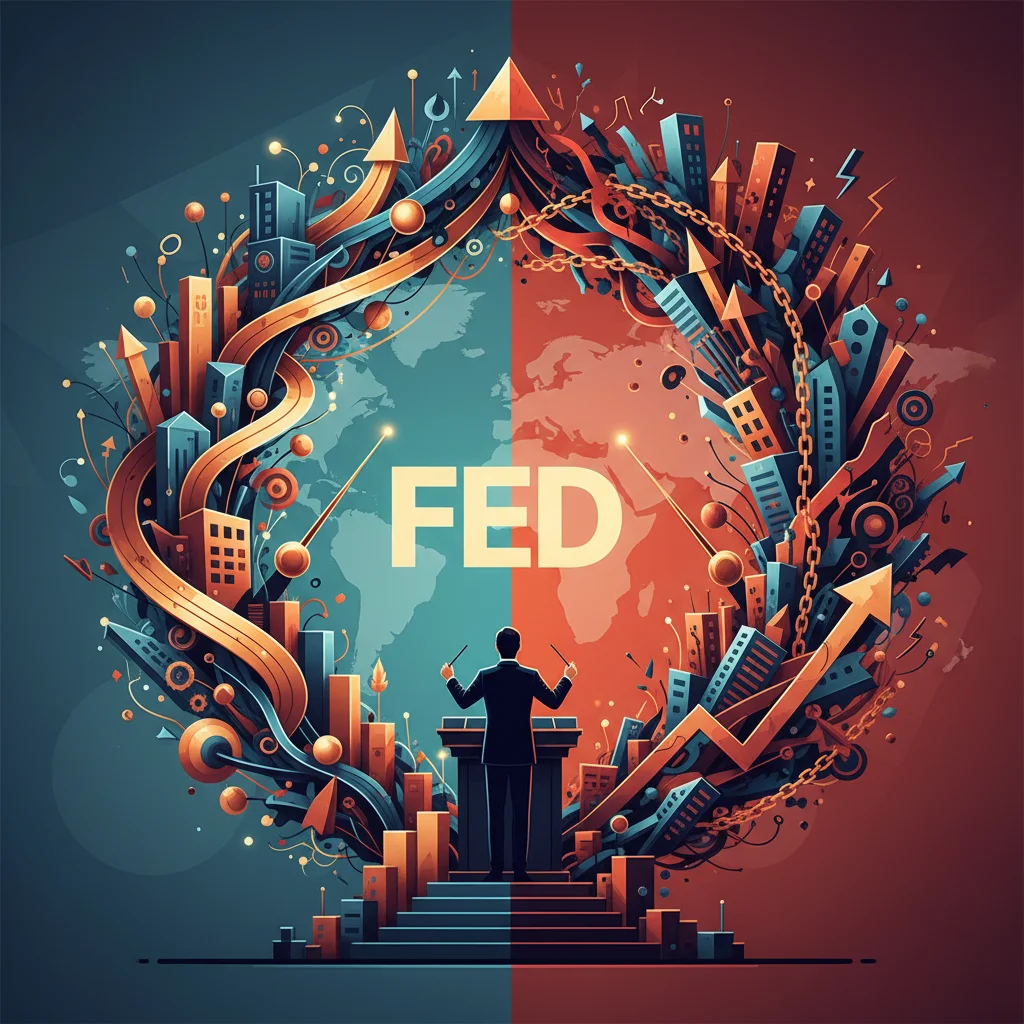
In the grand theater of the global economy, the United States often takes center stage. Its performance is a complex symphony, with each sector playing a crucial part. At the podium stands the conductor, the U.S. Federal Reserve, tasked with guiding this intricate orchestra through a delicate score. A recent letter to the Financial Times by Thomas Flannigan vividly captures the current tension of this performance, describing a scene where the conductor attempts to slow the tempo, yet the orchestra plays on, creating a “cacophony” that leaves the audience—investors, business leaders, and the public—on edge. Is the Fed’s monetary policy a masterfully conducted symphony heading towards a harmonious finale, or are we witnessing a loss of control that could end in a jarring crash?
This powerful metaphor perfectly encapsulates the high-stakes drama unfolding in American economics today. The Fed, led by its conductor Jerome Powell, has been wielding its primary instrument—interest rates—with vigor to combat the persistent roar of inflation. Yet, the resilience of the American economy has been nothing short of astonishing, creating a dissonant soundscape where policy and reality seem out of sync. This post will deconstruct this economic symphony, examining the conductor’s strategy, the orchestra’s surprising performance, and what it all means for your investments, your business, and the future of finance.
The Conductor’s Baton: Understanding the Federal Reserve’s Strategy
To appreciate the current drama, one must first understand the conductor’s sheet music: the Federal Reserve’s dual mandate. By law, the Fed is tasked with achieving two primary goals: maximum employment and stable prices. For years following the 2008 financial crisis, the focus was squarely on bolstering employment. But when inflation surged to 40-year highs post-pandemic, the spotlight shifted dramatically to price stability.
The Fed’s primary tool for this task is the federal funds rate, the overnight interest rate at which banks lend to one another. Raising this rate is akin to the conductor slowing the tempo of the music. It increases the cost of borrowing across the entire economy, from mortgages and car loans to corporate debt and business investment. The theory is simple: higher borrowing costs should cool demand, slow economic activity, and ultimately, bring inflation back down to the target 2%. Since March 2022, the Fed has executed one of the most aggressive rate-hiking cycles in its history, lifting the federal funds rate from near-zero to a range of 5.25% to 5.50% (source), a level unseen in over two decades.
Alongside rate hikes, the Fed has been employing another, more subtle tool: Quantitative Tightening (QT). This involves reducing the size of its massive balance sheet by letting the bonds it purchased during the pandemic mature without reinvesting the proceeds. In musical terms, this is like removing some instruments from the stage, reducing the overall volume and liquidity in the financial system. This two-pronged approach represents a powerful effort to rein in an overheated economy.
The Orchestra’s Defiant Performance: A Sector-by-Sector Breakdown
Despite the conductor’s clear signals to slow down, many sections of the economic orchestra have continued to play at a brisk pace. This defiance is the source of the “cacophony” and the core of the market’s uncertainty.
Below is a look at how different economic sectors are responding to the Fed’s tightening measures.
| Orchestra Section (Economic Sector) | Metaphorical Role | Real-World Performance Analysis |
|---|---|---|
| Housing Market | The Heavy Percussion | This is one of the few sections that has clearly heard the conductor. The “percussion of hammers building new homes,” as Flannigan wrote, has quieted. Average 30-year mortgage rates have soared, pricing many buyers out of the market and slowing construction. However, a persistent lack of inventory has kept prices stubbornly high. |
| Labor Market | The Unrelenting Rhythm | The rhythm section has been the most defiant. Despite high interest rates, the U.S. has continued to add jobs at a robust pace, with the unemployment rate remaining near historic lows. According to the Bureau of Labor Statistics, wage growth has also remained strong, providing consumers with the purchasing power to keep spending. This strength is a double-edged sword: it prevents a deep recession but also fuels the inflationary pressures the Fed is trying to fight. |
| Manufacturing & Industry | The Brassy Horns | The “brassy horns of industry” have given a mixed performance. Manufacturing has shown signs of contraction, as measured by indicators like the ISM Manufacturing PMI. Higher borrowing costs make it more expensive for companies to invest in new equipment and expand operations. Yet, sectors tied to government initiatives and reshoring trends have shown resilience. |
| Technology & Fintech | The Modern Synthesizers | The high-growth tech sector, including innovative areas of fintech and blockchain, has been particularly sensitive to the new tempo. The era of cheap money that fueled venture capital and speculative growth is over. This has led to layoffs and a renewed focus on profitability over growth-at-all-costs. However, transformative technologies continue to drive productivity, adding a complex layer to the economic score. |
The Paranormal Activity of the Market: What Horror Theater Reveals About Unseen Financial Risks
The Audience’s Anxiety: What This Means for Your Portfolio and Business
The dissonance between the Fed’s intentions and the economy’s performance has created a palpable sense of anxiety in the audience. For investors and business leaders, navigating this environment requires a shift in strategy and a keen ear for changes in the music.
For Investors: Navigating the Volatile Stock Market
The current climate challenges traditional investing playbooks. The “TINA” (There Is No Alternative) era, where low rates pushed everyone into the stock market, is over. Now, cash and short-term bonds offer attractive, lower-risk yields.
- Asset Allocation: A diversified portfolio is more critical than ever. The uncertainty calls for a balance between equities, fixed income, and alternative assets.
- Sector Selection: Companies with strong balance sheets, consistent cash flow, and pricing power (the ability to pass on costs to consumers) are better positioned to weather economic turbulence.
- Trading and Volatility: The “cacophony” translates directly to market volatility. Short-term trading strategies may capitalize on these swings, but long-term investors should remain focused on fundamental value rather than reacting to every note of economic data.
For Business Leaders: The Rising Cost of Capital
For businesses, the conductor’s slow-down directly impacts the bottom line. The cost of capital—for expansion, for R&D, for managing cash flow—has risen dramatically.
- Financial Discipline: A focus on operational efficiency, cost management, and robust balance sheets is paramount.
- Strategic Investment: Decisions to invest in new projects or financial technology must be scrutinized more carefully, with a clear line of sight to profitability.
- Forecasting: The economic uncertainty makes forecasting demand and revenue exceptionally difficult. Businesses must build flexibility and resilience into their strategic plans.
The Billion Media War: Analyzing the Financial Shockwaves of Trump's Lawsuit Against the BBC
The Final Cadence: Soft Landing, Hard Landing, or Lingering Dissonance?
As the performance continues, the audience waits to see how it will end. Economists and market analysts are debating three potential finales.
- The Soft Landing: This is the ideal, harmonious resolution. In this scenario, the Fed’s policies successfully cool inflation back to its 2% target without causing a significant economic downturn. The orchestra slows to a sustainable tempo, and the performance ends with applause. This outcome has historically been very difficult to achieve.
- The Hard Landing (Recession): This is the feared jarring crash. The Fed’s aggressive tightening overcorrects, choking off economic growth and sending the U.S. into a recession. The music stops abruptly, marked by widespread job losses and a sharp decline in corporate profits.
- Stagflation: This is perhaps the most frustrating outcome—a lingering, unresolved dissonance. Inflation remains stubbornly above target while economic growth stagnates or declines. This “stuck” scenario poses a significant challenge for both policymakers and investors, as the tools to fight inflation (raising rates) would worsen the growth problem. A letter writer in the FT captured this anxiety perfectly, questioning if the performance is about to end badly.
The Federal Reserve maintains that its decisions remain “data-dependent.” Every new inflation report, every jobs number, and every consumer spending survey is a note of music that the conductor must interpret in real time, adjusting the tempo as needed. The path forward is not pre-written; it is being composed as we listen.
The Atlantic Divide: Why a Landmark US-UK Tech Deal is on Ice and What it Means for Your Investments
Conclusion: The Unwritten Finale
The metaphor of the U.S. economy as an orchestra under the Fed’s direction is more than just a clever analogy; it is a profound framework for understanding the complex interplay of policy, data, and human behavior that shapes our financial lives. The current “cacophony” is not necessarily a sign of failure, but rather a reflection of an economy of unprecedented complexity, one that is not responding to the conductor’s baton in predictable ways.
For those of us in the audience—as investors, leaders, and citizens—the key is not to panic at the dissonant chords but to listen closely. By understanding the forces at play within each section of the orchestra and paying attention to the conductor’s strategy, we can better position ourselves for whatever the final cadence may be. The symphony is still in progress, and the most important notes are yet to be played.