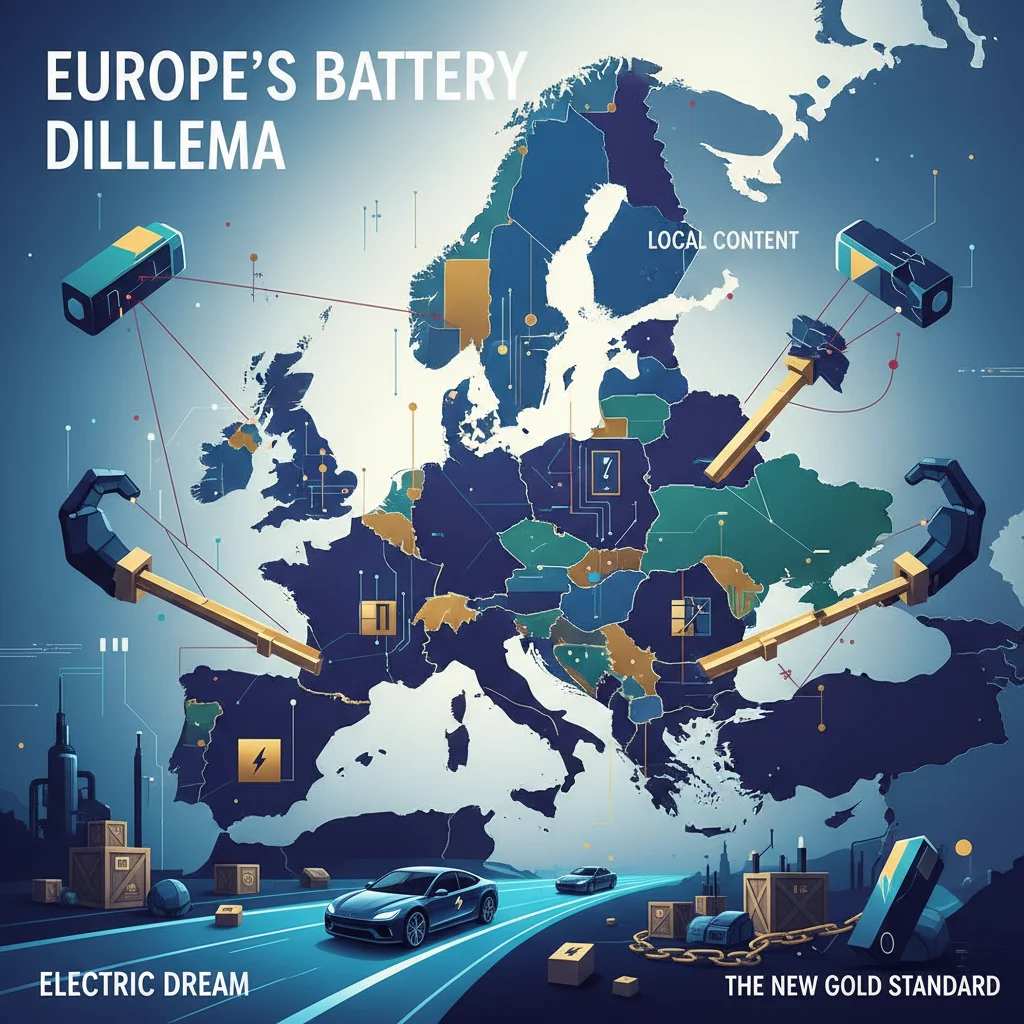
Europe’s Trillion-Dollar Battery Dilemma: Why Local Content is the New Gold Standard
The Electric Dream vs. The Supply Chain Nightmare
The electric vehicle (EV) revolution is accelerating, promising a future of silent, clean, and technologically advanced mobility. For Europe, a continent that prides itself on automotive excellence, this transition represents both a monumental opportunity and a terrifying vulnerability. While European carmakers are designing the EVs of tomorrow, a critical component—the battery—is largely being forged elsewhere. This dependency, primarily on China, has created a precarious situation that threatens to undermine the continent’s industrial sovereignty and its entire economic future. Now, industry titans are sounding the alarm, issuing a stark ultimatum: Europe must implement robust local content rules for its battery plants, or risk being left in the dust of a global technology race.
At the heart of this issue is a simple but profound economic and geopolitical reality. The battery is the single most valuable component of an EV, and the nation that controls its supply chain controls the future of mobility. Currently, China dominates every stage of this chain, from mining and refining critical minerals to manufacturing the finished cells. This has put European manufacturers in a difficult position, forcing them to rely on a complex and politically sensitive global supply chain. The call for local content rules is not mere protectionism; it’s a strategic imperative for survival, a move designed to re-shore critical manufacturing, spur innovation, and secure Europe’s place in the new world of green technology.
The Brussels Effect in Reverse: Is Europe's Regulatory Empire Stifling Its Own Economy?
The American Jolt: Learning from the Inflation Reduction Act
To understand the urgency in Europe, one need only look across the Atlantic. The United States, through its landmark Inflation Reduction Act (IRA), has fired a powerful starting gun in the race for green-tech supremacy. The IRA isn’t just a climate bill; it’s a formidable piece of industrial policy that uses a “carrot-and-stick” approach to build a domestic EV and battery supply chain. It offers generous tax credits to consumers who buy EVs, but only if those vehicles and their batteries meet stringent requirements for North American assembly and sourcing.
This policy has sent shockwaves through the global automotive and finance industries, effectively creating a powerful magnet for investment in the US. Companies are now scrambling to build factories on American soil to qualify for these lucrative incentives. European leaders, including Peter Carlsson, chief executive of Swedish battery maker Northvolt, and Benoit Lemaignan, co-founder of France’s Verkor, have watched this unfold with a mixture of admiration and alarm. They argue that Europe’s current approach, which relies on more complex subsidy schemes, is simply not enough to compete. The IRA’s clarity and power have set a new benchmark, forcing Europe to reconsider its own strategy for attracting and retaining critical investment in its burgeoning battery economy.
Below is a simplified comparison highlighting the strategic differences between the US and current EU approaches, which underscores the European industry’s call for a more decisive policy.
| Policy Feature | US Inflation Reduction Act (IRA) | Current European Union Approach |
|---|---|---|
| Primary Mechanism | Demand-side incentives (consumer tax credits) tied to strict local content rules. | Supply-side incentives (state aid, grants, loans) on a project-by-project basis. |
| Clarity & Simplicity | High. Clear, percentage-based rules for sourcing and assembly. | Lower. Complex approval processes (e.g., Important Projects of Common European Interest – IPCEI). |
| Market Impact | Immediately reshapes investment decisions, pulling capital into the US. | Slower to take effect, creating uncertainty for long-term investment planning. |
| Core Philosophy | Strategic protectionism to build a secure, domestic supply chain. | A blend of free-market principles with targeted strategic support. |
A “Made in Europe” Mandate for Survival
The proposal from industry leaders is clear: Europe needs its own version of the IRA’s local content requirements. This would mean that for an electric vehicle to be eligible for subsidies or to be sold without tariffs within the EU, a certain percentage of its battery components—from the refined minerals to the finished cell—must be sourced from within the region. According to Benoit Lemaignan of Verkor, this is vital “to give visibility” to investors and justify the massive capital expenditure required to build a European supply chain from the ground up (source). Without this guaranteed demand, the financial case for building refineries and component factories in high-cost Europe becomes much harder to make, especially when competing with state-subsidized rivals.
This isn’t just about competing with the US; it’s primarily about leveling the playing field with China. European battery start-ups face a daunting challenge: competing against established Chinese giants who benefit from lower costs, massive economies of scale, and significant government support. A local content rule would act as a market-shaping mechanism, creating a protected, premium market for European-made batteries. This would provide the revenue certainty needed to attract billions in private finance and unlock the full potential of Europe’s technology and engineering prowess. The banking sector would see a surge in demand for project financing, and the entire ecosystem of financial technology could be leveraged to streamline investment and manage supply chain transparency, perhaps even using blockchain for certifying the origin of materials.
The Financial Calculus: Investing in Europe’s Industrial Future
The transition to a localized battery supply chain is one of the most significant investment opportunities of our time, but it’s also laden with risk. The economics are staggering; building a single gigafactory can cost billions of euros. Scaling this across the continent will require an unprecedented mobilization of both public and private capital.
From an investing perspective, local content rules would de-risk these massive bets. By creating a predictable and protected market, such a policy would improve the financial models for new factories, making them more attractive to institutional investors, venture capital, and the public stock market. Companies like Northvolt, Verkor, and others in the European battery ecosystem could see their valuations soar as their path to profitability becomes clearer. For finance professionals, the key will be to identify the companies best positioned to capitalize on this policy shift, from raw material processors to cell manufacturers and recycling specialists.
The role of banking and financial technology will be crucial. Traditional project finance will be essential, but innovative fintech solutions can also play a part. Crowdfunding platforms for green projects, specialized ESG investment funds, and digital tools for managing the complex financing of these mega-projects will all be in high demand. The ultimate goal is to create a seamless flow of capital from investors to innovators, accelerating the build-out of this critical infrastructure.
From a macroeconomic standpoint, the benefits are clear, but so are the costs. On the one hand, a robust local supply chain would create hundreds of thousands of high-skilled jobs, reduce Europe’s trade deficit, and enhance its economic resilience. On the other hand, it could lead to higher battery and EV prices for consumers in the short term, potentially slowing adoption rates. This is the classic trade-off that sits at the heart of modern economics: balancing long-term strategic security against short-term market efficiency. According to one estimate, Europe needs to invest €40bn annually to meet its 2030 battery production targets, a figure that highlights the sheer scale of the financial challenge ahead.
The Swiss Paradox: How a Record M&A Boom is Defying Economic Gravity
The Road Ahead: A Charged Path Forward
Implementing local content rules is not a silver bullet. Europe faces significant hurdles in its quest for battery independence. The continent has a deficit of raw material mining and, more critically, refining capacity. Building these facilities is a capital-intensive and time-consuming process, often facing regulatory and environmental opposition. Furthermore, European producers must still find a way to compete on technology and cost with global leaders who have a decade-long head start.
However, the opportunity is too great to ignore. By creating a secure domestic market, Europe can foster a complete ecosystem, from research and development to recycling. This “battery passport” concept, which tracks the environmental footprint and origin of every battery, could become a new global standard, allowing Europe to compete not just on price, but on sustainability and quality—a powerful advantage in an increasingly ESG-conscious market.
For investors, business leaders, and policymakers, the message is clear. The global economic landscape is shifting from open markets to strategic competition. The race for the future of mobility will be won by the region that can build the most secure, resilient, and innovative supply chain. Europe has the technological know-how, the industrial base, and the political will. The question now is whether it can implement the bold policies, like local content rules, needed to turn its electric dream into a reality.

Related Posts

Europe’s High-Stakes Gamble: The Franco-German Clash Over Russian Assets Threatens Global Finance

High Seas Standoff: How a US Intercept of Venezuelan Oil Shakes Global Finance and Your Portfolio