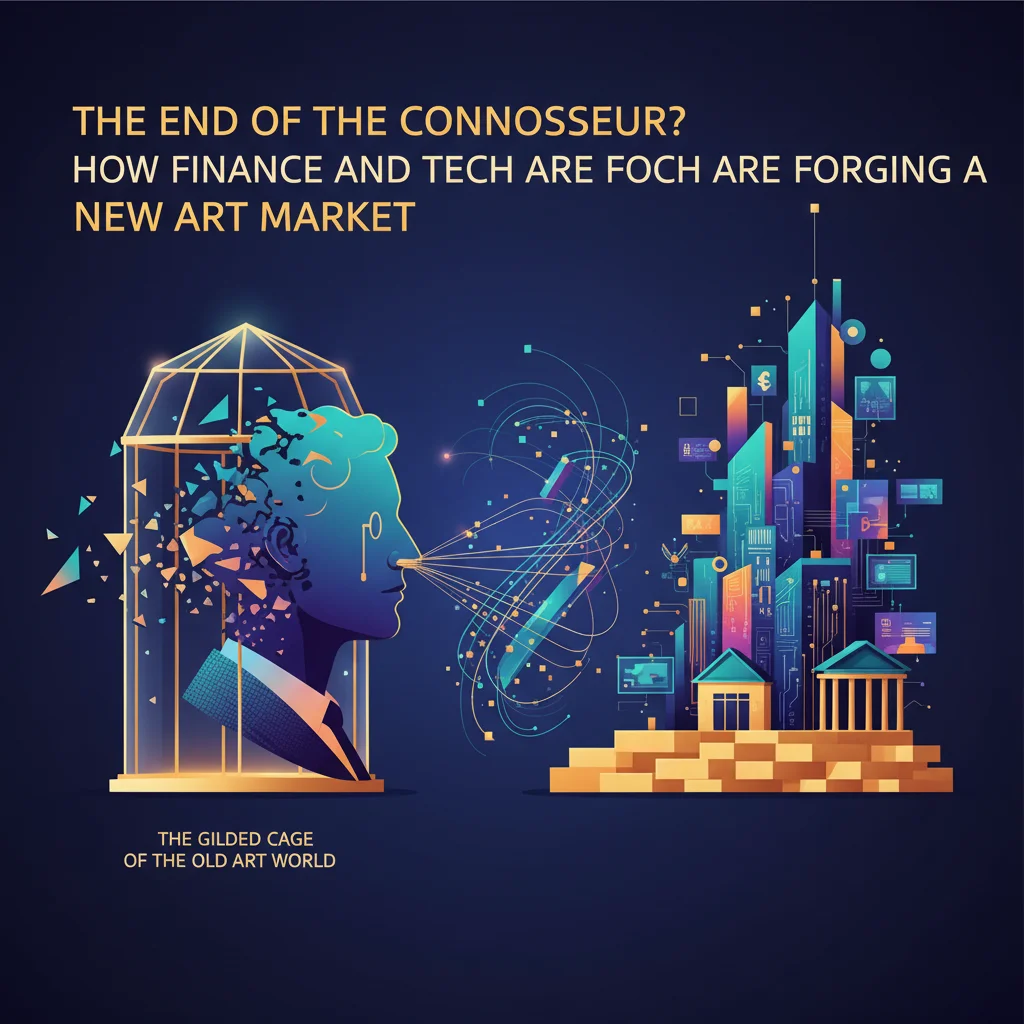
The End of the Connoisseur? How Finance and Tech Are Forging a New Art Market
The Gilded Cage of the Old Art World
There exists a romantic, almost cinematic, vision of the old art world. We picture dimly lit, wood-paneled galleries where a tweed-clad connoisseur, peering through a monocle, pronounces a canvas a “masterpiece” with a quiet, unassailable authority. In this nostalgic view, art was about pure aesthetic judgment, untainted by the vulgarities of commerce. It was a world of taste, not of trading; of beauty, not of balance sheets.
But how accurate is this picture? In a compelling letter to the Financial Times, esteemed art historian and dealer Clovis Whitfield argues that this nostalgia is deeply misplaced. He suggests that the so-called “golden age” of connoisseurship was, in reality, an opaque and often arbitrary system. “The idea that the judgment of a few so-called connoisseurs was a better guide to what was important in the visual arts than the present, more financially oriented one, is a complete myth,” Whitfield asserts. This old guard, he implies, operated within a closed loop, their pronouncements shaping the market in ways that were unaccountable and inaccessible to outsiders.
This critique opens a fascinating door into the evolution of a multi-billion dollar market. The shift from a world ruled by the subjective tastes of a few to one driven by the objective data of global finance is not just a story about art; it’s a story about the democratization of markets, the power of technology, and the changing nature of investing itself. The modern art market, for all its high-flying auction prices, may be more transparent and equitable than ever before, mirroring transformations seen across the entire financial economy.
From Salon to Stock Exchange: The Rise of Art as an Asset Class
The transformation of the art market didn’t happen in a vacuum. It is a direct consequence of a broader shift in the global economy and investment strategy. Over the past few decades, as traditional asset classes like stocks and bonds have become more correlated, savvy investors and financial institutions began looking for new avenues for diversification and growth. Art, once the exclusive domain of passionate collectors, emerged as a compelling alternative asset.
This wasn’t simply about wealthy patrons buying paintings they liked. It was a calculated move into an asset class with unique properties:
- Inflation Hedge: Tangible assets like art often hold their value, or even appreciate, during periods of high inflation when currency values decline.
- Low Correlation: The art market’s performance is not always directly tied to the fluctuations of the stock market, making it an excellent tool for portfolio diversification.
- Value Storage: A masterpiece can serve as a highly concentrated and portable store of immense wealth.
This pivot from aesthetic object to financial instrument brought the language and rigor of Wall Street into the auction house. The global art market reached an estimated $67.8 billion in 2022, demonstrating its significant economic footprint. This new paradigm demanded a new set of rules and a new kind of expert. Subjective “good taste” was no longer enough; investors required data, analytics, and verifiable provenance—the very things the old system lacked.
Below is a comparison highlighting the fundamental differences between the traditional and modern art market paradigms:
| Characteristic | The Connoisseur Era (Pre-1980s) | The Investor Era (Modern Day) |
|---|---|---|
| Primary Valuation Driver | Subjective aesthetic judgment by a few experts | Market data, artist’s track record, provenance, comparable sales |
| Market Transparency | Low; based on private sales and insider knowledge | High; public auction records, art market indices, data analytics platforms |
| Key Players | Elite collectors, dealers, museum curators | Hedge funds, family offices, art investment funds, fractional investors |
| Barriers to Entry | Extremely high; required social connections and deep capital | Lowering; fractional ownership, online auctions, accessible data |
| Core Language | Art history, aesthetics, “the eye” | ROI, alpha, diversification, risk management |
The £1,000 Ski Trip: How Currency Headwinds are Reshaping European Travel and Investment
Fintech at the Forefront: How Technology is Revolutionizing Art Investing
The most powerful catalyst in this transformation has been financial technology, or fintech. Just as fintech platforms disrupted traditional banking and stock trading, they are now democratizing and securing the art market in ways that were previously unimaginable. This technological wave is building a more transparent, accessible, and efficient ecosystem for art investing.
1. Data Analytics and Market Intelligence
The art world is no longer reliant on hearsay. Companies like Artnet and Artprice function as the Bloomberg Terminals of the art market, providing vast databases of auction results, artist performance charts, and market indices. Investors can now perform quantitative due diligence, analyzing an artist’s price history with the same rigor they would apply to a company’s stock performance. This data-driven approach removes much of the subjectivity and levels the playing field for new entrants.
2. Fractional Ownership Platforms
Perhaps the most revolutionary fintech development is fractionalization. Platforms like Masterworks allow individuals to buy shares in multi-million dollar paintings by artists like Banksy, Warhol, and Basquiat. This model shatters the high-capital barrier to entry, allowing a wider range of investors to add blue-chip art to their portfolios. It effectively turns a single, illiquid masterpiece into a tradable security, introducing a new level of liquidity and accessibility to the market.
3. The Blockchain Revolution: Solving the Provenance Problem
For centuries, the art market’s Achilles’ heel has been provenance—the documented history of a work of art’s ownership. Gaps in provenance can raise questions of authenticity and legal title, creating significant risk for investors. This is where blockchain technology offers a groundbreaking solution. By creating a decentralized, immutable digital ledger, a blockchain can record every transaction, exhibition, and appraisal in a work’s history. According to a 2021 report by Deloitte, 83% of wealth managers cited lack of transparency and authenticity concerns as key obstacles to art investment. Blockchain directly addresses this by providing a “digital passport” for a work of art that is virtually impossible to forge or alter, dramatically increasing trust and security in transactions.
The Chip War's New Frontline: Is Nvidia's H200 a Loophole for China's AI Ambitions?
The New Connoisseur: A Hybrid of Critic and Quant
The evolution of the art market has not made expertise obsolete; it has redefined it. The successful art advisor or investor of today cannot rely solely on a trained eye or a deep knowledge of art history. They must also possess a sophisticated understanding of macroeconomics, portfolio theory, and emerging technologies.
This new breed of expert navigates a world where auction houses employ data scientists and major banks have dedicated art finance divisions. For instance, institutions like UBS and Citi Private Bank have robust art advisory services that help high-net-worth clients manage their art collections as part of a broader wealth strategy. These services merge curatorial knowledge with rigorous financial analysis, advising on everything from acquisitions to using art as collateral for loans—a clear sign of art’s integration into the mainstream finance ecosystem.
The skills required now include:
- Quantitative Analysis: The ability to interpret auction data, understand market trends, and assess an artwork’s value relative to comparable assets.
- Risk Management: Understanding the unique risks of the art market, including authenticity, title, liquidity, and condition.
- Technological Fluency: Familiarity with platforms for fractional ownership, online auctions, and the application of blockchain for provenance verification.
- Art Historical Context: The foundational knowledge of an artist’s significance, their place in art history, and the cultural relevance of their work, which remains a primary long-term value driver.
The Financial Crossword: Deciphering the Most Complex Clues of the Modern Economy
A More Masterful Market
Clovis Whitfield’s critique of the old guard is a powerful reminder that transparency, data, and accessibility are hallmarks of a healthy market, whether it trades in stocks or in sculptures. The romanticized image of the lone connoisseur is being replaced by a more complex and dynamic reality—one where art and finance are inextricably linked. This fusion, powered by fintech, has not debased art but has instead created a more resilient, global, and surprisingly democratic marketplace.
While the staggering prices for top-tier works may seem to suggest a market more exclusive than ever, the underlying technological and financial structures are actually opening doors for a new generation of investors. The journey from an opaque, relationship-driven salon to a transparent, data-driven exchange is a net positive. It has created a market that, while still navigating its own evolution, is ultimately more accountable and robust, ensuring that great art remains a valuable asset—both culturally and financially—for generations to come.