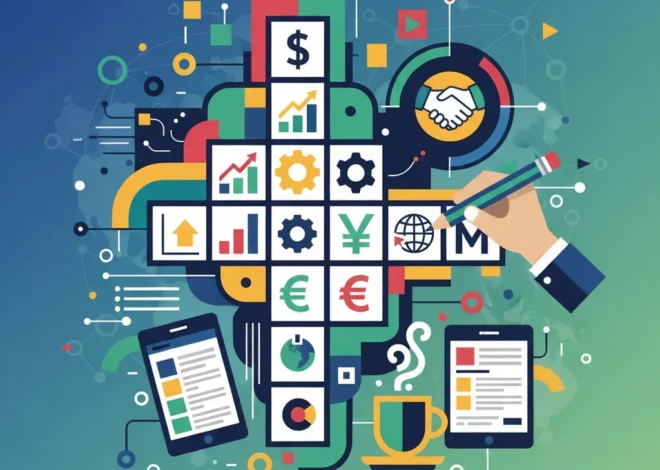
Solving the Puzzle of Modern Finance: Lessons from the Financial Times Crossword
The global economy can often feel like an intricate puzzle, a complex grid of interconnected concepts where a single misstep can unravel an entire strategy. Much like the Financial Times’ Jumbo Crossword, navigating the world of finance, investing, and economics requires a specific vocabulary, a strategic mindset, and the ability to see how individual pieces—from stock market fluctuations to fintech innovations—fit into the bigger picture. It’s a challenge of both knowledge and foresight.
In this analysis, we’ll deconstruct the modern financial landscape by treating it as the ultimate crossword. By exploring the “clues” presented by market trends, technological shifts, and economic policies, we can better understand the “answers” that drive wealth creation and economic stability. Whether you’re a seasoned investor, a business leader, or simply curious about the forces shaping our world, understanding these core concepts is the key to successfully completing the puzzle.
Across the Board: Understanding the Fundamentals of Capital and Investing
At the heart of any financial crossword lies the language of the stock market. These are the foundational terms that form the bedrock of any investment strategy. Consider a classic clue: “Market characterized by falling prices (4 letters).” The answer, of course, is BEAR. This simple word encapsulates a complex environment of investor pessimism, economic contraction, and declining asset values. Conversely, its counterpart, a BULL market, signals optimism and growth.
Understanding this dichotomy is the first step for any participant in the stock market. These trends are not random; they are driven by a confluence of factors including corporate earnings, geopolitical events, and macroeconomic data. For instance, during the uncertainty of early 2020, global markets entered a swift bear market, while the subsequent recovery, fueled by stimulus and technological growth, ushered in a powerful bull run. According to data from S&P Global, the S&P 500 has historically spent more time in bull markets than bear markets, a testament to the long-term growth trajectory of the economy.
Another crucial clue might be: “Funds used to start or grow a business (7 letters).” The answer: CAPITAL. This isn’t just about money; it’s about the lifeblood of the economy. Capital can be categorized in various ways:
- Venture Capital: High-risk funding for startups with high-growth potential.
- Private Equity: Investment in private companies, often to restructure or improve them before an exit.
- Public Equity: Capital raised by selling shares on a public stock exchange.
The efficient allocation of this capital is what fuels innovation and drives economic progress. When investors correctly identify promising ventures, they provide the resources needed for breakthroughs in everything from biotechnology to renewable energy. This process of capital allocation is a cornerstone of modern finance and a key determinant of a nation’s economic dynamism. The Jaffa Cake Principle: What a 1990s Snack Food Dispute Teaches Us About Modern Finance, Fintech, and the Economy
Down the Grid: The Disruptive Force of Financial Technology
As we move deeper into our puzzle, we encounter clues that reflect the radical transformation of the banking and finance sectors. A likely modern clue: “A decentralized digital ledger (10 letters).” The answer is, of course, BLOCKCHAIN. This single term represents a paradigm shift in how we think about trust, transparency, and transactions.
Blockchain is the foundational technology behind cryptocurrencies like Bitcoin, but its potential applications extend far beyond digital coins. It’s a core component of the broader fintech revolution—the wave of financial technology that is reshaping everything from payments to lending. Fintech companies leverage technology to offer more efficient, accessible, and user-friendly financial services, directly challenging the dominance of traditional banking institutions.
Let’s compare the old with the new. Below is a table illustrating how fintech is providing alternatives to legacy banking services:
| Traditional Banking Service | Fintech Alternative & Key Advantage |
|---|---|
| International Money Transfer | Remittance Apps (e.g., Wise, Remitly): Lower fees, faster transaction times, and transparent exchange rates. |
| Personal & Small Business Loans | Peer-to-Peer (P2P) Lending Platforms: Use of alternative data for credit scoring, potentially offering access to capital for underserved populations. |
| Investment & Stock Trading | Robo-Advisors & Commission-Free Trading Apps: Lowered barriers to entry for retail investors through fractional shares and automated portfolio management. |
| Payment Processing | Digital Wallets & Contactless Payments: Enhanced convenience, security (through tokenization), and integration with loyalty programs. |
The global fintech market was valued at approximately $194.1 billion in 2022 and is projected to grow significantly, demonstrating the immense investor and consumer confidence in this sector (source). This isn’t just about convenience; it’s about democratizing access to financial tools and empowering individuals and small businesses globally.
Connecting the Clues: Macroeconomics and Central Banking
No financial puzzle is complete without understanding the overarching forces that shape the entire grid: macroeconomics. These are the “meta-clues” that influence all other answers. Consider this clue: “A central bank’s primary tool to curb inflation (8, 4).” The answer: INTEREST RATE.
Central banks, like the U.S. Federal Reserve or the European Central Bank, wield immense power over the economy. By raising interest rates, they make borrowing more expensive, which cools demand and, in theory, tames inflation. By lowering them, they stimulate borrowing and investment, encouraging economic growth. This delicate balancing act is one of the most scrutinized aspects of modern economics. The decisions made in these boardrooms have direct consequences for the stock market, the housing market, and the cost of living for everyone.
Recent years have provided a masterclass in the impact of central bank policy. After a long period of near-zero interest rates, central banks around the world embarked on an aggressive hiking cycle to combat post-pandemic inflation (source). This policy shift directly impacted technology stock valuations, cooled red-hot housing markets, and increased the cost of capital for businesses, demonstrating the profound interconnectedness of monetary policy and everyday financial life. The Financial Crossword: Deciphering the Most Complex Clues of the Modern Economy
Understanding concepts like GDP (Gross Domestic Product), inflation, and unemployment is essential for any long-term investor. These metrics provide the context for market movements and help investors anticipate shifts in government policy and consumer behavior. Ignoring the macroeconomic environment is like trying to solve a crossword puzzle while only looking at one clue at a time—you miss the intersecting answers that reveal the full picture.
The Final Solution: A Holistic Approach to Financial Literacy
Completing the financial crossword isn’t about finding one secret answer. It’s about methodically filling in the grid, understanding how each term—from capital to blockchain, from bear markets to interest rates—connects with and influences the others. The world of finance is not a series of isolated events but a dynamic, interconnected system.
For investors and business leaders, the key takeaway is the importance of continuous learning and a holistic perspective. A deep understanding of the stock market is valuable, but it’s exponentially more powerful when combined with an appreciation for disruptive financial technology and a firm grasp of the macroeconomic forces at play. By embracing this multidisciplinary approach, we can move beyond simply reacting to market news and begin to anticipate trends, identify opportunities, and strategically navigate the complexities of the global economy. The puzzle is vast, but with the right knowledge, every clue becomes an opportunity. The £1,000 Ski Trip: How Currency Headwinds are Reshaping European Travel and Investment