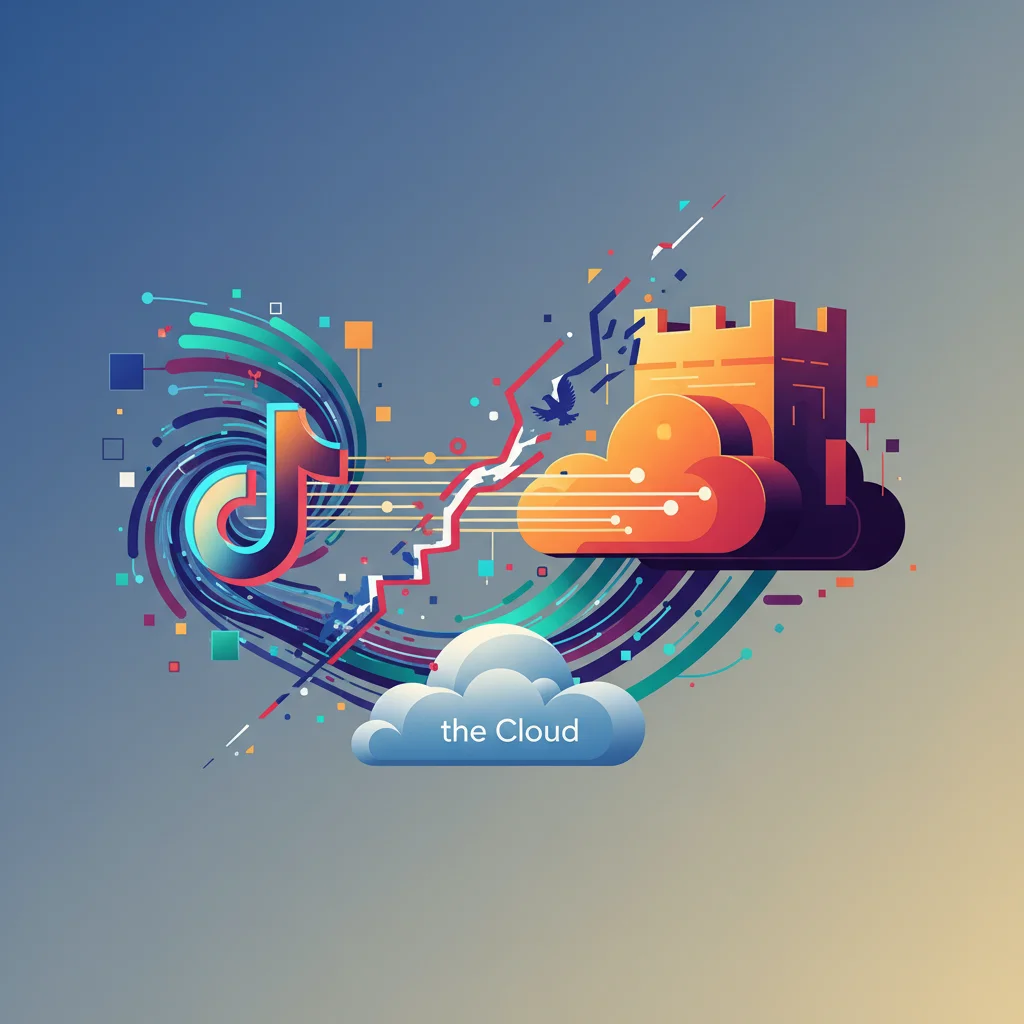
The TikTok-Oracle Saga: A Deep Dive into the Deal That Redefined Tech, Politics, and the Cloud
Remember the summer of 2020? Amid global uncertainty, another drama was unfolding in the digital world—one that threatened to pull the plug on one of the world’s most popular apps. TikTok, the viral video sensation, was facing a potential ban in the United States over national security concerns. The clock was ticking. Then, in a plot twist worthy of a Hollywood blockbuster, an unlikely hero emerged: Oracle, the enterprise software giant.
The resulting deal wasn’t a simple sale. It was a complex, politically charged partnership that created a new US-based entity, TikTok Global. This arrangement, involving Oracle, investment firm Silver Lake, and retail giant Walmart, was designed to appease the Trump administration’s concerns while keeping the app accessible to its 100 million American users. But what really happened behind the scenes? This wasn’t just about saving a social media app. It was a landmark event at the intersection of cybersecurity, cloud computing, global politics, and the future of the internet itself.
In this deep dive, we’ll unpack the intricate layers of the TikTok-Oracle deal. We’ll explore why Oracle, a legacy tech company, was the chosen partner, dissect the monumental technical challenges involved, and analyze the long-term implications for developers, startups, and the entire tech ecosystem. This is the story of how a social media app became a geopolitical chess piece, and what it tells us about the future of innovation in a fractured world.
The Geopolitical Tightrope: How We Got Here
To understand the Oracle deal, we have to rewind to the escalating tech tensions between the U.S. and China. The core concern, as voiced by the U.S. government, was that TikTok’s parent company, ByteDance, could be compelled by the Chinese government to hand over sensitive data on American users. The fear was that this data could be used for espionage or influence campaigns, leveraging the app’s powerful artificial intelligence algorithm.
This led to an executive order demanding that ByteDance divest its U.S. operations. Initially, Microsoft was the frontrunner for an outright acquisition, a move that seemed logical given its massive cloud infrastructure (Azure) and consumer-facing products. However, those talks collapsed, paving the way for a more creative—and complex—solution. The final proposal, brokered under intense pressure, wasn’t a sale but a partnership. As reported by the Financial Times, the deal established a new US joint venture with Oracle, Silver Lake, and MGX (initially Walmart was also part of the consortium) as investors, aiming to place TikTok’s American operations under American control.
Deconstructing the Deal: Who Got What?
The structure of the “Project Texas” agreement, as it came to be known, is a masterclass in corporate and political maneuvering. It was designed to solve a data sovereignty problem. Let’s break down the key players and their roles in this new entity, TikTok Global.
Here’s a look at the primary stakeholders and their strategic interests:
| Player | Role & Stake | Strategic Motivation |
|---|---|---|
| Oracle | “Trusted Technology Partner” & Minority Investor (~12.5% stake) | To secure a monumental client for Oracle Cloud Infrastructure (OCI), gain immense credibility in the cloud wars, and showcase its cybersecurity capabilities. |
| ByteDance | Majority Owner of TikTok Global (~80%) | To avoid a forced sale, maintain control of its prized algorithm, and keep its lucrative U.S. market accessible. |
| Silver Lake & other US Investors | Minority Investors | To capitalize on the massive growth of TikTok while being part of a U.S.-approved corporate structure. |
| U.S. Government | Instigator & Approver | To address national security concerns by ensuring U.S. user data is stored in the U.S. and overseen by a U.S. company, a concept known as data localization. |
The cornerstone of the agreement was a commitment to migrate all U.S. user data to Oracle’s cloud infrastructure and for Oracle to review TikTok’s source code and content moderation algorithms. This was a direct response to the data privacy and security fears that sparked the crisis in the first place (source). The idea was to create a digital fortress around U.S. data, managed and monitored by a trusted American tech vendor.
The New Titans: Why TIME Magazine's Nod to AI's Architects is a Defining Moment for Our Future
Why Oracle? A Strategic Coup in the Cloud Wars
For many in the tech world, Oracle was a surprising choice. Why not Amazon Web Services (AWS), Microsoft Azure, or Google Cloud—the undisputed leaders in the cloud computing space? The answer lies in a combination of technology, politics, and brilliant strategy.
Oracle, while a powerhouse in database and enterprise software, has historically been a distant fourth in the infrastructure-as-a-service (IaaS) market. Winning the TikTok account was more than just a massive revenue opportunity; it was a colossal marketing victory. It instantly gave Oracle Cloud Infrastructure (OCI) a globally recognized, hyper-scale client to rival the marquee customers of its competitors. This was a chance to prove that OCI could handle one of the most data-intensive applications on the planet, which processes billions of video views daily.
From a cybersecurity perspective, Oracle positioned itself as the “secure” choice. The company’s deep roots in database security and enterprise-grade solutions resonated with the government’s mandate. The core of their pitch was simple: “We can build a wall around U.S. data that no one else can.” This involved not just hosting the data but also providing sophisticated monitoring and automation tools to inspect the underlying code for backdoors or malicious logic, a task of immense complexity.
The AI Algorithm: The Billion-Dollar Secret Sauce
While data hosting and cybersecurity were the public-facing issues, the real crown jewel of TikTok is its recommendation algorithm. This sophisticated piece of artificial intelligence is what makes the app so compellingly addictive. Using advanced machine learning models, it analyzes user behavior—watch time, likes, shares, comments—to create a hyper-personalized “For You” page that seems to read your mind.
This algorithm was the biggest sticking point in the negotiations. According to reports, Beijing was unwilling to approve a deal that included the export of this core AI technology, viewing it as a national asset (source). The final agreement reflects this tension: Oracle would secure the data and have oversight of the code running in the U.S., but the core intellectual property of the recommendation engine would remain with ByteDance.
This raises complex questions for developers and AI professionals. How do you truly “secure” a system when the core machine learning models are developed elsewhere? The process of reviewing and validating a constantly evolving AI system is a monumental programming and logistical challenge. It highlights a new frontier in cybersecurity: algorithmic assurance. It’s no longer just about protecting data; it’s about ensuring the code that processes it is transparent and free from manipulation.
Disney's New Magic: How a Billion OpenAI Deal is Rewriting the Story of Entertainment
The Ripple Effect: What This Means for the Tech Ecosystem
The TikTok-Oracle saga is not an isolated event. It’s a bellwether for the future of technology, with profound implications for everyone from solo developers to multinational corporations.
For Startups & Entrepreneurs: The key takeaway is that data governance and geopolitical awareness are no longer afterthoughts. Where your data is stored, who has access to it, and how you comply with international regulations are now Day 1 concerns. Startups aiming for a global user base must now factor in the possibility of data localization requirements and the need for regional cloud partners. The era of frictionless global scaling for SaaS platforms is facing significant headwinds.
For Developers & Tech Professionals: The demand for skills in cloud security, data privacy engineering, and ethical AI is exploding. Understanding how to build, deploy, and manage applications across different regulatory environments is becoming a critical skill. The technical challenges solved by Project Texas—migrating petabytes of data, securing a live environment without disrupting user experience, and implementing continuous code verification—are case studies in modern cloud architecture and security.
For the Tech Industry: This deal has solidified the concept of the “trusted technology partner” as a viable business model. We may see more partnerships where companies from one country team up with a local firm to satisfy regulatory demands in another. It also signals a massive shift in how we view the internet—from a global, open network to a collection of national or regional internets, each with its own rules and gatekeepers. This trend toward a “splinternet” could stifle innovation and collaboration on a global scale.
Conclusion: A New Chapter for Global Tech
The TikTok-Oracle deal was far more than a corporate transaction. It was a forced marriage of convenience, born from a geopolitical storm. It served as a high-stakes stress test for our assumptions about data, sovereignty, and the global nature of the internet. For Oracle, it was a game-changing win that catapulted its cloud ambitions into the spotlight. For TikTok, it was a creative survival strategy that allowed it to keep operating in one of its most important markets.
For the rest of us, it’s a sign of a new, more complex era. The lines between software, hardware, and national interest have blurred permanently. The flow of data across borders is no longer a simple technical process but a politically sensitive act. As we move forward, the lessons from this saga will continue to shape how companies are built, how code is written, and how innovation navigates a world where digital borders are becoming as real as physical ones.

Related Posts
The Great Tech Wall: Unpacking the TikTok Deal and Its Shockwaves for AI, Startups, and Global Innovation
iRobot’s Downfall: A Cautionary Tale of Arrogance, AI, and the Perils of Ignoring Software