The Lincoln Arbitrage: What a Melodramatic Play Reveals About Modern Finance and Investing
The Unlikely Muse for Your Next Investment Strategy
In the world of high finance and strategic investing, we often look to economic models, historical market data, and quantitative analysis for guidance. We dissect earnings reports, monitor Federal Reserve announcements, and build complex algorithms to gain an edge. But what if the next great insight into the modern economy didn’t come from a Wall Street journal, but from the London stage? What if the key to understanding market volatility and fintech disruption could be found in a “ridiculously funny melodrama” about the wife of the 16th US President?
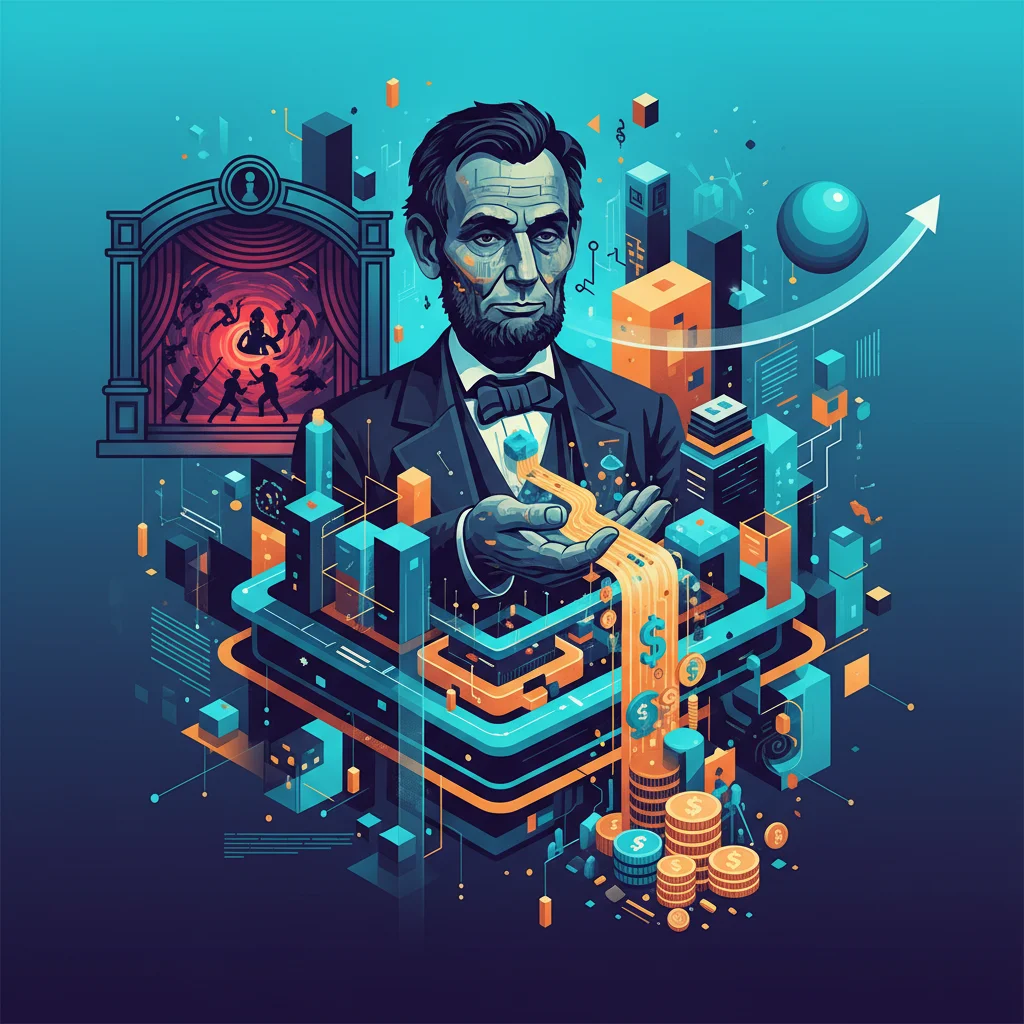
Enter Oh, Mary!, a play by Cole Escola that has taken the theatre world by storm. Currently running at London’s Trafalgar Theatre, the production reimagines the life of Mary Todd Lincoln, transforming her historical footnote into a whirlwind of “crazed comic energy” (source). On the surface, this has nothing to do with finance, trading, or the intricacies of our global economy. Yet, by looking closer at the play’s structure, themes, and its very existence, we can uncover powerful analogies that illuminate some of the most critical trends shaping our financial world today.
This isn’t just an academic exercise. Understanding the narratives that drive human behavior—whether in a theatre or on a trading floor—is fundamental to successful investing and business leadership. The play serves as a perfect, if unconventional, case study in volatility, disruption, and the search for hidden value. Let’s pull back the curtain on the lessons the financial world can learn from Mary Todd Lincoln’s chaotic, comedic, and thoroughly modern reimagining.
Act I: The Melodrama of the Market and the Economics of Narrative
The central pillar of Oh, Mary! is its embrace of melodrama. It’s loud, unpredictable, and driven by heightened emotion rather than quiet logic. This description could just as easily be applied to the stock market on any given Tuesday. For decades, traditional economics was built on the assumption of the rational actor—an investor who makes logical decisions based on perfect information. The reality, as we’ve seen time and again, is far more theatrical.
The market is, in many ways, a grand stage where narratives compete for the spotlight. A single tweet, a rumor, or a charismatic CEO’s presentation can send a stock soaring or tumbling, often detached from its underlying financial fundamentals. This is the essence of narrative economics—the study of how popular stories and shared beliefs drive economic fluctuations. The “crazed energy” of the play mirrors the meme stock phenomenon, where the story of “David vs. Goliath” retail traders fueled massive, logic-defying rallies. It reflects the breathless hype cycles around new technologies, where the promise of a future utopia can overshadow present-day unprofitability.
In this environment, successful trading and investing require more than just spreadsheet skills. It demands an understanding of psychology, sentiment, and the power of a compelling story. Just as an audience is captivated by Mary Lincoln’s on-stage antics, investors can be swayed by a powerful narrative, leading to bubbles and crashes. The key takeaway for a finance professional is to be the discerning critic in the audience, able to appreciate the performance without mistaking it for reality. One must always ask: is this asset’s value based on a solid foundation, or is it merely propped up by a temporary, melodramatic script?
Drax's Power Play: Why an Energy Giant's Move into Data Centres is a Game-Changer for Investors
Act II: Disrupting the Historical Ledger – A Fintech Allegory
Cole Escola’s play doesn’t just re-enact history; it aggressively disrupts it. It takes a well-known, almost ossified narrative—the stoic Abraham Lincoln and his troubled wife—and smashes it, rebuilding it into something new, unexpected, and relevant to a modern audience. This act of creative destruction is a perfect parallel to the ongoing revolution in financial technology.
For centuries, the world of banking and finance has been a rigid, slow-moving institution with an established cast of characters. The system was built on legacy infrastructure, arcane processes, and a high barrier to entry. Then came fintech. Like a bold new playwright, fintech startups looked at the established script and decided to rewrite it. They questioned every assumption:
- Why does a loan application need to take weeks?
- Why can’t international money transfers be instant and cheap?
- Why should investment advice be reserved for the ultra-wealthy?
Technologies like blockchain are fundamentally challenging the very concept of a centralized financial ledger, much like Oh, Mary! challenges the centralized, “official” version of history. Blockchain offers a decentralized, transparent, and immutable record, taking power from central gatekeepers (traditional banks) and distributing it among the participants. This is a fundamental reimagining of how trust and transactions are managed in our economy.
The following table illustrates this parallel between theatrical and financial disruption:
| Theatrical & Historical Realm | Financial & Technological Realm |
|---|---|
| The “Official” History: A rigid, accepted narrative of the Lincolns. | Traditional Banking: Legacy systems, centralized control, slow innovation. |
| The Playwright (Cole Escola): An outside disruptor with a new vision. | Fintech Startups: Agile innovators challenging the status quo. |
| The Play (Oh, Mary!): A radical reinterpretation that gives voice to a sidelined character. | Financial Technology (e.g., Neobanks, DeFi): New platforms empowering underserved customers. |
| The Audience’s Reaction: Initial surprise, followed by engagement with a fresh perspective. | Market Adoption: Initial skepticism, followed by mass adoption of user-centric financial tools. |
For investors and business leaders, the lesson is clear. The scripts that have governed industries for decades are not immutable. The most significant opportunities for growth often lie with the disruptors who are brave enough to ask, “What if we told this story a different way?” Investing in fintech is a bet on a new narrative for finance—one that is more accessible, efficient, and democratic.
The Great Unwinding: Why Global Economics, Not Hype, Is Dictating Bitcoin's Next Move
Act III: The Understudy’s Portfolio – Finding Value Where Others Aren’t Looking
Perhaps the most potent financial lesson from Oh, Mary! comes from its choice of protagonist. For 150 years, Mary Todd Lincoln has been a supporting character in her husband’s story—often portrayed as tragic, unstable, or merely an appendage to greatness. The play thrusts her into the spotlight, exploring her ambitions, frustrations, and comedic potential. In doing so, it uncovers a wealth of narrative value that was previously ignored.
This is the very essence of value investing. It is the art of looking past the market’s darlings—the “Abraham Lincolns” of the stock market that everyone knows and loves—and finding the “Mary Todds”: the overlooked, misunderstood, or temporarily unfashionable assets that hold immense, unrecognized potential. This could be a company in a boring industry that the market has written off, a small-cap stock with solid fundamentals but no analyst coverage, or a contrarian bet on a sector that has fallen out of favor.
This principle extends beyond the stock market into the broader economy. Venture capital firms that invested early in non-obvious technologies were practicing a form of this. Business leaders who pivot their companies to serve niche, underserved markets are doing the same. It requires independent thought, rigorous research, and the courage to go against the crowd. It means seeing the potential for a leading role where everyone else only sees an understudy.
As the wife of Abraham Lincoln, Mary was proximate to power but rarely seen as powerful herself. The value investor’s job is to analyze the fundamentals and see that latent power—the strong balance sheet, the sticky customer base, the untapped intellectual property—before the rest of the market decides to put it in the spotlight. The greatest returns are often found not in the crowded center stage, but in the wings, waiting for their cue.
The New Financial Battlefield: How US Sanctions are Reshaping Venezuela's Economy and Global Markets
Curtain Call: The Intersection of Creativity and Capital
It is admittedly a stretch to draw a direct line from a comedic play about a former First Lady to a portfolio allocation strategy. Yet, the underlying principles are universal. Oh, Mary! serves as a vibrant, hilarious reminder that the forces driving our world—and by extension, our economy—are deeply human. They are about the stories we tell, the conventions we choose to break, and our ability to see value where others see none.
For the modern investor, banker, or business leader, the takeaways are threefold. First, recognize the melodrama of the market and learn to distinguish between a compelling performance and a sustainable reality. Second, embrace disruption, understanding that the most entrenched narratives in any industry are ripe for a rewrite by bold innovators in financial technology. And third, cultivate the vision of a value investor, constantly scanning the periphery for the overlooked characters and companies that are ready for their starring role. The world of finance may seem like a science, but as Oh, Mary! shows us, it is often just as much an art.