The Fed’s Black Friday Dilemma: Why a Premature Rate Cut Could Be a Costly Mistake
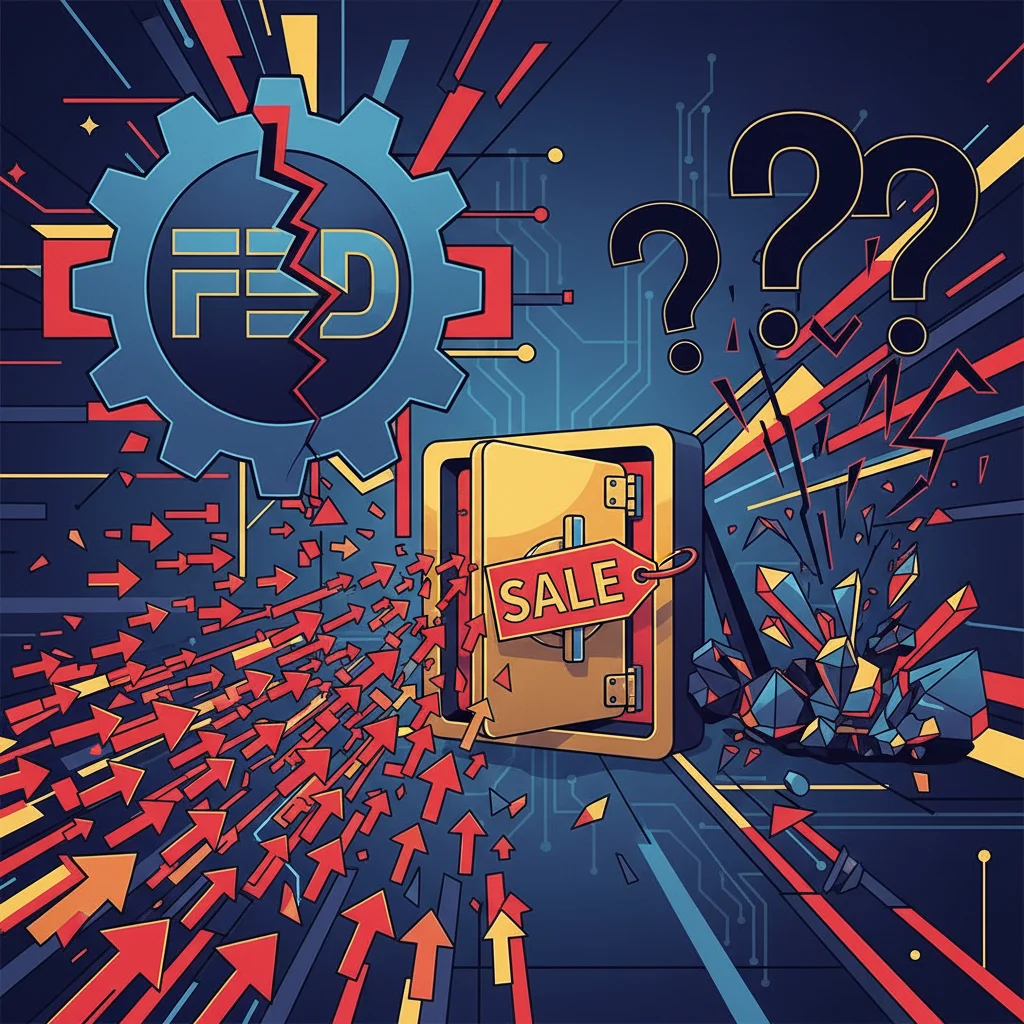
Imagine the scene on Black Friday: doors burst open, and a frantic crowd surges forward, desperate to grab the best deals before they disappear. It’s an environment driven by impulse, fear of missing out, and a focus on immediate gratification. Now, apply that same frenetic energy to the world of monetary policy. According to Professor Costas Milas of the University of Liverpool, this is precisely the dangerous game the U.S. Federal Reserve is being pressured to play. The market is clamoring for interest rate cuts, acting like shoppers desperate for a discount, but the Fed would be wise to resist this “Black Friday” rush.
After a grueling battle to bring inflation down from 40-year highs, the central bank finds itself at a critical juncture. The progress has been significant, but the war is not yet won. The journey to tame inflation is less like a sprint and more like a marathon, and as any long-distance runner knows, the final mile is often the most grueling. A premature declaration of victory—cutting rates too soon—could unravel all the hard-won progress, forcing more painful measures down the road and jeopardizing the stability of the entire economy.
In this analysis, we will delve into the high-stakes debate surrounding the Fed’s next move. We’ll explore why the “last mile” of inflation is so treacherous, dissect the growing chasm between market expectations and the Fed’s own projections, and analyze the profound implications for investing, banking, and the future of our financial landscape.
The Great Divide: Market Hopes vs. Central Bank Realities
The core of the current tension lies in a stark disagreement over the future path of interest rates. On one side, you have the financial markets—traders, investors, and the algorithms that power modern trading—who are pricing in a series of aggressive rate cuts. On the other, you have the Federal Reserve, which, through its official communications and projections, has signaled a much more cautious, “higher for longer” approach.
This divergence is most clearly illustrated by comparing the market’s expectations with the Fed’s own “dot plot.” The dot plot is a chart that records each of the 19 Fed officials’ projections for the federal funds rate. While not a formal promise, it’s the clearest window we have into the collective thinking of the committee. For months, a significant gap has persisted between what the Fed signals and what the market believes.
Below is a simplified representation of this divergence, illustrating how market participants have consistently anticipated a more dovish (inclined to cut rates) stance than the Fed itself has projected.
| Time Period | Fed’s Median “Dot Plot” Projection (End of Year) | Market-Implied Policy Rate (via Fed Funds Futures) |
|---|---|---|
| Year-End 2024 | 5.1% | 4.6% |
| Year-End 2025 | 4.1% | 3.5% |
Note: Figures are illustrative based on typical divergences seen in late 2023/early 2024. Actual figures change daily.
This isn’t just an academic disagreement; it has real-world consequences. When the stock market rallies on the *hope* of rate cuts, it can actually work against the Fed’s goals. This “easing of financial conditions” can stimulate demand and fuel the very inflationary pressures the Fed is trying to extinguish. It’s a paradoxical feedback loop where the market’s optimism complicates the central bank’s job, essentially ignoring the referee’s whistle to continue playing the game.
The Red Shoes Dilemma: Navigating Ambition, Risk, and Sacrifice in Modern Finance
The Marathon’s Final Mile: Why Taming the Last Bit of Inflation is the Hardest
Professor Milas’s analogy of a marathon runner is particularly apt. The initial phase of disinflation—from over 9% to around 3%—was the easier part. It was driven by the untangling of supply chains, falling energy prices, and the initial, powerful impact of rate hikes on interest-sensitive sectors like housing. But getting from 3% to the Fed’s official 2% target is the “last mile,” and it’s uphill.
This final leg of the race is difficult due to a phenomenon known as “sticky inflation.” While prices for goods can fall quickly, prices for services—such as healthcare, insurance, and rent—tend to be much more stubborn. These are often tied to labor costs, and with a tight job market, wage growth has remained robust. According to data from the U.S. Bureau of Labor Statistics, services inflation has consistently outpaced goods inflation, representing the primary challenge for policymakers.
History provides a chilling cautionary tale. In the 1970s, then-Fed Chair Arthur Burns repeatedly eased monetary policy at the first sign of economic weakness, long before inflation was truly defeated. This “stop-go” policy allowed inflation to become deeply entrenched in the economy, leading to a “lost decade” of stagflation that was only broken by the brutally deep recession induced by his successor, Paul Volcker, in the early 1980s. The lesson is clear: the cost of acting too late is high, but the cost of giving up too soon can be even higher.
The Fed’s current challenge is as much about communication as it is about economics. How do you convince an impatient market that the medicine, while bitter, is still necessary? In an age of instant analysis and algorithmic trading, every word from the Fed Chair is parsed in microseconds, often amplifying volatility. The Fed isn’t just battling inflation; it’s battling a narrative. Its greatest asset is its credibility. If it bows to market pressure and inflation re-accelerates, that credibility will be shattered, making any future attempts to manage the economy infinitely more difficult.
Implications for Investors and the Broader Economy
The outcome of this tug-of-war has massive implications for every corner of the financial world. The path the Fed chooses will directly influence investment strategies, the health of the banking sector, and the trajectory of innovative fields like financial technology.
For Investors: A premature pivot could create a dangerous head-fake for the stock market. An initial rally might occur as borrowing costs fall, but if inflation returns, the Fed would be forced to reverse course and hike rates even more aggressively than before. This would likely trigger a far more severe market downturn and economic recession than simply maintaining the current restrictive stance for a few more months. Asset allocation becomes critical. Portfolios heavily weighted toward long-duration growth stocks are vulnerable to a hawkish surprise, while assets that perform well in inflationary environments could see renewed interest.
For the Economy and Banking: For the broader economy, the risk is a volatile “stop-go” cycle that cripples business investment and consumer confidence. Businesses cannot plan effectively when the cost of capital swings wildly. For the banking sector, sustained high rates put pressure on lending margins and can expose weaknesses, as seen with the regional bank turmoil in 2023. A clear and steady policy path is far healthier than a reactive and unpredictable one.
For Fintech and Innovation: The world of fintech and even nascent decentralized systems like blockchain are not insulated. Venture capital funding for startups is highly sensitive to interest rates. A stable macroeconomic environment is essential for long-term technological investment. While lower rates are generally a boon for tech, the instability caused by a policy error would be far more damaging, stifling the innovation that drives future economic growth. The Investor's Crossword: Decoding the Complexities of Modern Finance
Patience is a Virtue: The Case for a Data-Driven Approach
So, what is the right path forward? The answer is a resolute commitment to data-dependency and a rejection of the market’s clamor for immediate gratification. The Fed has a dual mandate: stable prices and maximum employment. For the past two years, the focus has rightly been on the former. While the labor market has shown some signs of cooling, it remains strong by historical standards, giving the Fed the leeway it needs to finish the job on inflation.
This means waiting for a consistent and convincing series of data points that show inflation is firmly on a path back to 2%. It means listening to the signal from the economic data, not the noise from the market. As stated by Fed officials themselves, the risks of easing too soon far outweigh the risks of holding rates steady for a little longer. A slightly delayed economic recovery is a much smaller price to pay than a resurgence of corrosive inflation that erodes savings, distorts investment, and ultimately requires a deep recession to eradicate.
The £1.9 Billion Void: Deconstructing the UK's COVID Fraud and its Economic Aftermath
Conclusion: Avoiding a Costly Bargain
The allure of a Black Friday deal is its promise of immediate savings. But as any savvy shopper knows, not all deals are good ones. A cheap product that breaks in a week is no bargain. Similarly, a premature interest rate cut might offer the market a brief sugar high, but it would be a costly bargain for the long-term health of the U.S. economy.
Professor Milas’s warning is a crucial reminder that in the complex world of finance and monetary policy, patience is not passivity; it is a strategy. The Federal Reserve has run 25 miles of a grueling 26.2-mile marathon. Now is the time for endurance and focus, not for a frantic, ill-advised sprint to a finish line that is further away than it appears. By holding the line and ensuring inflation is well and truly vanquished, the Fed can build a sustainable foundation for durable growth, a stable stock market, and lasting prosperity.