The Chip War’s Ingenious Loophole: How China is Rewriting the Rules of AI and Global Finance
The High-Stakes Game of Silicon Sovereignty
In the grand theater of global economics, few dramas are as compelling or consequential as the ongoing tech rivalry between the United States and China. At the heart of this conflict lies a piece of technology smaller than a human fingernail but more valuable than gold: the advanced semiconductor. For years, the U.S. has strategically employed export controls to build a technological fortress, aiming to slow China’s ascent in critical areas like Artificial Intelligence. The centerpiece of this strategy has been restricting access to the world’s most sophisticated chipmaking equipment. But a new chapter is unfolding, one that reveals both the limits of this containment policy and the remarkable ingenuity it has spurred.
Recent developments indicate that Chinese companies are making significant strides in producing advanced AI chips, not by acquiring forbidden technology, but by cleverly retrofitting older, permissible machinery. According to a bombshell report from the Financial Times, China is boosting its domestic AI chip output by upgrading last-generation tools from Dutch giant ASML. This strategic pivot isn’t just a technical workaround; it’s a geopolitical maneuver that exposes potential cracks in the U.S.-led sanctions regime and sends ripples across the global stock market, impacting everything from investing strategies to the future of financial technology.
DUV vs. EUV: A Tale of Two Technologies
To grasp the significance of this development, one must understand the arcane world of lithography—the process of “printing” complex circuits onto silicon wafers. For the last decade, the pinnacle of this technology has been Extreme Ultraviolet (EUV) lithography, a closely guarded process monopolized by ASML. EUV machines, which can cost upwards of $200 million each, are the only tools capable of efficiently producing the most advanced chips (5-nanometer and below) that power the latest iPhones and AI data centers. The U.S. and its allies have successfully blocked China from ever acquiring these machines.
The predecessor to EUV is Deep Ultraviolet (DUV) lithography. While less precise, DUV machines are still incredibly capable and, crucially, have been more widely available. The prevailing wisdom was that DUV technology had a hard ceiling, preventing it from producing the kind of chips needed for cutting-edge AI. This assumption, it turns out, was a critical miscalculation.
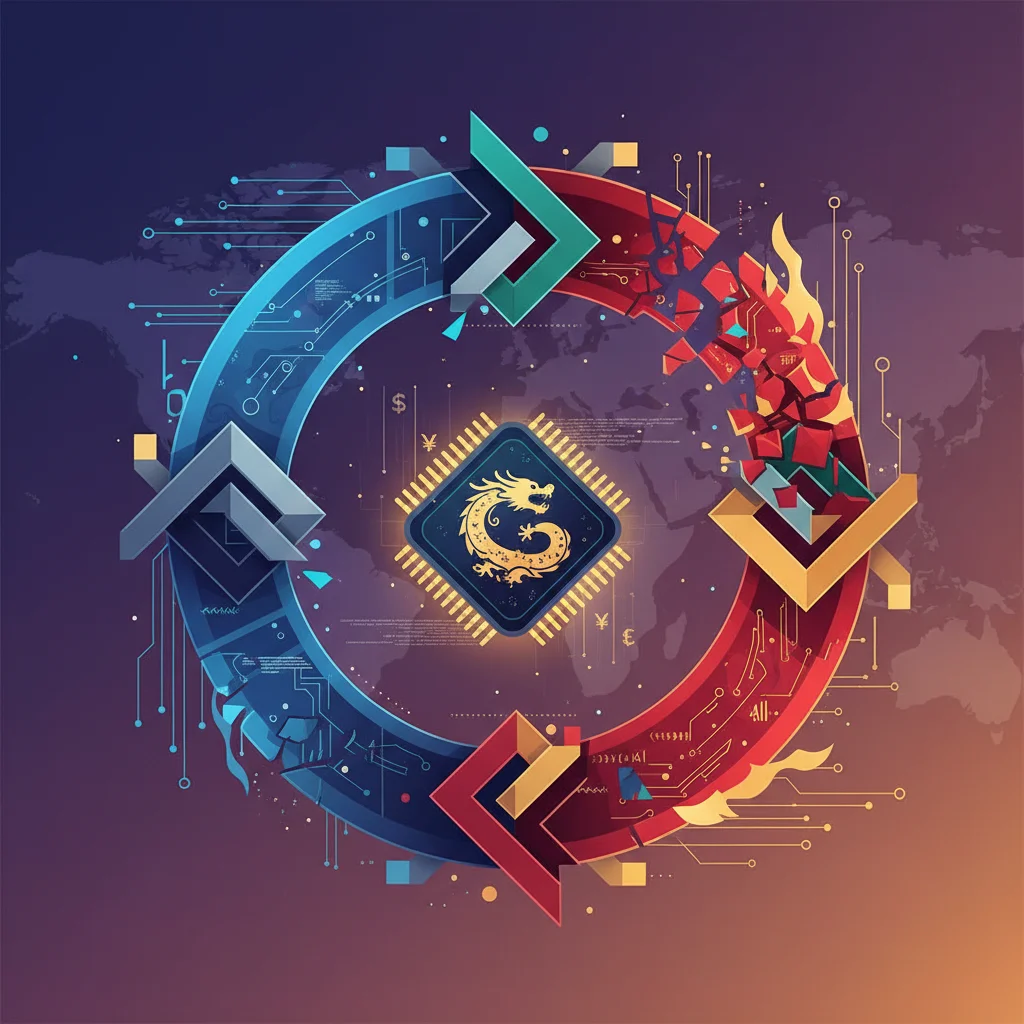
Chinese firms, led by giants like Semiconductor Manufacturing International Corporation (SMIC) and Huawei, have found ways to push DUV tools far beyond their intended limits. By combining them with other technologies and sophisticated techniques like multi-patterning (exposing a wafer multiple times to etch finer details), they are now reportedly capable of producing 7-nanometer chips—a feat previously thought to be the exclusive domain of EUV. While less efficient and more costly than using EUV, this method provides a viable, homegrown path to advanced semiconductor manufacturing, a critical step towards technological self-reliance.
London's Green Gridlock: Why Stalling on EV Car Clubs is a Multi-Billion Pound Economic Mistake
The Financial and Economic Shockwaves
This breakthrough is far more than a technical curiosity; it carries profound implications for the global economy and financial markets. For investors and business leaders, understanding these shockwaves is essential for navigating the evolving landscape.
1. Recalibrating the Semiconductor Stock Market
The news challenges the narrative of absolute Western dominance in the semiconductor space. While companies like TSMC, Samsung, and Intel still hold a commanding lead in cutting-edge manufacturing, China’s progress signals the rise of a formidable competitor. This could exert long-term pressure on the valuations of established chipmakers and equipment suppliers like ASML. Investors must now factor in a new variable: the speed and scale of China’s domestic semiconductor industry. The investing thesis for many tech stocks has been predicated on a stable, Western-led supply chain; that foundation is now showing signs of a seismic shift.
2. The Dawn of a Bifurcated Tech Ecosystem
China’s success accelerates the trend towards a “decoupled” or bifurcated global tech ecosystem. We are moving towards a world with two parallel tech stacks: one centered around the U.S. and its allies, and another driven by China’s domestic champions. This has massive implications for global trade, standards, and innovation. For businesses, this means navigating increasingly complex supply chains and competing in markets with different technological rules. The global economics of the tech sector are being fundamentally rewritten.
3. Fueling China’s Fintech and AI Ambitions
Advanced chips are the lifeblood of modern innovation. They power the complex algorithms essential for high-frequency trading, the secure ledgers of blockchain technology, and the data-intensive infrastructure of digital banking. By securing a domestic supply of advanced AI chips, China is ensuring it can continue to build and scale its world-leading financial technology (fintech) sector without relying on foreign suppliers. This homegrown hardware capability is a strategic asset that will fuel its ambitions in AI, autonomous systems, and next-generation telecommunications.
To better understand the trade-offs, consider the two primary paths to advanced chip manufacturing:
| Attribute | EUV Lithography (Western Approach) | DUV Retrofit (China’s Approach) |
|---|---|---|
| Core Technology | Extreme Ultraviolet (EUV) | Deep Ultraviolet (DUV) with multi-patterning |
| Leading Node Capability | 3nm and below (highly efficient) | 7nm (less efficient, higher cost) |
| Key Equipment Supplier | ASML (Netherlands) | ASML (older models), plus domestic tools from Naura, SMEE |
| Geopolitical Status | Subject to strict U.S. export controls | Workaround for sanctions, promotes self-sufficiency |
| Economic Implication | Maintains Western technological lead | Reduces reliance on foreign tech, builds domestic industry |
Sudan's Economic Abyss: A Financial Perspective on a Nation in Turmoil
The Unintended Consequences of Containment
The U.S. export control policy was designed to be a decisive blow, a “choke point” to halt China’s technological progress. However, this strategy appears to have had a powerful, unintended consequence: it has forced an unprecedented level of state-backed investment and national focus on achieving semiconductor independence. As one analyst cited by the FT noted, China is now building chip factories at a “breakneck pace,” creating a surge in demand for all types of equipment, especially mature DUV tools. In fact, China was ASML’s largest market in 2023, accounting for 46% of its sales in the third quarter.
This situation presents a paradox for Western policymakers. Tighter restrictions on DUV machines—the logical next step—could further accelerate China’s efforts to build its own domestic lithography equipment, completely cutting out Western suppliers in the long term. Leaving the rules as they are allows China to continue exploiting this loophole. There are no easy answers, and each path carries significant risks for the global technology supply chain.
The Venezuelan Quagmire: How a Failed Sanctions Policy Impacts the Global Economy
What This Means for the Future
The revelation that China is successfully retrofitting older equipment to build modern chips is more than just a technical headline. It is a defining moment in the new era of great power competition, demonstrating that ingenuity can often find a way around even the most formidable barriers.
For those in finance and business, the key takeaway is that the geopolitical landscape is now an inextricable part of any sound investing or corporate strategy. The assumptions of a single, globalized market for technology are obsolete. The rise of techno-nationalism means that supply chains, market access, and technological leadership are all in flux.
As China continues to pour billions into its domestic chip industry, the world is watching to see if this DUV-based strategy is a sustainable long-term solution or merely a temporary bridge. Regardless of the outcome, one thing is certain: the global chip war has entered a new, more unpredictable phase. The critical question for every investor and business leader is no longer *if* a technological decoupling will happen, but how to navigate the world once it does.