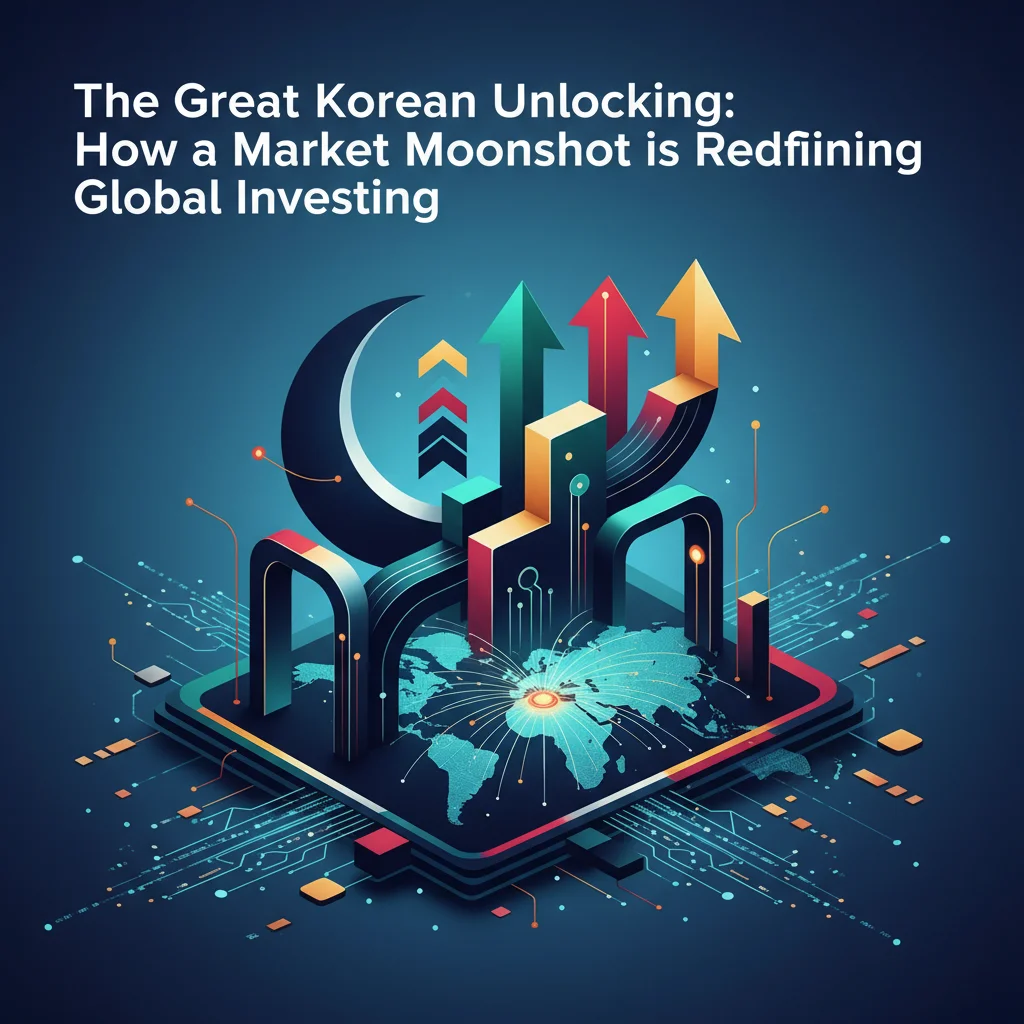
The Great Korean Unlocking: How a Market Moonshot is Redefining Global Investing
In the world of global finance, some stories develop slowly, over decades, before bursting into the spotlight. For years, South Korea’s stock market was one such story—a tale of world-class companies trading at bargain-bin prices. But something has fundamentally shifted. In a move that has captured the attention of investors worldwide, the local Kospi index has experienced a meteoric re-rating, with a sharp surge that signals a new era for the nation’s economy. This isn’t just a momentary rally; it’s a structural transformation rooted in bold corporate governance reforms that could serve as a blueprint for other economies.
The numbers themselves are staggering. According to the Financial Times, local shares have seen a dramatic re-evaluation, with the Kospi index up an incredible 69% this year. This “market moonshot” is the direct result of a concerted effort to dismantle a long-standing problem that has plagued the country’s capital markets: the infamous “Korea Discount.”
Understanding the Decades-Old Enigma: The ‘Korea Discount’
For seasoned market watchers, the “Korea Discount” is a familiar term. It refers to the persistent tendency for South Korean companies to trade at a lower valuation compared to their global peers, even when their underlying performance, technology, and market share are superior. Imagine two companies with identical profits and growth prospects—one in the U.S. and one in South Korea. The Korean company’s stock would, on average, be priced significantly lower.
What caused this valuation gap? The reasons are complex and deeply embedded in the country’s unique economic history:
- The Chaebol Structure: South Korea’s rapid post-war economic miracle was powered by massive family-owned conglomerates known as chaebols (e.g., Samsung, Hyundai, LG). While instrumental in building the modern Korean economy, their complex webs of cross-shareholdings and opaque governance structures often prioritized the interests of founding families over those of minority shareholders.
- Low Shareholder Returns: Historically, Korean companies have been notorious for their low dividend payout ratios. Cash was often hoarded on balance sheets or reinvested in sprawling, sometimes unrelated, business ventures rather than being returned to investors.
- Weak Minority Shareholder Rights: A lack of robust protections for smaller investors meant there was little recourse to challenge management decisions that were not in the best interest of all shareholders.
This environment created a stock market where value was often trapped, inaccessible to the average investor. Despite the global dominance of Korean brands in everything from semiconductors to smartphones, the stock market failed to reflect this success, frustrating both domestic and international investors for years.
The Fed's Divided House: Why the Latest Rate Cut Signals Deeper Economic Uncertainty
The ‘Corporate Value-up Program’: A Catalyst for Seismic Change
Frustration has finally given way to action. Spurred by similar successful reforms in neighboring Japan, the South Korean government has launched the “Corporate Value-up Program.” This ambitious initiative is designed to tackle the root causes of the Korea Discount head-on by pressuring companies to improve governance and enhance shareholder returns. It’s a multi-pronged approach that moves beyond mere suggestion to create powerful incentives for change.
Here’s a breakdown of the program’s key pillars and their intended impact:
| Pillar of the Program | Intended Outcome and Mechanism |
|---|---|
| Voluntary Disclosure of Value-up Plans | Companies are “strongly encouraged” to voluntarily disclose multi-year plans detailing how they will improve their price-to-book (P/B) ratios, return on equity (ROE), and dividend payouts. |
| Tax Incentives | The government is offering significant tax benefits to corporations that actively increase dividends and engage in share buybacks, directly rewarding shareholder-friendly actions. |
| “Name and Shame” Approach | A new stock market index will be created to highlight companies with exemplary corporate governance and value-enhancement plans. This creates public and peer pressure on underperformers to improve. |
| Empowering Shareholders | The reforms aim to simplify the process for shareholder activism and strengthen the stewardship code for institutional investors, encouraging them to use their voting power to demand change. |
This program is a fundamental shift in the philosophy of the Korean stock market. It’s an official acknowledgment that a company’s responsibility extends beyond just operational success to include creating and returning value to the people and institutions who own its shares. The market’s enthusiastic response, including the sharp re-rating of local shares, shows that investors believe this time is different.
The Role of Fintech and a New Generation of Traders
This transformation isn’t just a top-down government mandate; it’s also being fueled from the ground up by profound changes in financial technology and investor behavior. The rise of sophisticated, low-cost mobile trading platforms has democratized investing in South Korea, empowering a massive cohort of retail investors, often dubbed “Ants.”
This new class of investors is more informed, more organized, and far more vocal than previous generations. Through online communities and social media, they share research, coordinate strategies, and apply public pressure on underperforming companies. This digital-first approach to trading and activism adds a powerful new dynamic to the market. When the government announced its reform plans, it was this energized retail base that helped fuel the initial momentum. This synergy between policy and public participation, enabled by modern financial technology, is a crucial element of the program’s success.
Leon's Crunch: Why the "Healthy" Fast Food Chain's Restructuring is a Warning for the Entire Economy
A Blueprint for Global Economies?
South Korea’s bold experiment offers a powerful case study for other emerging and even developed economies grappling with similar issues of corporate entrenchment and undervalued markets. The core lesson is that unlocking deep-seated value requires more than just a healthy economy; it demands a deliberate and sustained focus on corporate governance, transparency, and shareholder rights.
Countries with dominant family-owned businesses or state-owned enterprises could look to Korea’s model of using tax incentives and public indices to nudge companies in the right direction without resorting to heavy-handed regulation. The program’s success demonstrates that aligning the interests of corporations with those of their shareholders is not just good ethics—it’s brilliant economics. As global capital becomes more discerning, a commitment to strong governance is increasingly becoming a prerequisite for attracting international investment. A recent report highlighted that markets with stronger governance standards consistently attract higher foreign investment flows (source).
Your Bank Wants to Be Your Financial Advisor: What New UK Rules Mean for Your Money
The Road Ahead: What Investors Should Watch
The journey for the South Korean stock market is far from over. The initial surge is a vote of confidence, but the long-term success will depend on execution. Key things to watch for include:
- Corporate Adoption Rates: How many companies will genuinely commit to meaningful value-up plans versus those who engage in superficial “box-ticking”?
- Dividend Payout and Buyback Trends: The most tangible proof will be in the cash returned to shareholders. A sustained increase in these metrics will be a critical sign of success.
- Foreign Capital Inflows: Will international institutional investors, who have long been underweight in Korea, begin to allocate significant capital to the market? This will be the ultimate validation of the reforms.
In conclusion, South Korea’s market moonshot is far more than a simple bull run. It is a landmark event in the evolution of global finance, showcasing how targeted reforms can dismantle decades-old structural inefficiencies. It’s a compelling story of a nation actively working to align its world-class industries with a world-class stock market. For investors, business leaders, and policymakers alike, the lesson from Seoul is clear: in today’s economy, good governance isn’t just a buzzword; it’s the ultimate catalyst for unlocking value.