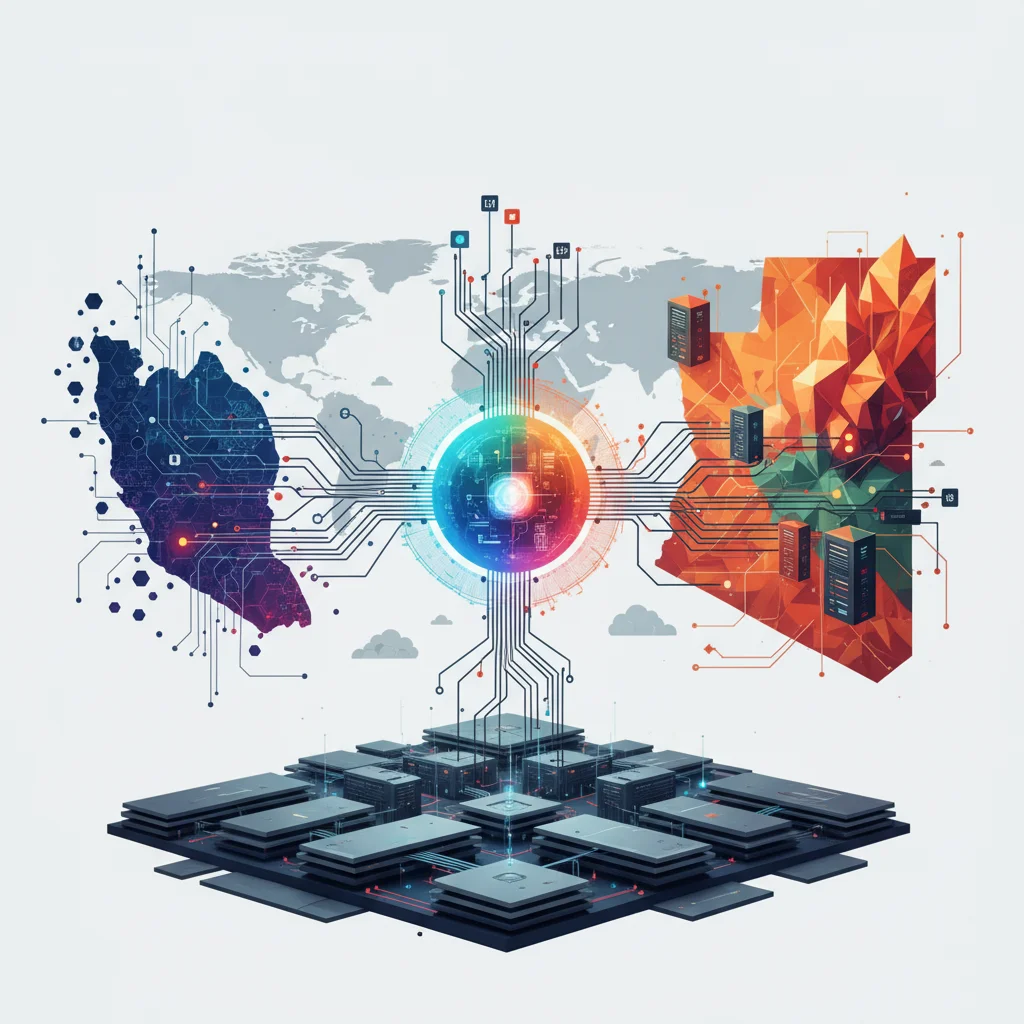
AI’s New Power Grid: Why Malaysia and Arizona are Quietly Reshaping Global Tech
The artificial intelligence revolution isn’t just happening in the cloud or on your screen; it’s a colossal physical undertaking. It’s a world of sprawling server farms humming with power and micro-factories fabricating silicon wafers with near-impossible precision. While we obsess over the latest AI software and machine learning models, the real story—the one that will define the next decade of innovation—is about the picks and shovels of this digital gold rush. Where are they being made, and where are they being put to work?
Forget Silicon Valley for a moment. Two seemingly unrelated stories from opposite ends of the globe reveal the new map of technological power. In Southeast Asia, Malaysia is experiencing a data center boom of epic proportions. Meanwhile, in the Arizona desert, the world’s most advanced chipmaker, TSMC, is building a mega-factory that has been fraught with challenges but is critical for America’s tech future. These aren’t isolated events. They are two sides of the same coin: a massive, geopolitically-charged rewiring of the global tech supply chain, all fueled by the insatiable appetite of AI.
Let’s dive into how these two hotspots are becoming the new backbone for everything from the cloud and SaaS platforms to the next generation of AI-driven automation.
Malaysia: The World’s New Data Center Darling
For years, Singapore was the undisputed data center king of Southeast Asia. It had the stability, the infrastructure, and the connectivity. But it also has a critical shortage of two things: land and power. As the AI boom demands exponentially more of both, the industry has been forced to look for a new home, and it’s found one just across the causeway in Malaysia.
Led by the southern state of Johor, Malaysia is rapidly becoming the region’s premier destination for hyperscale data centers. Tech giants are pouring in billions. Microsoft has pledged a massive $2.2 billion investment into new cloud and AI infrastructure. Google, Amazon, and even AI-chip powerhouse Nvidia are setting up shop, transforming the landscape.
So, what’s driving this Malaysian miracle? It’s a perfect storm of opportunity and strategy.
Below is a quick look at the key investments fueling this growth:
| Company | Announced Investment/Involvement | Key Focus |
|---|---|---|
| Microsoft | $2.2 billion | Cloud Computing & AI Infrastructure |
| Data Center & Cloud Region | Serving Digital Services Growth | |
| Nvidia | Partnership with YTL Power | AI Cloud & Supercomputing |
| GDS (China) | Hyperscale Data Center Campus | Regional Cloud & Data Hub |
The appeal is clear: Malaysia offers more affordable land, cheaper and more accessible energy, and strong government support. Its proximity to Singapore allows companies to maintain a connection to the established financial and networking hub while building out at a scale that’s no longer possible in the city-state. This boom is creating the physical foundation for the digital economy. Every line of programming code executed, every SaaS application launched, and every complex machine learning model trained in the region will increasingly run on servers housed in these new Malaysian facilities.
For developers and startups in Southeast Asia, this is a game-changer. It means lower latency, better access to high-performance computing for AI development, and a more resilient regional cloud infrastructure. However, this explosive growth isn’t without its challenges. The strain on Malaysia’s power grid will be immense, and concerns about sustainable energy and water usage for cooling are growing. Building the infrastructure is one thing; powering it responsibly is another. Oracle's Billion AI Gamble: Why a Massive Bet on the Future Spooked Wall Street
The Arizona Gamble: Forging AI’s Brain in the Desert
While Malaysia builds the server farms, the silicon brains that will power them are being forged in a new, unlikely cradle of semiconductor manufacturing: Phoenix, Arizona. Taiwan Semiconductor Manufacturing Co. (TSMC), the undisputed global leader in advanced chipmaking, is making a monumental $65 billion bet on American soil.
This move is about one thing: de-risking the tech supply chain. For decades, the world has relied on Taiwan for over 90% of its most advanced chips—the kind that power everything from iPhones to Nvidia’s AI GPUs. With rising geopolitical tensions, the U.S. government recognized this as a critical vulnerability. The solution? The CHIPS Act, a massive subsidy program designed to lure companies like TSMC to build factories in America.
The project has been anything but smooth. TSMC has faced construction delays, soaring costs, and well-publicized cultural clashes between its Taiwanese management style and American labor expectations. Yet, despite the hurdles, the commitment is deepening. TSMC recently announced it will build a third “fab” in Arizona and will produce the world’s most advanced 2-nanometer chips there by 2028 (source). This is a seismic development, promising to bring the bleeding edge of semiconductor innovation back to the U.S.
Here’s a snapshot of TSMC’s ambitious Arizona commitment:
| Metric | Details |
|---|---|
| Total Investment | Over $65 billion |
| U.S. Government Funding | $6.6 billion in grants, ~$5 billion in loans (CHIPS Act) |
| Number of Factories (Fabs) | Three planned |
| Announced Technology | 4nm, 3nm, and cutting-edge 2nm chips |
| Target for 2nm Production | By 2028 |
For tech professionals and entrepreneurs, a stable, geographically diverse supply of advanced chips is non-negotiable. The development of more powerful artificial intelligence, more efficient software, and more secure systems depends entirely on access to this fundamental hardware. The Arizona project, despite its teething problems, represents a critical step toward ensuring that supply chain disruptions don’t derail the next wave of technological progress. Lugano's Bitcoin Bet: A Swiss City's Blueprint for the Future of Urban Tech
Connecting the Dots: The New Global AI Supply Chain
Viewed together, the stories of Malaysia and Arizona paint a clear picture of the future. The chips forged in the Arizona desert will be shipped to server manufacturers, who will then install them in machines destined for data centers—like the new ones popping up all over Johor, Malaysia. This is the new global AI supply chain in action: a distributed, resilient, and geopolitically-aware network.
This marks a fundamental shift away from the hyper-centralized model of the past, where a few key locations held all the cards. This new paradigm has profound implications:
- Resilience Over Efficiency: For decades, the mantra was “just-in-time” efficiency, leading to concentrated supply chains. Now, the focus is shifting to “just-in-case” resilience, with governments and companies willing to pay a premium for geographic diversification.
- Democratization of Opportunity: As tech infrastructure becomes more distributed, so do the opportunities. This creates new tech hubs, jobs, and ecosystems for startups far from traditional centers of power. A developer in Kuala Lumpur will have faster access to the cloud, while an engineer in Phoenix will be at the forefront of chip manufacturing.
- The Rise of Industrial Policy: The CHIPS Act is a clear example of governments stepping in to strategically shape the tech landscape. We can expect to see more of this, as nations recognize that leadership in AI and other advanced technologies is a matter of economic and national security.
The road ahead is complex. Managing these new global systems will require incredible feats of logistics, automation, and international cooperation. But the direction of travel is clear. Oracle's AI Paradox: Why a Revenue Miss Sparked a Debate About the Future of Cloud
The Future is Distributed
The relentless march of artificial intelligence is forcing a physical re-architecture of our world. The quiet boom in Malaysia’s data center alleys and the loud, challenging construction in the Arizona desert are not just industry footnotes; they are the foundational stories of the next technological era.
They signal a move toward a more robust, decentralized, and complex global tech ecosystem. For anyone working in tech—from programming and cybersecurity to founding a startup—understanding this shifting physical landscape is no longer optional. The virtual world of AI is being built on a very real and rapidly changing new ground, and the epicenters of that change are, for now, in Johor and Phoenix.