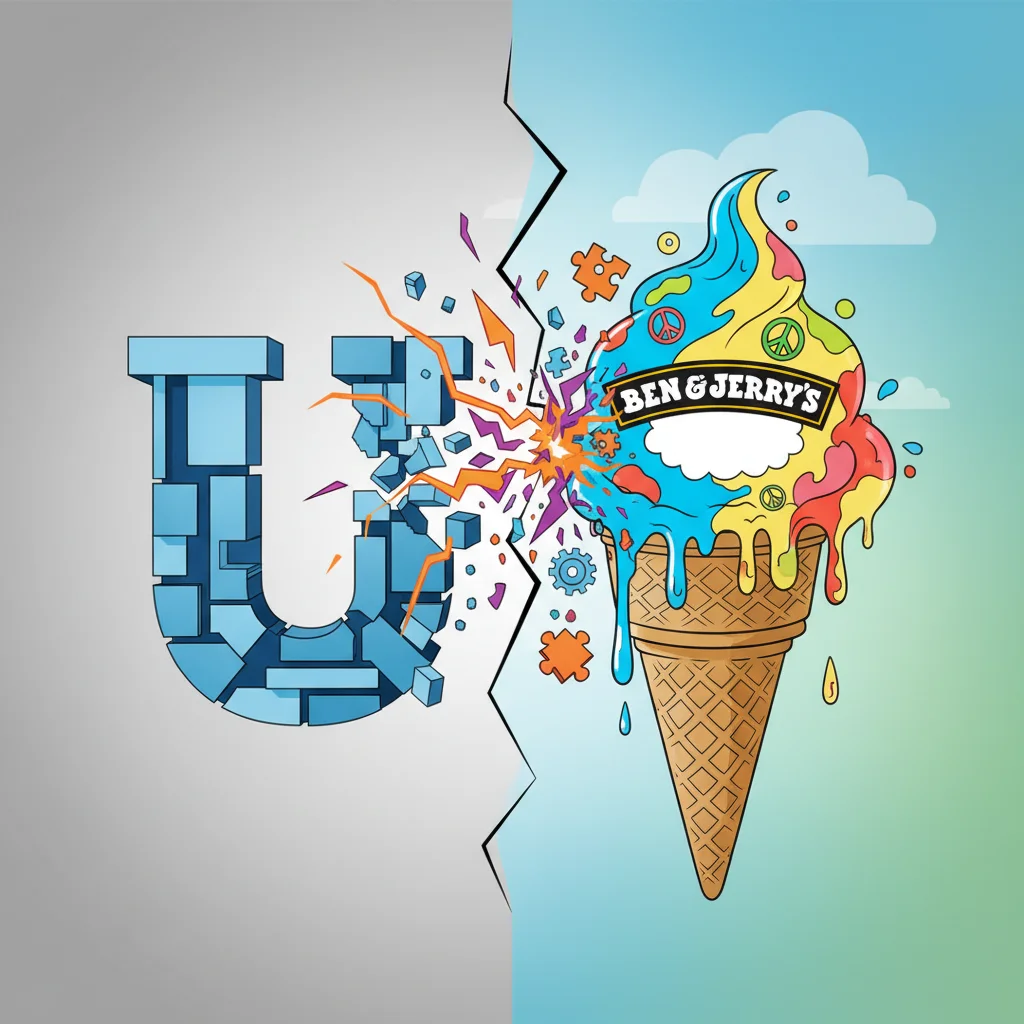
Unilever vs. Ben & Jerry’s: A Meltdown in Corporate Governance
Ben & Jerry’s. The name conjures images of whimsical ice cream flavors, happy cows, and a steadfast commitment to social justice. For decades, the Vermont-based company has been a paragon of conscious capitalism, proving that a business can do well by doing good. However, beneath the sweet veneer of “Cherry Garcia” and “Phish Food,” a bitter corporate battle is raging. The recent removal of three members from the company’s independent board by its parent, Unilever, marks a dramatic escalation in a long-simmering conflict. Co-founder Ben Cohen didn’t mince words, calling the move a “blatant power grab” designed to neutralize the very body created to protect the brand’s soul.
This isn’t just an internal squabble over corporate procedure. It’s a high-stakes war over brand identity, social mission, and the fundamental question of who controls a company’s conscience. For investors, finance professionals, and business leaders, the Ben & Jerry’s saga has become a crucial case study, testing the limits of ESG (Environmental, Social, and Governance) principles when they collide with the fiduciary duty of a multinational conglomerate. The outcome of this dispute will have profound implications for the future of corporate activism, mergers and acquisitions, and the very structure of the modern, socially-aware economy.
A Sweet Deal with a Radical Clause
To understand the current meltdown, we must rewind to the year 2000. When the global consumer goods giant Unilever acquired Ben & Jerry’s for $326 million, many feared the quirky, activist brand would be swallowed whole, its unique identity diluted into just another product line. The founders, Ben Cohen and Jerry Greenfield, shared these concerns. To prevent this, they negotiated a landmark acquisition agreement, a document that has become the central pillar of this entire conflict.
The deal was unique in the world of corporate finance. It allowed for the creation of an independent Board of Directors for Ben & Jerry’s, separate from Unilever’s main corporate structure. This board was given a specific and powerful mandate: to preserve and enhance the “Social Mission” and “Brand Integrity” of Ben & Jerry’s. In essence, Unilever acquired the company’s assets and operations, but legally entrusted its soul to this independent body. For two decades, this unorthodox arrangement worked, allowing Ben & Jerry’s to continue its advocacy on issues from climate change to racial justice, all under the umbrella of one of the world’s largest corporations.
This structure was a pioneering experiment in corporate governance, attempting to solve the age-old problem of how a large corporation can acquire a beloved, mission-driven brand without destroying the very essence that made it valuable. It was a model that other companies watched closely, a potential blueprint for a new kind of conscious M&A strategy.
The Poverty Paradox: Why Free Markets and Social Safety Nets Are Two Sides of the Same Coin
The Flashpoint: A Controversial Decision in the West Bank
The delicate balance between profit and purpose shattered in July 2021. In a move consistent with its long history of activism, the Ben & Jerry’s independent board announced it would stop selling its ice cream in the occupied Palestinian territories, stating that doing so was “inconsistent with our values.”
The decision ignited a firestorm. It was praised by pro-Palestinian activists but condemned by Israeli officials and pro-Israel groups, some of whom accused the company of antisemitism. The backlash put immense pressure on Unilever. Several U.S. states, citing laws against the Boycott, Divestment, and Sanctions (BDS) movement, moved to divest their pension funds from Unilever stock, creating a significant financial headache for the parent company. The impact was felt directly on the stock market, as institutional investing decisions began to hinge on this geopolitical issue.
Faced with mounting financial and political pressure, Unilever made a decisive move. In June 2022, it overrode the board’s decision by selling the Israeli portion of the Ben & Jerry’s business to a local licensee, Avi Zinger. This maneuver effectively ensured the ice cream would remain on shelves throughout Israel and the West Bank, directly contravening the independent board’s resolution. For the board, this was an unforgivable breach of the acquisition agreement. They promptly sued their own parent company, and the battle for control was on.
A Timeline of the Corporate Conflict
The dispute has unfolded over several years, marked by key decisions and legal challenges. Here is a simplified timeline of the major events that have led to the current crisis.
| Date | Event | Significance |
|---|---|---|
| April 2000 | Unilever acquires Ben & Jerry’s. | A unique merger agreement creates an independent board to protect the brand’s social mission. |
| July 2021 | Ben & Jerry’s board announces it will halt sales in occupied Palestinian territories. | The board exercises its power over the social mission, triggering a major geopolitical and financial controversy. |
| June 2022 | Unilever sells the Israeli arm of the business to a local licensee. | Unilever directly overrides the board’s decision to protect its financial interests, escalating the conflict. |
| July 2022 | Ben & Jerry’s sues Unilever. | The board takes legal action to block the sale, claiming it violates the original acquisition agreement. The case was ultimately settled out of court. |
| June 2024 | Three board members are removed. | Unilever’s appointee on the board removes long-standing members, a move seen by founders as a “power grab” to weaken the board’s independence. |
A Red Line Crossed: Why the 1.5°C Climate Breach is a Tipping Point for the Global Economy
The Chilling Effect: Broader Implications for Finance and Business
The drama unfolding in Vermont has implications that reach far beyond the freezer aisle. It touches upon some of the most critical themes in modern finance and corporate strategy.
1. The Future of ESG Investing: This case highlights the inherent tension within ESG. Is it a genuine framework for ethical business conduct, or is it primarily a risk-management and marketing tool? When a social stance creates financial risk, as it did for Unilever, the company’s reaction reveals its true priorities. This conflict will force ESG funds and analysts to look beyond corporate reports and scrutinize the actual governance structures that empower or limit a company’s social mission.
2. Corporate Governance and Board Independence: The power and autonomy of a subsidiary’s board are now under a microscope. The Ben & Jerry’s agreement was an outlier, but it represented a progressive vision. Unilever’s recent actions to, in the words of the founders, “dismantle” that board, send a chilling message to other mission-driven companies: your independence is only guaranteed as long as it aligns with the parent company’s bottom line. This could make future acquisitions of activist brands more fraught with mistrust.
3. The Role of Financial Technology: The speed at which this story has unfolded and reverberated through the financial world is a testament to the power of modern financial technology. News of the board’s decision and Unilever’s subsequent actions were disseminated globally in an instant, influencing retail and institutional trading patterns. Social media campaigns and online petitions can now be mobilized faster than ever, creating real-world pressure that corporate boards and C-suites cannot ignore.
4. Brand Equity vs. Corporate Control: What is a brand worth? For Ben & Jerry’s, its value is inextricably linked to its authenticity and its unwavering activist stance. By overriding the board, Unilever may have protected its short-term financial position in a specific market, but it risks inflicting long-term, perhaps irreparable, damage to the brand equity of one of its most iconic assets. Consumers, particularly younger generations, are highly attuned to corporate hypocrisy.
The Hidden Flaw in Our Economy: What the UK Doctors' Strike Reveals About Our Financial Reality
Conclusion: A Battle for the Soul of a Company
The removal of three board members is not the end of this story; it is merely the latest chapter in a defining struggle for the future of conscious capitalism. The conflict between Ben & Jerry’s and Unilever is a microcosm of a larger debate playing out across the global economy: can a company truly serve both its shareholders and a broader social purpose? Or is one inevitably subservient to the other?
This case has moved beyond the realm of simple economics and into the complex intersection of law, ethics, and corporate identity. As investors and business leaders watch this saga unfold, they are witnessing a real-time stress test of the promises made in countless corporate social responsibility reports. The final outcome will not only determine the fate of Ben & Jerry’s social mission but will also set a powerful precedent for any company that dares to believe that business can, and should, be a force for good in the world.

Related Posts

The Billion-Dollar Question: Should the UK Pay Whistleblowers to Expose Financial Crime?

Brussels’ Regulatory Blitz: How the EU’s New Rules on Everything Will Reshape the Global Economy