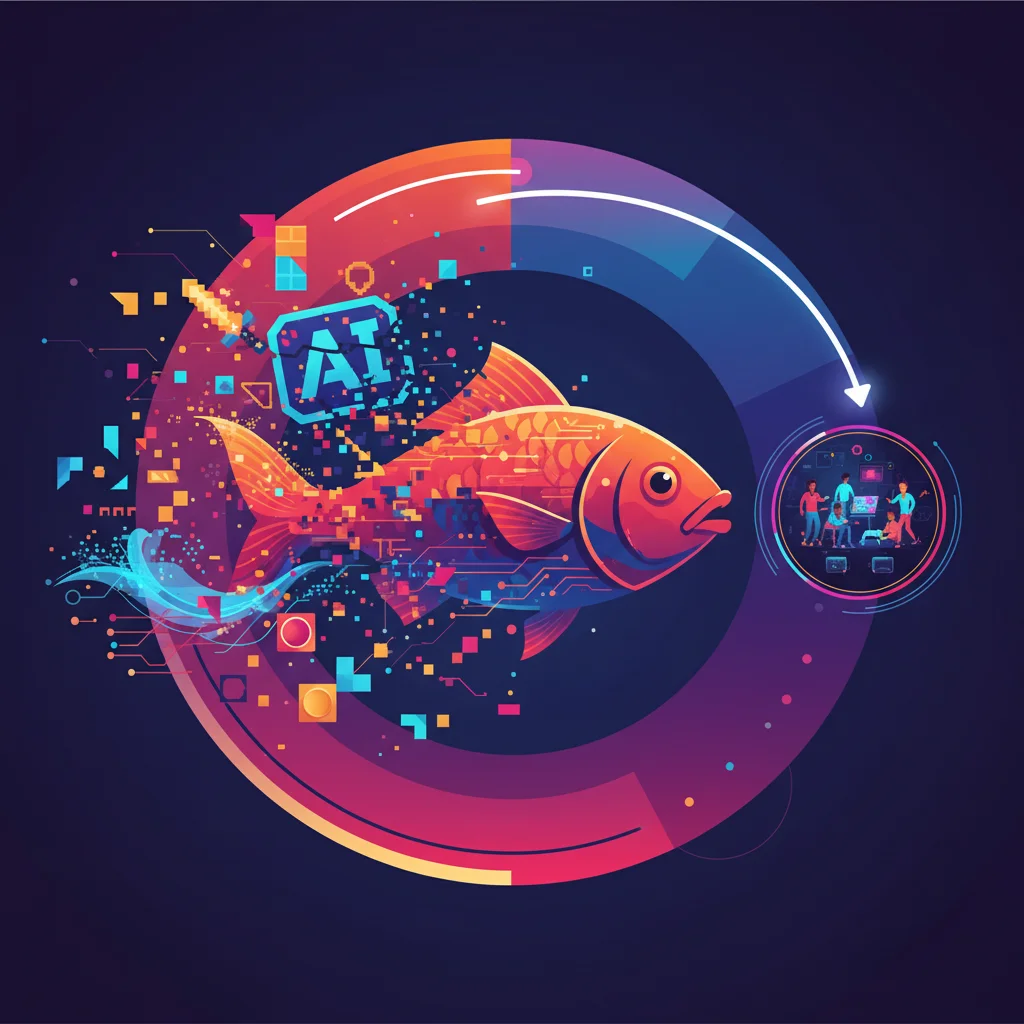
The ‘Made by AI’ Label Is a Red Herring. Here’s What the Gaming Industry Taught Us.
We’re living through a Cambrian explosion of artificial intelligence. From stunning video clips generated by OpenAI’s Sora to hyper-realistic images and incredibly fluent text, generative AI is no longer a futuristic concept—it’s a tool in our collective digital workshop. With this explosion comes a natural, and necessary, conversation about transparency. In response, tech giants like Meta, Google, and OpenAI are pushing for a simple solution: a “Made by AI” label. The idea is to clearly distinguish between human-made and machine-generated content.
On the surface, it sounds like a perfect fix. It promises clarity for consumers and accountability for creators. But is it really that simple? Or is this label a well-intentioned but ultimately flawed solution that creates more confusion than clarity?
To find the answer, we don’t need to look to the future. We just need to look at the recent past of an industry that has been grappling with the “made by a tool” debate for over a decade: video games. The experience of game developers suggests that the push for a generic AI label is not just impractical, but it completely misses the point.
A Tale of Two Engines: Lessons from the Gaming World
Anyone who has played a modern indie game is familiar with the splash screens that pop up when you launch the title: “Made with Unity” or “Powered by Unreal Engine.” For years, these labels have served as a form of transparency, indicating the core software or “game engine” used to build the experience. Game engines are sophisticated platforms that provide developers with foundational tools for rendering graphics, handling physics, managing audio, and more. In many ways, they are to game developers what large language models (LLMs) are becoming to creators of all stripes: a powerful foundation upon which to build.
However, the history of these labels is a powerful cautionary tale. In the early days, particularly for the Unity engine, the “Made with Unity” logo was sometimes associated with low-effort, low-quality games. It became a shorthand for “asset flips”—games cobbled together from pre-made assets with little original programming or artistry. A vocal minority of players would groan, assuming the game was destined to be a cheap knock-off.
But then, something changed. Masterpieces started emerging from these so-called “generic” engines. Games like Hollow Knight, Cuphead, and Genshin Impact—all built with Unity—showcased breathtaking art, innovative gameplay, and deep, engaging worlds. Suddenly, the engine was irrelevant. No one cared about the splash screen; they cared about the quality of the game. The tool didn’t define the art; the artist did. The lesson was clear: a powerful tool in the hands of a visionary creator can produce magic. In the hands of a lazy one, it produces shovelware. The label couldn’t tell you which was which.
Nvidia's Tightrope Walk: Navigating the High-Stakes US-China AI Chip War
The Spectrum of Creation: Why a Single Label Fails
The parallel to the “Made by AI” debate is striking. Just like a game engine, artificial intelligence is not a monolithic creator. It’s a tool, a collaborator, a brush, and an assistant, all rolled into one. Labeling a piece of work “Made by AI” is as unhelpful as labeling a Michelin-star meal “Made with a Stove.” It tells you nothing about the nuance, the skill, or the human intention behind the final product.
When someone says they “used AI,” what do they actually mean? The spectrum of involvement is vast, and a single label simply can’t capture that complexity.
To illustrate, let’s consider the different ways AI can be integrated into a creative or technical project:
| Level of AI Integration | Example in Software Development | Example in Creative Work | Is a “Made by AI” Label Informative? |
|---|---|---|---|
| AI-Assisted | Using GitHub Copilot for code completion and suggestions. | Using an AI-powered grammar checker or Photoshop’s Generative Fill to remove an object. | No. The human is still in full creative control. The AI is a productivity tool. |
| AI-Augmented | Generating boilerplate code or unit tests for a new software module. | Creating a background texture for a digital painting or generating musical accompaniment ideas. | Hardly. The core creative direction and key elements are human-led. |
| AI-Collaborated | Using a machine learning model to optimize a complex algorithm for a SaaS platform. | Writing a story where a human provides the plot points and an AI generates the descriptive prose. | Partially, but it lacks crucial context about the human-AI partnership. |
| AI-Generated | An AI agent that autonomously writes, tests, and deploys a simple application based on a prompt. | A short film where the script, visuals, and soundtrack are all created by generative AI models. | Yes, but this is the least common and most extreme use case. |
As the table shows, the vast majority of current and near-future AI use cases fall into the “assisted” and “augmented” categories. Slapping the same label on a developer using AI for code suggestions and a system that generates deepfake videos is a categorical error. It punishes the innovator for using smart tools and fails to properly identify the truly problematic content.
Beyond the Label: What We Should Actually Be Asking
If the label is a red herring, what should consumers, developers, and entrepreneurs be focusing on? The conversation needs to shift from the tool to the process and the principles behind it.
1. Provenance and Ethics
Instead of asking “Was AI used?”, we should ask, “Was the AI model trained ethically?” This is the billion-dollar question at the heart of dozens of lawsuits against AI companies. For creators and consumers, knowing that an AI tool was built on a foundation of ethically sourced, properly licensed data is far more important than knowing it was used to help write a marketing email. For startups in the AI space, building on an ethically sound data foundation isn’t just good practice; it’s a critical defense against future legal and reputational risks.
2. Intent and Application
The purpose behind the use of AI matters immensely. Is a developer using automation to handle repetitive tasks so they can focus on high-level creative problem-solving? That’s a net positive for innovation. Is a company using AI to generate hundreds of low-quality articles to game search engine rankings? That’s a net negative. The intent separates value-additive applications from spam. The backlash seen in some gaming communities, such as on the platform Steam, has been less about the use of AI itself and more about the fear that it will be used for low-effort “asset-flipping”, devaluing the work of human artists.
3. Quality and Execution
Just as the gaming world learned, the final product is the ultimate judge. An incredible film, a revolutionary piece of software, or a beautifully written novel will stand on its own merits. If AI was part of the process, it becomes an interesting footnote, a “behind-the-scenes” detail. If the product is bad, derivative, or soulless, blaming the AI is an excuse. The responsibility always lies with the human creator who signed off on the final output. Audiences and markets are ruthless meritocracies; quality eventually wins out over novelty.
The AI Arms Race is a Myth: China is Hosting a Study Group, and You're Invited
The Way Forward: Meaningful Transparency for a New Era of Creation
For developers, tech professionals, and entrepreneurs, navigating this new landscape requires a more nuanced approach than simply checking a box for an AI label.
- Be Transparent About Process, Not Just Tools: Instead of a generic label, share your creative process. Write a blog post explaining how you used a machine learning model to analyze user data and improve your SaaS product’s features. Create a video showing how generative AI helped you prototype 3D models faster, allowing your small team to build a richer game world. This kind of transparency builds trust and educates your audience.
- Focus on the “Why”: Explain why you turned to AI. Did it unlock a creative possibility that was previously out of reach? Did it accelerate your development timeline, allowing your startup to compete with larger incumbents? Connecting AI use to a compelling mission is far more powerful than a simple disclosure.
- Prioritize Cybersecurity and Responsibility: As you integrate AI, especially with cloud-based services, ensure your data pipelines and models are secure. Responsible AI usage also means having humans in the loop to review and validate AI-generated output, preventing the propagation of errors or biased information.
The “Made by AI” label is a 20th-century solution for a 21st-century reality. It’s a binary answer to a spectral question. The video game industry’s journey with engine labels has already played this movie for us, and the ending is clear: people stop caring about the tools when the creations are compelling enough. Our focus should not be on stigmatizing or blindly celebrating a technology, but on championing the human creativity, ethical considerations, and relentless pursuit of quality that truly matter.
Hollywood's 8B AI Power Play: Why the Paramount vs. Warner Bros. Saga is a Tech Epic
Ultimately, the most important label isn’t “Made by AI” or “Made by Human.” It’s “Made with Care.” And no machine can automate that.

Related Posts

AI Inside: Why a ‘Made by Humans’ Label Isn’t as Simple as It Sounds
The Wimpy Kid Glitch: What a Movie Mix-Up on Amazon Reveals About the Fragility of Our Automated World