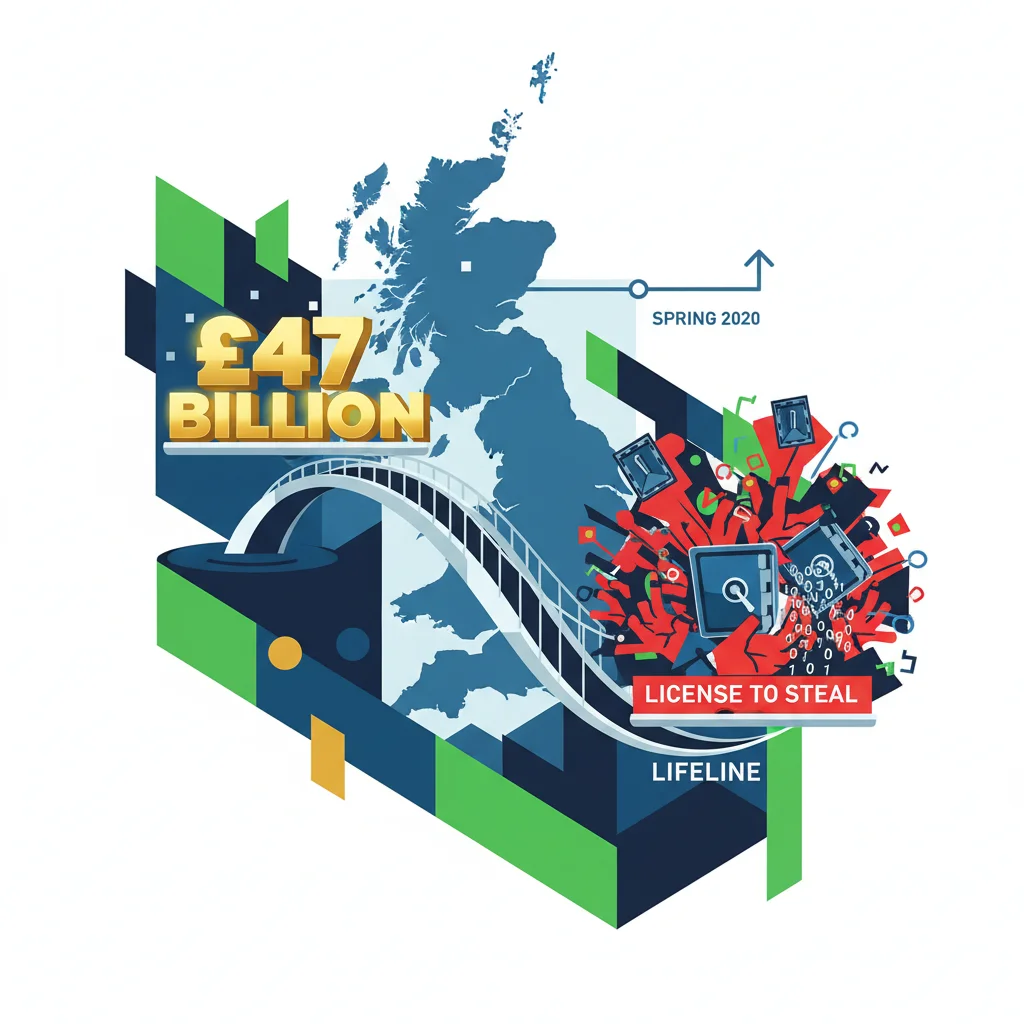
The £47 Billion Gamble: Was the UK’s COVID Loan Scheme a Lifeline or a License to Steal?
In the frantic spring of 2020, as the global economy teetered on the brink of an abyss, governments worldwide unleashed unprecedented financial firepower to avert a total collapse. In the United Kingdom, one of the flagship policies was the Bounce Back Loan Scheme (BBLS), a program designed to inject cash into small businesses with breathtaking speed. Now, years later, the scheme is under intense scrutiny, with Prime Minister Rishi Sunak, the Chancellor at the time, defending it against claims of “excessive” fraud. The controversy forces us to confront a critical dilemma in crisis management: when faced with economic armageddon, how much risk is too much?
This article delves into the complex legacy of the Bounce Back Loan Scheme. We will dissect its architecture, explore the high-stakes trade-off between speed and security, analyze the staggering scale of the fraud, and consider the lasting implications for the UK economy, public finance, and the future of financial technology in crisis response.
The Anatomy of a Crisis Lifeline
To understand the controversy, one must first appreciate the sheer panic of March 2020. Businesses were ordered to close, supply chains disintegrated, and the very fabric of the commercial world seemed to be unraveling. The government’s primary fear was a domino effect of mass insolvencies and catastrophic unemployment. The BBLS was the emergency defibrillator intended to restart the heart of the UK’s small business economy.
Launched in May 2020, the scheme’s design was predicated on one thing: velocity. It allowed small businesses to borrow between £2,000 and £50,000, capped at 25% of their turnover. The revolutionary and, as it turned out, highly perilous feature was the 100% government guarantee to the lender. This removed almost all risk for the banks, incentivizing them to approve loans at a pace never before seen in commercial banking. The application process was radically simplified, often relying on self-certification from the business owners with minimal credit or fraud checks.
The scale of the rollout was monumental. In a matter of months, a financial bazooka was fired, providing what many saw as an essential lifeline. Below is a summary of the scheme’s key statistics, which illustrate the immense scope of the intervention.
| Metric | Figure |
|---|---|
| Total Value of Loans | £47.36 billion (source: National Audit Office) |
| Number of Loans Approved | Over 1.5 million |
| Government Guarantee | 100% of loan value |
| Estimated Fraudulent Loans (as of Dec 2021) | £4.9 billion (11% of total) (source: BEIS) |
| Interest Rate | 2.5% fixed |
This data highlights the sheer volume of capital deployed. For millions of legitimate business owners, these funds were the difference between survival and bankruptcy. However, the same features that made it a lifeline also made it a magnet for abuse.
The £13,000 Cloned Car: A Modern Parable for Investors on Risk, Trust, and Technology
Speed vs. Security: A Justifiable Trade-Off?
Rishi Sunak’s core defense, as reiterated recently, is that the potential economic devastation warranted the risk. He argued that if the government had spent months building a perfect, fraud-proof system, “hundreds of thousands of businesses would have failed” in the interim. This is the classic crisis-response conundrum. In the world of economics and public finance, it represents a high-stakes bet on the immediate health of the economy at the expense of future fiscal liabilities.
The argument for speed has merit. The UK economy was contracting at its fastest rate on record. Delay meant permanent scarring: lost jobs, shuttered businesses, and eroded consumer confidence that could take a decade to rebuild. The government effectively chose to underwrite the entire small business sector, using the commercial banking infrastructure, supercharged by financial technology, as its distribution network. The fintech platforms and digital onboarding processes used by many banks were crucial to disbursing funds so quickly, a testament to the evolution of modern banking.
Conversely, critics argue the government was naive, creating a “bonanza for fraudsters.” Reports from the National Audit Office (NAO) and other bodies highlighted that the government was warned about the risks from the outset but chose to proceed. The lack of robust checks meant that criminals could create shell companies, inflate turnover figures, and take out multiple loans with impunity. The 100% taxpayer guarantee created a moral hazard, as lenders had little incentive to perform their own due diligence, turning the process into a high-speed, low-friction conveyor belt for cash.
The Long Shadow: Economic Fallout and the Hunt for Lost Billions
The BBLS has left an indelible mark on the UK’s public finances. The £4.9 billion in estimated fraud, combined with billions more in legitimate loans that will inevitably default due to business failures, represents a significant liability for the British taxpayer. This debt is not abstract; it will be paid for through future taxes or reduced public spending, impacting the national economy for years to come.
The government’s National Crime Agency is now engaged in a painstaking and costly effort to track down the fraudsters and recover the funds. Successes have been reported, but they represent a fraction of the total losses. Much of the money was quickly moved out of the country or dissipated through complex networks, making recovery a monumental challenge. This ongoing saga has significant implications for the stock market and investing community, as the scale of national debt and the government’s fiscal credibility are key factors influencing investor confidence and the UK’s sovereign risk profile.
Scoops, Stocks, and Social Justice: The Billion-Dollar Battle for Ben & Jerry's Soul
The political fallout is equally significant. The scheme has become a symbol of the government’s pandemic-era spending, fueling a narrative of waste and mismanagement that continues to dog those who were in charge. For investors and business leaders, it raises important questions about governance and the state’s ability to manage large-scale financial interventions effectively.
Lessons for the Future: Fintech, Regulation, and Crisis Preparedness
The BBLS fiasco, while costly, provides invaluable lessons for the next inevitable crisis. The central challenge remains: how do you disburse vast sums of money quickly, but securely? The answer may lie in smarter financial technology and a more dynamic approach to regulation.
Several key takeaways emerge:
- Leveraging Advanced Fintech: Future schemes could mandate the use of more sophisticated fintech solutions. This includes digital identity verification, AI-powered tools to spot anomalous applications in real-time, and cross-referencing applications against tax records and other government data. While some of this was used, a more integrated, government-led data infrastructure could have prevented much of the fraud.
- The Potential of Blockchain: While not a silver bullet, distributed ledger technology, or blockchain, offers a potential framework for creating more transparent and tamper-proof systems for disbursing funds. A secure, centralized ledger could have prevented individuals from receiving multiple loans for the same business or non-existent entities.
- Dynamic Risk-Scoring: Instead of a one-size-fits-all approach with minimal checks, a dynamic system could have been implemented. Applications could have been triaged using a risk score, with low-risk, well-established businesses getting instant approval, while newer or less-documented businesses underwent slightly more rigorous (but still fast) automated checks.
- Smarter Guarantees: A 100% state guarantee, while effective at encouraging bank participation, eliminated the lenders’ “skin in the game.” A 90% or 95% guarantee might have preserved the speed while encouraging banks to apply at least a light layer of their own fraud-detection expertise.
The intersection of banking, technology, and government policy is where the solution lies. The future of effective economic response will depend not on massive, blunt-force spending, but on precise, data-driven, and technologically advanced interventions.
Conclusion: A Legacy of Complexity
The Bounce Back Loan Scheme cannot be judged as a simple success or failure. It was a desperate measure for desperate times. It undoubtedly saved thousands of businesses and jobs, cushioning the UK economy from the pandemic’s initial, terrifying shock. Yet, it also exposed the public purse to an unprecedented level of fraud, revealing deep vulnerabilities in the government’s ability to manage crisis spending.
For finance professionals, investors, and business leaders, the BBLS is a powerful case study in risk, reward, and the unintended consequences of massive government intervention in the economy. The debate over whether the trade-off was worth it will continue for years. The only certainty is that the lessons learned from this £47 billion gamble must be embedded into the core of our economic and financial technology infrastructure. The next crisis is not a matter of ‘if’, but ‘when’, and our preparedness will be the ultimate legacy of this controversial chapter in British economic history.

Related Posts

Beyond the Paycheck: How the UK’s New Employment Bill Will Reshape the Investment Landscape

The Billion-Dollar Question: Should the UK Pay Whistleblowers to Expose Financial Crime?