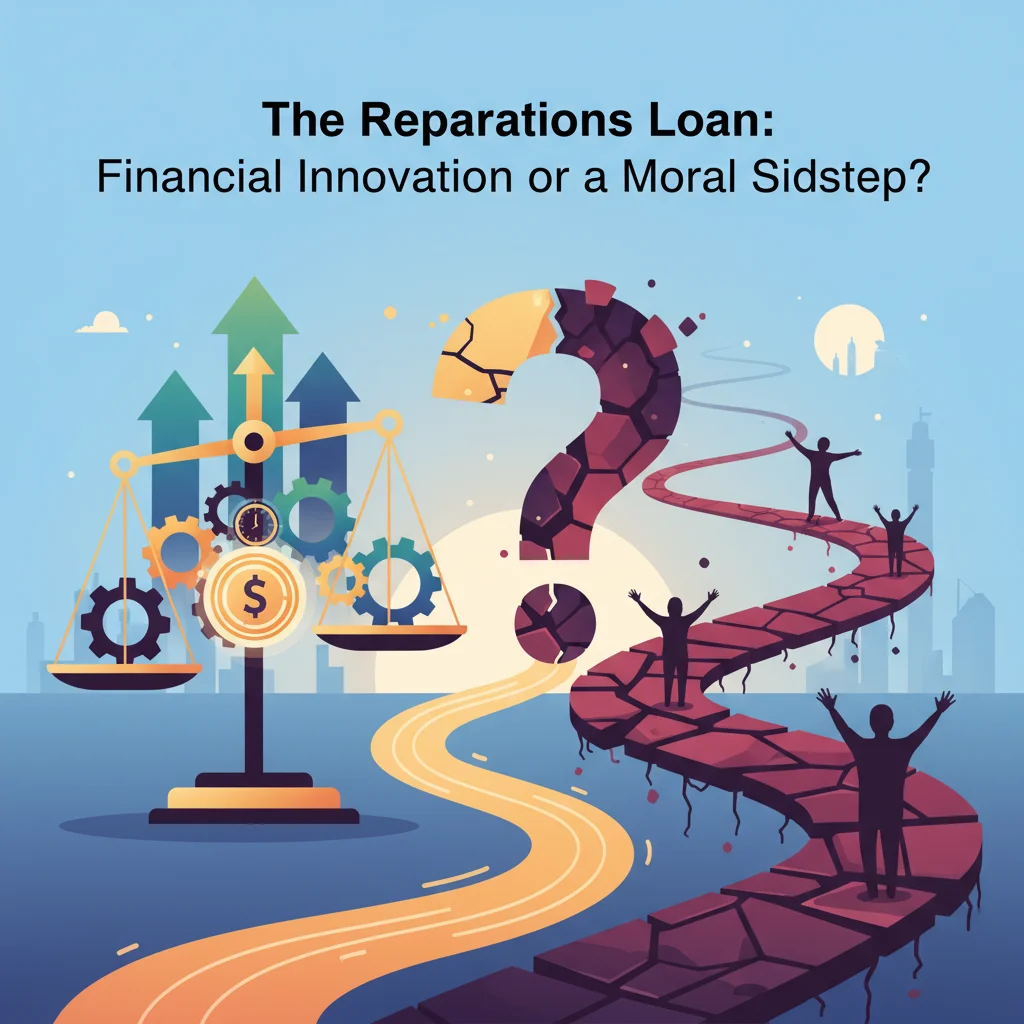
The Reparations Loan: Financial Innovation or a Moral Sidestep?
The conversation around reparations for historical injustices, particularly slavery and its enduring legacy, is gaining significant traction in public discourse. As the debate moves from the philosophical to the practical, the crucial question becomes: “How?” The mechanics of such a monumental undertaking are fraught with economic, political, and ethical complexities. Amidst proposals for direct payments, community investments, and educational funds, a more contentious idea has emerged—structuring reparations as a loan. This concept, highlighted in a recent letter to the Financial Times, frames the approach as a form of “legal game-playing,” a way to acknowledge a debt without truly paying it.
This proposal forces us to look beyond the headlines and delve into the intricate world of finance, economics, and public policy. Is a reparations loan a pragmatic, innovative financial solution for an unprecedented challenge? Or is it a fundamental misapplication of financial tools, one that sidesteps the moral core of the issue by transforming an act of atonement into a new form of debt? This article will dissect the financial architecture of a reparations loan, weigh its economic arguments, and place it within a broader historical and ethical context to understand what is truly at stake.
Deconstructing the Financials: What is a Reparations Loan?
At its core, a loan is a contract based on future repayment. Applying this to reparations is a novel and controversial concept. While specific proposals vary, a reparations loan program would likely involve the government (the lender) extending capital to eligible individuals or communities (the borrowers) under specific terms. These terms are where the financial engineering and the ethical dilemmas begin.
Key variables would include:
- Interest Rate: Would the loans be interest-free to avoid compounding the economic burden? A zero-interest, or “concessionary,” loan is common in development finance, but applying it here is symbolically charged. Charging any interest, no matter how low, could be seen as profiting from the very injustice the program aims to redress.
- Repayment Terms: Over what period would the loan be repaid? Decades? Generations? Would it be forgivable upon meeting certain conditions, such as starting a business or purchasing a home?
- Principal and Purpose: Would the loan be a general-purpose cash facility, or would it be restricted for specific uses like education, housing, or entrepreneurship? This touches on the debate between paternalistic policy and economic self-determination.
From a purely fiscal perspective, proponents might argue a loan is more palatable to taxpayers and less disruptive to the national economy. It would be accounted for as an asset on the government’s balance sheet, rather than a direct expenditure, mitigating the immediate impact on the national debt. Modern financial technology (fintech) platforms could be deployed for efficient distribution and management, tracking the use of funds and managing repayment schedules on a massive scale. However, this clinical, balance-sheet approach is precisely what critics find so troubling.
The New Political Risk: Is Crony Capitalism Threatening Your US Investments?
The Economic Tightrope: A Tool for Growth or a Debt Trap?
The economic arguments for and against a loan-based reparations model are deeply divided. They hinge on whether one views the problem as a lack of capital that can be solved with credit, or a historical injustice that requires a definitive transfer of wealth.
One of the most persistent economic disparities is the racial wealth gap. According to a 2022 report from the Federal Reserve, the typical White family has a net worth of $285,000, while the typical Black family’s net worth is $44,900—a staggering difference (source). The core question is whether debt is the right instrument to close this gap.
To clarify the competing models, the following table compares the primary approaches to reparations:
| Reparations Model | Financial Mechanism | Potential Pros | Potential Cons |
|---|---|---|---|
| Direct Grants/Payments | Direct wealth transfer from the government to individuals/communities. No repayment required. | Directly addresses the wealth gap; clear act of atonement; maximizes individual autonomy. | High upfront cost to the government; potential for inflation; politically contentious. |
| Loan Program | Government extends capital with an obligation for future repayment, possibly with zero interest. | Lower immediate impact on national debt; can be structured to encourage specific investments (e.g., business). | Creates a new debt burden; ethically questionable as “reparation”; complex to administer. |
| Community Investment Fund | Government capitalizes funds dedicated to long-term investment in housing, education, and infrastructure in targeted communities. | Focuses on systemic issues and long-term growth; builds community wealth; potential for professional management. | Less direct impact on individual wealth; benefits are diffuse and slow to materialize; potential for mismanagement. |
A loan program, while fiscally appealing on paper, risks creating a moral hazard. It saddles recipients with a new financial obligation as a supposed remedy for a historical one. Instead of a clean slate, it offers a leveraged start, where the risk of failure results in debt. This is fundamentally different from how historical precedents for reparations have been handled.
Historical Precedents: A Debt of Justice, Not Credit
When examining historical examples, the concept of a loan is conspicuously absent. The goal has consistently been restitution, not credit.
- Post-Holocaust Germany: Through the Claims Conference, Germany has paid over $90 billion in indemnification to Jewish victims of the Holocaust since 1952 (source). These were grants and pensions—direct payments acknowledging responsibility, not loans expecting repayment.
- Japanese American Internment: The Civil Liberties Act of 1988, signed by President Ronald Reagan, issued a formal apology and paid $20,000 to each surviving victim of internment during World War II. This was a direct, tax-free payment, a symbolic and tangible act of redress.
These examples establish a clear principle: reparations are a payment for a wrong committed. They are a closing of a moral ledger, not the opening of a financial one. Framing a solution as a loan breaks sharply with this established international and historical precedent, suggesting a different, and arguably lesser, form of accountability.
Market Implications and the Broader Economy
Regardless of the form it takes, a reparations program on the scale being discussed—often estimated in the trillions of dollars—would have significant consequences for the U.S. economy and its financial markets.
A massive direct-payment program would inject huge amounts of liquidity into the economy, raising legitimate concerns about inflation. It would also dramatically increase the national debt, potentially affecting interest rates and the government’s borrowing costs. The impact on the stock market would be complex; consumer-facing sectors might see a boom, while the broader market could react nervously to the fiscal expansion.
A loan program would have a different, more muted initial impact. The immediate hit to the national debt would be smaller. However, it would create a new, massive class of financial assets—government-held reparations loans. It’s not hard to imagine a future where these loans are securitized and traded on secondary markets, creating a new frontier of investing. This raises its own set of ethical questions about Wall Street potentially profiting from instruments born of historical injustice.
Furthermore, the long-term economic stimulus of a loan program is debatable. As a study from the Roosevelt Institute notes, policies aimed at closing the racial wealth gap must be “ambitious in scale and scope” to be effective (source). A program that simultaneously injects capital while creating debt may work at cross-purposes, limiting the very wealth-creation it is intended to foster.
Conclusion: The Currency of Justice
The idea of a reparations loan is a testament to the power of financial innovation, but it may be a solution in search of the wrong problem. It applies the logic of banking and credit to a matter of moral and historical justice, and the two are not interchangeable. While potentially more politically and fiscally convenient in the short term, a loan-based model risks perpetuating a cycle of debt and falls short of the restorative spirit that animates the very concept of reparations.
As this debate continues, business leaders, investors, and policymakers must ask a fundamental question: What is the goal? If it is simply to inject capital into underserved communities, then a loan is one of many tools. But if the goal is to atone for a profound historical wrong and definitively close a chapter of economic injustice, then the currency must be one of genuine restitution, not credit. The form of the payment is not a minor detail; it is a message in itself, defining whether we are settling a debt or simply refinancing it for a new generation.

Related Posts
Navigating the Void: Rishi Sunak, the COVID Economy, and the Playbook That Never Was

The Surveillance Premium: How America’s Watchful Eye Creates a Haven for Investors