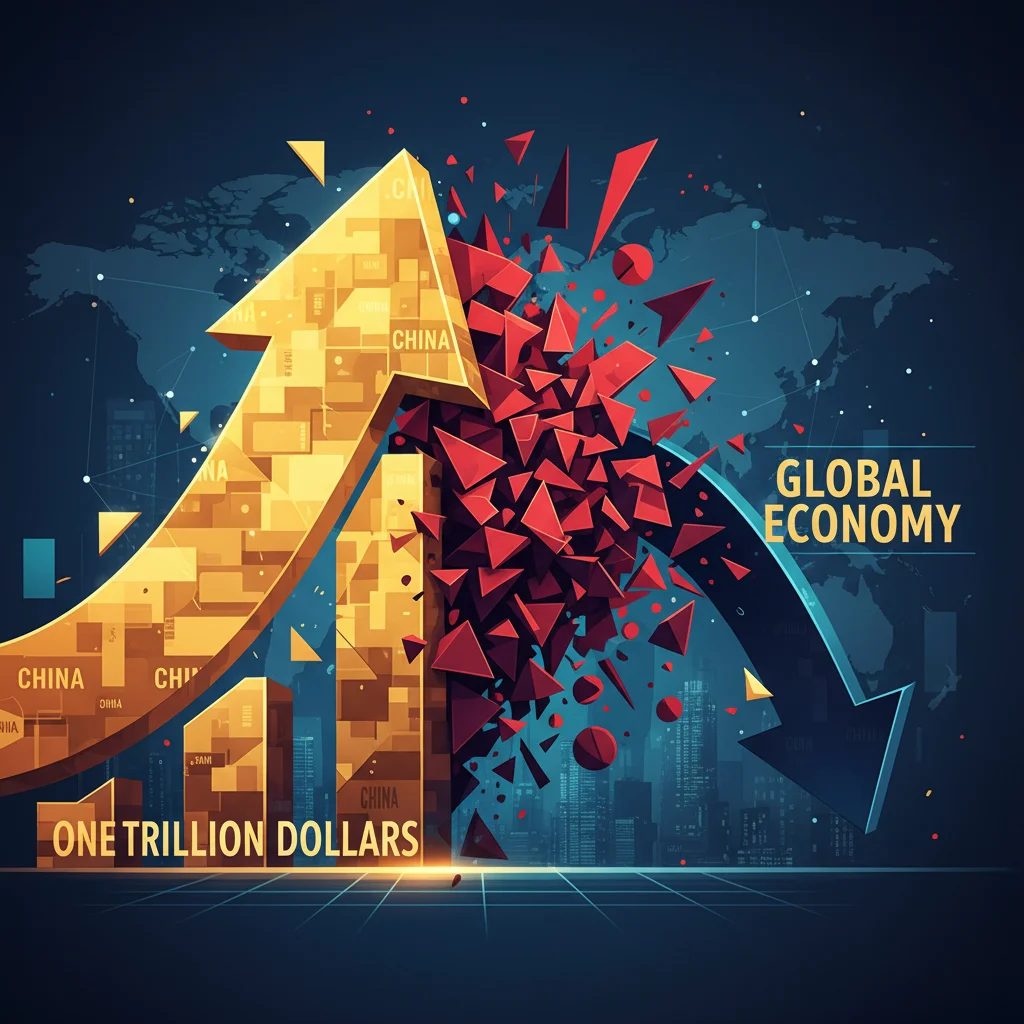
The Trillion-Dollar Paradox: Why China’s Record Trade Surplus Is a Red Flag for the Global Economy
A Staggering Figure with a Hidden Warning
At first glance, a trade surplus nearing one trillion dollars sounds like an incredible feat of economic strength. For China, it represents a monumental flow of capital into the country, seemingly cementing its status as the world’s manufacturing powerhouse. However, peeling back the layers of this colossal figure reveals a much more complex and troubling story. This isn’t a sign of a booming, healthy economy; it’s a symptom of a deep-seated structural imbalance that poses a significant threat not only to Beijing’s long-term stability but to the entire global economic order.
The core of the issue lies in a simple but critical disparity: China is producing far more than it consumes. While its factories are running at full tilt, churning out everything from electric vehicles to solar panels, its own citizens are not buying. This has forced China to push its massive surplus of goods onto the global market at an unprecedented scale, a strategy that is becoming increasingly unsustainable. For investors, finance professionals, and business leaders, understanding this paradox is crucial, as it signals a new era of trade friction, geopolitical tension, and stock market volatility.
Deconstructing the Surplus: A Tale of Two Trends
A country’s trade balance is the difference between its exports (goods sold to other countries) and its imports (goods bought from other countries). China’s gargantuan surplus is the result of two divergent trends that paint a stark picture of its domestic economy.
- Surging Exports: China has aggressively ramped up its export machine, particularly in high-tech, green-energy sectors. This is a deliberate policy choice by Beijing.
- Slumping Imports: Simultaneously, China’s demand for foreign goods has stagnated. Imports, when measured in volume, were reportedly no higher last year than they were in 2018 (source).
This isn’t a short-term blip; it’s a clear indicator of profound weakness in domestic demand. The Chinese consumer, once hailed as the next great engine of global growth, is hesitant. The lingering scars of draconian zero-Covid policies, a deepening crisis in the property market that has wiped out household wealth, and a general sense of economic uncertainty have crippled consumer confidence. When people are worried about their jobs and the value of their primary asset (their home), they save instead of spend. This reality is reflected in the weak import numbers, creating a domestic demand vacuum that the state is trying to fill with exports.
The Monroe Doctrine 2.0: What a US 'Peace Through Strength' Policy Means for the Global Economy
Beijing’s Gamble: Exporting Its Way Out of a Crisis
Faced with a sluggish domestic economy, Beijing has chosen to double down on what it knows best: state-led investment in industrial production. The government is pouring capital into what it calls the “new productive forces”—a trio of strategic industries intended to dominate the future of global technology and energy.
This table highlights the key sectors at the heart of China’s export-focused strategy:
| Strategic Sector | Description & Global Ambition |
|---|---|
| Electric Vehicles (EVs) | China is already the world’s largest EV producer and is aggressively expanding its presence in Europe, Southeast Asia, and Latin America, often at highly competitive prices. |
| Solar Panels | Having long dominated the solar supply chain, China is increasing production to meet global green energy targets, effectively controlling the market. |
| Lithium-ion Batteries | As a critical component for EVs and energy storage, China’s dominance in battery technology and production gives it immense leverage in the global energy transition. |
From Beijing’s perspective, this strategy kills two birds with one stone: it maintains GDP growth and employment while positioning China as the indispensable leader in the technologies of the future. However, the economic consequence is that China is effectively exporting its domestic problems—namely, overcapacity and deflation—to the rest of the world. When a country produces far more of something than it can absorb, prices fall. By flooding global markets with low-cost goods, China puts immense pressure on manufacturers in other nations, threatening jobs and industrial stability abroad. This sets the stage for a major international confrontation.
The Inevitable Global Backlash
The world is not standing idly by. The flood of Chinese exports is already triggering a fierce backlash from its primary trading partners, who view it as an unfair competitive threat fueled by state subsidies. The playbook of responses is predictable, and the first moves are already underway.
Both the United States and the European Union have launched investigations into China’s industrial practices. The EU is scrutinizing subsidies in the Chinese EV industry, a probe that is widely expected to result in defensive tariffs. Similarly, Washington, operating under a bipartisan consensus that is hawkish on China, is likely to erect further trade barriers to protect its domestic industries. According to the Financial Times article, China’s current account surplus is now over 1.5% of global GDP, a level of imbalance that historically triggers a protectionist response (source).
This isn’t just a problem for developed nations. Emerging economies in Southeast Asia and Latin America, which are trying to build their own manufacturing bases, find themselves in direct competition with a state-subsidized industrial giant. The result is a growing global trend towards protectionism that threatens to unwind decades of economic integration. This fragmentation of the global economy creates uncertainty for international trading and complicates corporate financial planning.
Beyond the Stream: Why the Netflix-Warner Bros. Deal Rewrites the Rules of Media and Finance
The Core of the Problem: China’s Unbalanced Economy
Tariffs and trade wars are merely symptoms of a deeper, more fundamental problem within China’s economic model: the dangerously low share of consumption in its GDP. For years, economists have warned that for China’s growth to be sustainable, it must rebalance away from an over-reliance on investment and exports and towards domestic consumption. Yet, Beijing has repeatedly failed to enact the necessary reforms.
Why? Because a genuine rebalancing would require a massive transfer of wealth from the state to households. It would mean:
- Building a robust social safety net: If citizens had confidence in their pensions, healthcare, and unemployment benefits, they would feel more secure and be more willing to spend rather than save.
- Empowering private enterprise and consumers: This would involve reforming the state-dominated banking system, which currently funnels cheap credit to large, state-owned manufacturers rather than to small businesses or for consumer loans.
- Allowing wages to rise faster: For consumption to grow, household income must command a larger share of the national economic pie.
These are politically difficult reforms that challenge the very foundations of China’s state-led model. It is far easier for the government to issue directives to build more factories than it is to empower 1.4 billion consumers. While advances in financial technology, or fintech, could play a role in expanding consumer credit, they cannot solve the fundamental lack of confidence and the structural tilt away from household income. Until this core imbalance is addressed, China will remain locked in a cycle of overproduction and dependence on foreign markets—a cycle that now threatens global stability.
The Unraveling of a Fabric Empire: A Cautionary Tale in Finance and Brand Equity
Implications for Investors and the Future of the Global Economy
China’s trillion-dollar trade surplus is not a trophy but a flashing red light on the dashboard of the global economy. It signals that the country’s long-standing growth model has reached its limits and is now exporting instability abroad. For those in finance, investing, and business, the key takeaways are clear:
- Expect Increased Volatility: The coming wave of protectionism and trade disputes will create significant headwinds for specific sectors, particularly automotive, renewable energy, and advanced manufacturing. The stock market will be highly sensitive to tariff announcements and geopolitical developments.
- Re-evaluate Supply Chain Risk: Businesses that rely heavily on Chinese manufacturing must prepare for a more fragmented and unpredictable global trading environment. Diversification is no longer a strategic choice but a necessity.
- Monitor China’s Domestic Data: The most important indicators coming out of China are no longer just its GDP figures, but its retail sales and consumer confidence numbers. Any sign of a genuine shift towards pro-consumption policies would be a major—and positive—turning point for the global economy.
Ultimately, the world is too small to absorb China’s massive overcapacity indefinitely. The path to sustainable global growth requires a more balanced Chinese economy, one where the purchasing power of its own people becomes the primary engine of its prosperity. Without that fundamental shift, the trillion-dollar paradox will continue to loom large, fueling conflict and uncertainty for years to come.

Related Posts

The Brussels Effect in Reverse: Is Europe’s Regulatory Empire Stifling Its Own Economy?
An 88-Year Streak Broken: Why VW’s German Factory Closure Signals a Seismic Shift in the Global Economy