The Brussels Effect in Reverse: Is Europe’s Regulatory Empire Stifling Its Own Economy?
The Unraveling of a Superpower’s Signature Move
For decades, the term “Brussels effect” was a testament to the European Union’s immense, yet subtle, global power. It described the bloc’s unique ability to export its regulations worldwide. By setting stringent standards for its vast, wealthy single market of 450 million consumers, the EU compelled international corporations—from Silicon Valley tech giants to Asian manufacturers—to adopt its rules as the de facto global norm. It was a masterful display of soft power, shaping everything from data privacy (with GDPR) to chemical safety without firing a single shot. This regulatory dominance was not just a political victory; it was a cornerstone of the European economy, creating a predictable and high-standard environment.
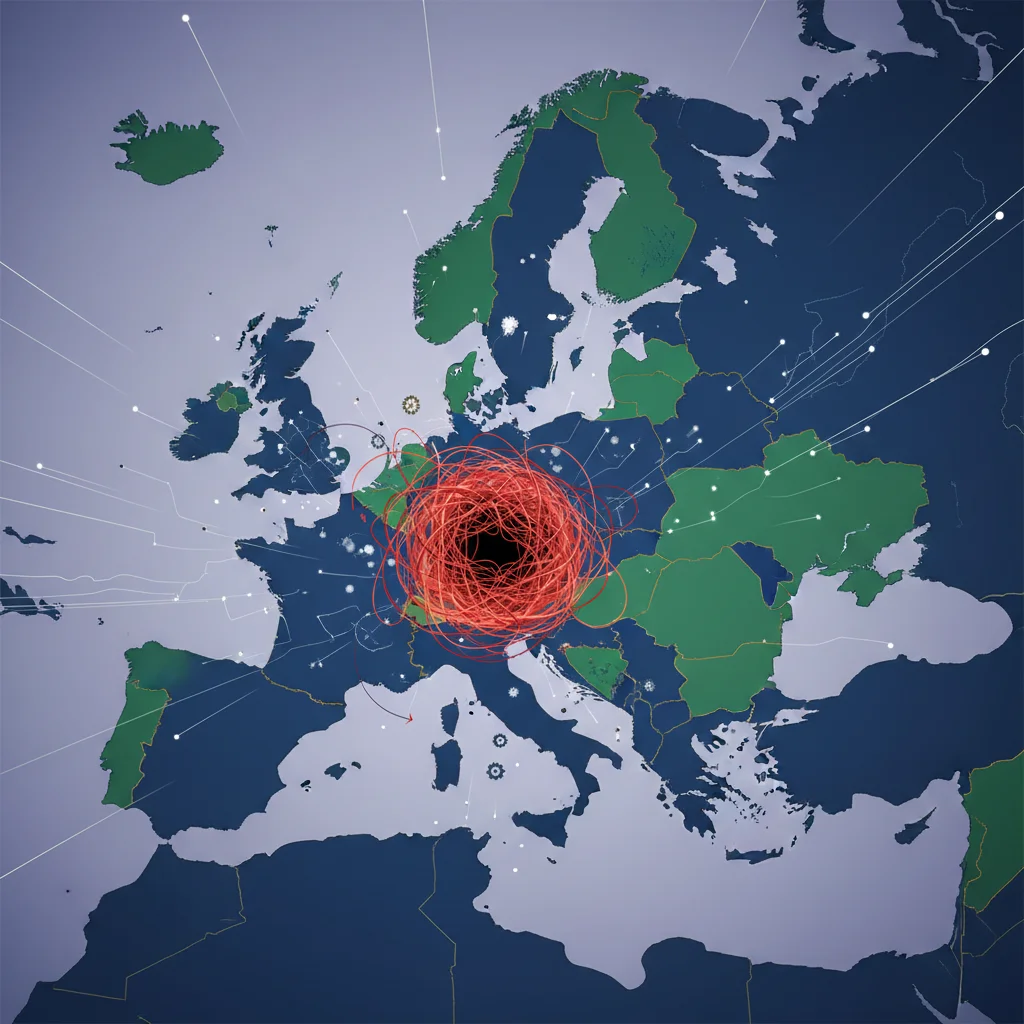
However, the ground is shifting. What was once a source of strength and stability is now being described as a potential liability. A wave of ambitious, sprawling, and often cumbersome regulations is causing a chilling effect on innovation and investment. The very machine designed to project European values is now at risk of isolating its own market, raising a critical question for business leaders, investors, and finance professionals: Is the Brussels effect backfiring?
This analysis will delve into the decline of the EU’s regulatory influence, exploring the economic consequences for key sectors like financial technology and banking, and what this new reality means for the future of global investing and trade.
From Global Standard-Setter to Regulatory Overreach
The logic behind the Brussels effect was simple and powerful. It was often more cost-effective for a multinational company to design a single product compliant with the EU’s high standards and sell it globally, rather than creating multiple versions for different markets. The General Data Protection Regulation (GDPR) is the textbook example. Despite initial grumbling, companies worldwide overhauled their data practices to comply, effectively making EU privacy standards the global baseline.
Buoyed by such successes, the EU’s ambition grew. In recent years, Brussels has unleashed a firehose of complex legislation aimed at shaping the future of the digital and green economies. This includes the AI Act, the Digital Services Act (DSA), the Digital Markets Act (DMA), the Carbon Border Adjustment Mechanism (CBAM), and the Corporate Sustainability Due Diligence Directive (CSDDD), to name just a few. According to one analysis mentioned in the Financial Times, the EU’s legislative output has been staggering, creating a dense web of compliance obligations.
But this hyperactivity has come at a cost. The key pillars supporting the Brussels effect are beginning to crumble:
- Geopolitical Pushback: The world is no longer passively accepting EU leadership. The US, China, and India are now actively forging their own regulatory paths in critical areas like artificial intelligence and blockchain technology. This is leading to a fragmented global landscape, not a harmonized one.
- Economic Drag: The sheer volume and complexity of new rules are creating a significant drag on European competitiveness. Businesses are diverting vast resources from innovation to compliance. Start-ups in high-growth sectors like fintech face daunting barriers to entry, making them more likely to launch and scale in less restrictive jurisdictions.
- Loss of Credibility: The EU is increasingly seen not as a neutral standard-setter but as a protectionist power using regulation to shield its own industries. This perception undermines the legitimacy needed for its rules to be adopted voluntarily abroad.
The “first-mover advantage” in regulation is turning into a “first-sufferer disadvantage,” where European companies are the first to bear the costs and constraints, while international rivals watch, learn, and adapt from a distance.
The Impact on Finance, Technology, and Investment Portfolios
The backfiring of the Brussels effect is not an abstract political debate; it has tangible consequences for the world of finance. The EU’s regulatory approach is creating new risks and altering the calculus for investors and financial institutions.
For instance, the EU’s landmark Markets in Crypto-Assets (MiCA) regulation, while providing some legal clarity for the blockchain space, is also viewed by some as highly prescriptive. It could potentially stifle the kind of rapid, permissionless innovation that characterizes the sector. Innovators may choose to develop new decentralized finance (DeFi) protocols in more flexible jurisdictions like Switzerland or Dubai, leaving the EU’s banking and financial sectors to play catch-up.
Below is a comparison of the intended goals of recent EU regulations versus their emerging, often unintended, consequences for the business and investment environment.
| EU Regulation | Intended Goal (The Promise) | Unintended Consequence (The Reality) |
|---|---|---|
| GDPR (General Data Protection Regulation) | Set a global gold standard for data privacy and empower consumers. | Created a massive compliance industry and disproportionately burdened small businesses and startups. |
| AI Act | Foster trustworthy, human-centric AI and mitigate high-risk applications. | Fears of stifling innovation, causing AI developers to geofence Europe or launch elsewhere first. Major labs have voiced concerns (source). |
| CBAM (Carbon Border Adjustment Mechanism) | Prevent “carbon leakage” by taxing carbon-intensive imports, encouraging global green transition. | Viewed as “green protectionism” by trading partners, risking retaliatory tariffs and disrupting global supply chains. |
| MiCA (Markets in Crypto-Assets) | Provide a clear, harmonized framework for crypto-assets to protect investors and ensure financial stability. | Could limit DeFi innovation and push cutting-edge blockchain projects outside the EU. |
For investors, this translates into a “regulatory risk premium” for European assets. When evaluating a European company, one must now meticulously assess its exposure to the ever-expanding rulebook. How much of its capital expenditure is being diverted to compliance instead of growth? Is its business model at risk from future directives? This uncertainty can depress valuations on the European stock market when compared to their US and Asian counterparts, who often operate with more agility.
The impact on the banking and financial technology sectors is particularly acute. Regulations like the Digital Operational Resilience Act (DORA) impose stringent ICT risk management requirements. While sensible in isolation, they add to a cumulative burden that can slow the adoption of new technologies and make it harder for traditional banks to compete with nimble fintech challengers from outside the EU.
The Vulnerability Hangover: Why Your Biggest Emotional Risk is Your Best Investment
Navigating the New Global Order: A Playbook for Leaders and Investors
The decline of the Brussels effect signals a move toward a multi-polar regulatory world. This new environment demands a shift in strategy for both corporate leaders and investors.
For Business and Finance Leaders:
- Embrace Regulatory Agility: The era of a single global standard is over. Businesses, particularly in tech and finance, must build teams and systems capable of navigating a patchwork of competing international regulations.
- Strategic Market Entry: Companies may need to reconsider the EU as their default launch market. A “de-risking” strategy might involve launching new products or services in the US or Asia first, only entering the EU once the regulatory landscape is clearer and the product is mature.
- Engage, Don’t Evade: Proactive engagement with Brussels policymakers is more crucial than ever. The original FT article highlights that industry pushback is growing; being part of that conversation can help shape more pragmatic rules.
For Investors:
- Price in Regulatory Risk: Due diligence must now include a thorough analysis of a company’s regulatory burden. This is a key factor in the long-term economics of any European investment.
- Look for “Regulatory Arbitrage” Opportunities: Identify companies headquartered outside the EU that can serve the global market more efficiently due to lower compliance costs. Conversely, find European firms that have turned regulatory mastery into a competitive advantage.
- Reassess Geographic Allocation: The macro case for overweighting European equities may be weakening. Investors should consider if their portfolios adequately reflect the innovation and growth potential in North American and Asian markets, where regulatory headwinds may be less severe.
The future of global trading will be defined by this fragmentation. Supply chains will be redrawn, and digital services will be architected to navigate these new regulatory walls. Success will belong to those who can master this complexity.
Decoding the Buffett Indicator: Is the Global Stock Market Flashing a Major Warning Sign?
Conclusion: A Call for Recalibration
The Brussels effect was a product of a specific moment in history—a post-Cold War, globalizing world where the EU’s economic heft and regulatory vision were largely unrivaled. That world is gone. Today, in a landscape of great power competition and rapid technological change, the EU’s go-it-alone approach is proving to be a strategic misstep. The ambition to write the rules for the world is clashing with the reality of a world that no longer wants to listen.
For Europe to remain a competitive and attractive hub for capital and innovation, a fundamental recalibration is needed. Policymakers in Brussels must shift their focus from generating ever-more-prescriptive rules to creating a framework that fosters growth while upholding core values. If they fail, the Brussels effect won’t just be a backfiring policy; it will be a historical footnote marking the moment Europe regulated itself out of the future.