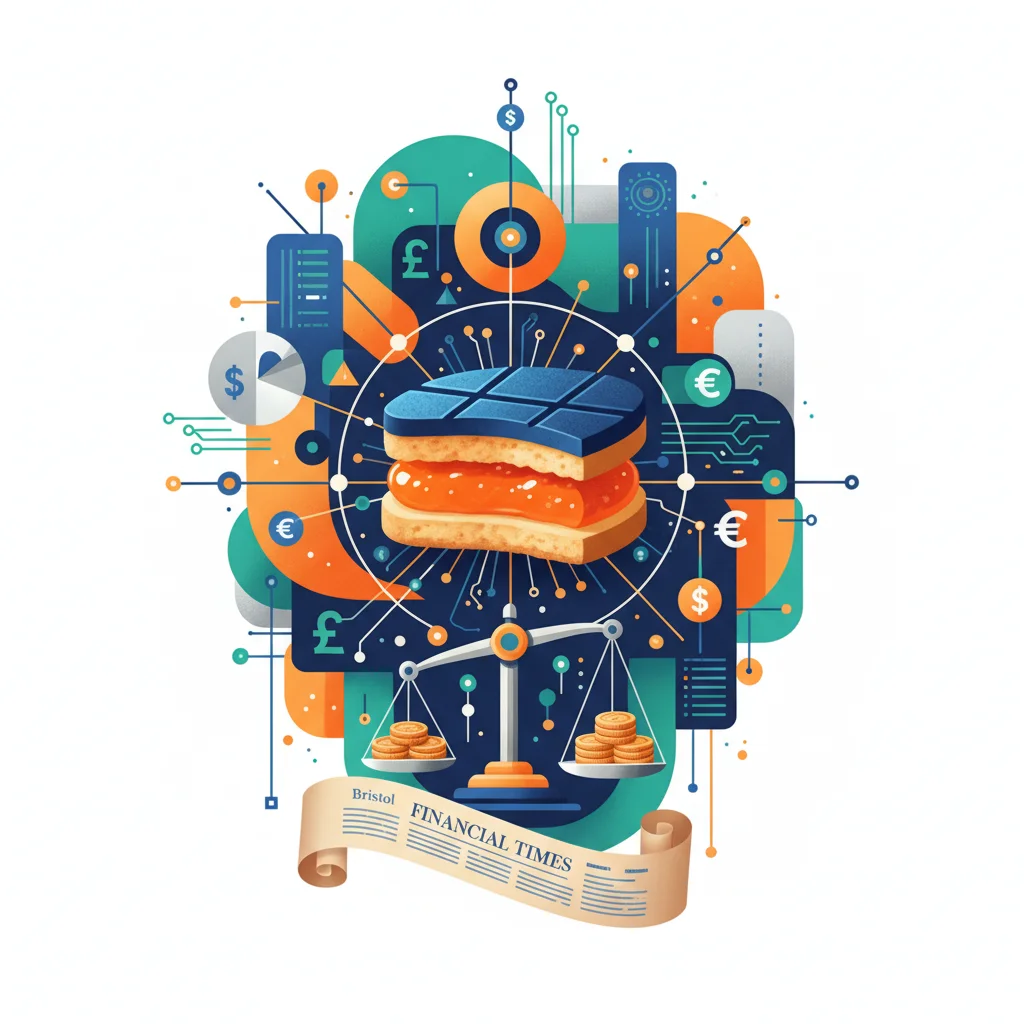
The Jaffa Cake Principle: What a 1990s Snack Food Dispute Teaches Us About Modern Finance, Fintech, and the Economy
It began, as many profound British discussions do, with a simple, almost trivial question. In a letter to the Financial Times, Julian Hemming of Bristol posed the query that has echoed through courtrooms and common rooms for decades: “Cake or biscuit, m’lord?” He was referring, of course, to the Jaffa Cake, that beloved confection of sponge, orange jelly, and a chocolate topping.
On the surface, it’s a lighthearted debate. But beneath the chocolatey exterior lies a multi-million-pound legal battle that serves as a powerful allegory for some of the most complex and consequential challenges facing the modern global economy. The seemingly semantic argument over how to classify a snack food holds a crucial lesson for anyone involved in finance, investing, fintech, and business leadership. It’s a principle we can apply to everything from the stock market valuation of tech giants to the regulatory quagmire of blockchain and cryptocurrencies.
This is the Jaffa Cake Principle: how we define something determines its value, its regulation, and its place in the economic order. And in an era of rapid technological disruption, getting the definition right—or wrong—can be the difference between innovation and litigation, profit and penalty.
The £3 Million Question: A History of the Great Jaffa Cake Debate
To understand the depth of this issue, we must travel back to 1991. The dispute wasn’t about taste, but about taxes. In the UK, Value Added Tax (VAT) is a cornerstone of the tax system. However, the law makes critical distinctions based on perceived necessity. Most food is considered essential and is therefore “zero-rated” for VAT. But certain “luxury” items are subject to a standard VAT rate. The law was clear: cakes are essentials, but chocolate-covered biscuits are luxuries.
Her Majesty’s Customs and Excise (the precursor to today’s HMRC) contended that McVitie’s Jaffa Cakes were, in fact, biscuits. This classification would have subjected them to VAT, costing the company millions. McVitie’s, naturally, argued they were cakes. The case went to a VAT tribunal, where the fate of the Jaffa Cake was debated with a seriousness usually reserved for matters of state.
The tribunal examined the evidence with forensic precision. The arguments presented by both sides highlight the absurdity and the critical importance of classification.
Here is a breakdown of the key arguments considered by the court:
| Characteristic | The “Biscuit” Argument (HMRC) | The “Cake” Argument (McVitie’s) |
|---|---|---|
| Name | The name contains “Cake,” but this could be marketing. | It’s explicitly called a “Jaffa Cake.” |
| Ingredients & Texture | It has a thin, biscuit-like base. | The base is a Genoise sponge, a classic cake ingredient. |
| Size & Packaging | They are small, packaged, and sold in the biscuit aisle. | Size is not a defining characteristic of a cake (e.g., cupcakes). |
| Consumption Context | Often eaten as a snack with tea, like a biscuit. | Can be eaten as a light dessert, like a small cake. |
| Effect of Aging | Irrelevant to its core identity. | The deciding factor: When left to go stale, a Jaffa Cake goes hard, like a cake. A biscuit goes soft. |
Ultimately, the “staleness test” proved decisive. The judge, Mr. D. C. Potter, ruled in favor of McVitie’s, declaring the Jaffa Cake “is a cake.” This ruling, based on a subtle physical property, has saved the company an estimated tens of millions of pounds in taxes over the decades. It’s a perfect illustration of how a definitional nuance can have massive real-world financial consequences.
Bitcoin's Coiled Spring: Why Price Compression Below K Could Unleash a Massive Move
Beyond the Bakery: The Jaffa Cake Principle in Modern Finance and Economics
The Jaffa Cake case is far more than a historical curiosity. It’s a framework for understanding the high-stakes classification battles that define our modern economy.
Case Study 1: The Stock Market and Corporate Identity
Is Tesla a car company or a technology company? How you answer this question dramatically changes its valuation. Traditional auto manufacturers like Ford or GM historically trade at modest price-to-earnings (P/E) ratios. Tech companies, on the other hand, often command massive P/E multiples due to expectations of scalable, high-margin growth.
For years, investors have debated Tesla’s classification. By positioning itself as a leader in AI, battery technology, and autonomous driving, Tesla successfully argued it was more akin to Apple or Google than to General Motors. This “tech” classification, rather than “auto,” was instrumental in its meteoric rise on the stock market. This single definitional debate has been worth hundreds of billions of dollars in market capitalization. The Jaffa Cake Principle is at play every day in equity trading and analysis.
Case Study 2: The Gig Economy and the Nature of Work
Are Uber drivers employees or independent contractors? This is a global Jaffa Cake-style debate with profound implications for labor law, corporate finance, and the social safety net. If drivers are independent contractors, the company avoids payroll taxes, healthcare costs, and retirement contributions. If they are employees, the entire business model and its financial viability are called into question.
Courts around the world have come to different conclusions. A 2021 UK Supreme Court ruling classified Uber drivers as “workers,” a category granting them minimum wage and holiday pay (source). In California, legislative and voter battles have raged over this very definition. This isn’t just semantics; it’s a fight over the fundamental classification of labor in the 21st-century economy.
The New Frontier: Classifying the Digital World of Fintech and Blockchain
Nowhere is the Jaffa Cake Principle more relevant today than in the rapidly evolving world of financial technology. Regulators are playing catch-up, trying to fit revolutionary new concepts into antiquated legal frameworks. The outcomes of these definitional battles will shape the future of banking and commerce.
Cryptocurrencies: Commodity, Security, or Something Else Entirely?
The single most important question in the blockchain space is one of classification. The U.S. Securities and Exchange Commission (SEC) has been at the center of this debate. Is Bitcoin a commodity, like gold? Is Ethereum a security, like a stock? What about the thousands of other tokens?
The distinction is critical:
- Securities: Heavily regulated, requiring extensive disclosures and investor protections. Trading is restricted to licensed exchanges.
- Commodities: Regulated more loosely by bodies like the CFTC, with a focus on futures markets and preventing manipulation.
- Currencies: Regulated by banking and treasury departments, with a focus on monetary policy and preventing money laundering.
The SEC’s high-profile lawsuit against Ripple Labs hinged on this very question: is the XRP token an unregistered security? A US judge delivered a split ruling in 2023, stating that some sales of XRP amounted to security offerings while others did not, adding yet another layer of complexity. This ongoing ambiguity creates enormous uncertainty for investors, developers, and financial institutions looking to engage with the digital asset class.
Netflix's Billion Gambit: Analyzing the Warner Bros Acquisition That's Reshaping Hollywood
Navigating Ambiguity: An Investor’s and Leader’s Guide
For investors, finance professionals, and business leaders, the Jaffa Cake Principle is not just a theoretical concept; it’s a practical guide to risk management and opportunity identification in a complex market.
1. Scrutinize Regulatory Risk: When evaluating an investment, especially in emerging sectors like fintech or biotech, ask the hard questions. What is the current regulatory classification of this company’s core product or service? How might that change? A company thriving in a grey area—a practice known as regulatory arbitrage—carries a hidden risk. A single court ruling or piece of legislation can evaporate its competitive advantage overnight.
2. Understand Valuation Narratives: Be critical of the stories companies tell to justify their valuations. As we saw with Tesla, being classified as “tech” can add billions to a company’s value. Analyze whether this narrative is backed by fundamentals or if it’s a temporary market perception that could shift.
3. Look for the “Staleness Test”: In any new field, try to identify the fundamental, underlying characteristic that will ultimately decide its classification. For Jaffa Cakes, it was how they aged. For crypto, it might be the degree of decentralization (the so-called “Howey Test” is the American legal equivalent). Identifying this core feature early can provide a significant analytical edge.
4. Diversify Across Definitions: In a portfolio, consider exposure to assets and companies that fall under different regulatory regimes. The uncertainty in the US crypto market, for instance, has driven innovation and trading to jurisdictions with clearer frameworks, like those in Europe or Asia. A globally aware investment strategy can mitigate the risks of a single, adverse legal ruling.
The Gehry Effect: How One Architect's Vision Reshaped Modern Investing and Economics
Conclusion: The Enduring Legacy of a Humble Snack
From a sponge base in a UK factory to the distributed ledgers of the blockchain, the Jaffa Cake Principle endures. It reminds us that language is not passive; it is an active force that shapes our economic reality. The words we choose—cake or biscuit, employee or contractor, security or commodity—are the invisible architecture of the market.
The next time you see a debate about a seemingly obscure technical definition, whether in a government report on financial technology or a legal brief about the stock market, don’t dismiss it. Remember the Jaffa Cake. The answer could be worth billions.

Related Posts

The Playboy of the Western Market: A Timeless Lesson on Hype, Bubbles, and Investor Psychology
The Silent Reshuffle: How Internal Migration is Redrawing America’s Economic and Investment Map