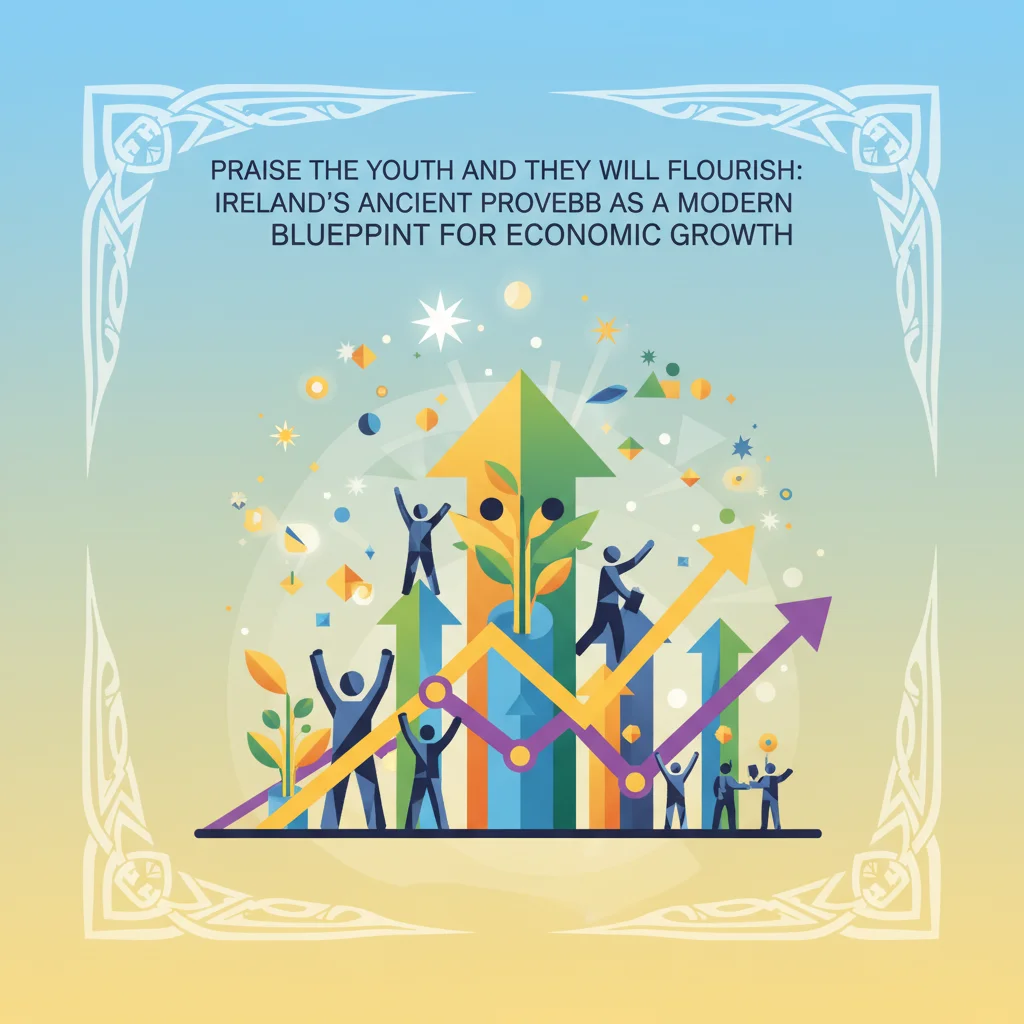
Praise the Youth and They Will Flourish: Ireland’s Ancient Proverb as a Modern Blueprint for Economic Growth
In a world saturated with complex economic theories and volatile market predictions, sometimes the most profound financial wisdom is found not in a dense analyst report, but in the simple elegance of an ancient proverb. A recent letter to the Financial Times by Michael Cullen of Dublin highlighted one such piece of wisdom, connecting the slogan of Ireland’s Tidy Towns competition—“Mol an óige agus tiocfaidh sí”—to the nation’s economic future under its new leader, Simon Harris. The proverb translates to, “Praise the youth and they will flourish.”
As Mr. Cullen astutely noted, this principle “applies as much to a country’s economy as to its gardens” (source). This is not mere sentimentality; it is a powerful and actionable blueprint for long-term, sustainable economic prosperity. For investors, finance professionals, and business leaders, understanding this principle is key to identifying the next frontiers of growth. It’s a call to shift our perspective from short-term gains to the foundational investments in human capital that cultivate a thriving, innovative, and resilient economy.
This article will explore the deep economic truth behind “Mol an óige,” using Ireland as a compelling case study. We will analyze how this philosophy has already shaped its journey from the “Celtic Tiger” to a global fintech hub, and how it provides a strategic roadmap for navigating the future of finance, technology, and global economics.
The Economic Calculus of Human Capital
At its core, “Mol an óige” is a philosophy of investment in human capital. In the language of economics, this refers to the economic value of a worker’s experience and skills. This includes assets like education, intelligence, skills, health, and other things employers value, such as loyalty and punctuality. Praising the youth, in an economic sense, means creating an environment where this capital can be nurtured and maximized.
This isn’t about feel-good policies; it’s about a calculated, long-term strategy with a demonstrably high return on investment. According to research from the OECD, adults with a tertiary degree earn, on average, 55% more than those with only upper secondary education. This translates into higher tax revenues, reduced social welfare costs, and increased consumer spending—all essential components of a robust economy. The investment in a single student’s education ripples outwards, strengthening the entire financial ecosystem.
Think of it in terms of an investment portfolio. While a short-term trading strategy might yield quick profits, the most resilient and valuable portfolios are built on long-hold assets with strong fundamentals. Investing in youth is the macroeconomic equivalent of investing in a blue-chip stock with compounding dividends. The “dividends” are innovation, entrepreneurship, a skilled workforce, and the very dynamism that keeps a stock market and an economy from stagnating.
Ireland’s Story: From Celtic Tiger to Fintech Phoenix
Ireland provides a masterclass in the “Mol an óige” principle. The “Celtic Tiger” boom of the late 1990s and early 2000s wasn’t a random stroke of luck. It was the direct result of decades of strategic investment in free education, which produced a young, highly skilled, English-speaking workforce. This made Ireland exceptionally attractive to foreign direct investment (FDI) from global tech and pharmaceutical giants.
However, the real test of this strategy came after the 2008 financial crisis. Ireland didn’t just rebuild; it pivoted. It leveraged its deep talent pool to become a world leader in high-value sectors, most notably financial technology, or fintech. Today, Dublin is a globally recognized fintech hub, hosting over 250 leading firms and employing thousands in high-skilled jobs. This evolution was only possible because the foundational investment in its youth had already been made.
The country’s pro-business environment, combined with its talent pipeline from world-class universities, created a fertile ground for innovation in banking, payments, and blockchain technology. This synergy demonstrates that “praising the youth” is a two-part formula: first, build the human capital through education, and second, create the economic and regulatory environment where that capital can be effectively deployed. According to IDA Ireland, the state agency for attracting FDI, technology and financial services remain cornerstone sectors, continually fueled by a stream of new graduates.
The Modern Toolkit for Cultivating a Flourishing Economy
Applying the “Mol an óige” principle in today’s complex global economy requires a modern, multi-faceted toolkit. It extends far beyond traditional education into the realms of finance, technology, and regulation.
1. Redefining Education for the Digital Age
The curriculum of the future must be deeply integrated with the demands of the modern economy. This means a strong emphasis on STEM, but also on financial literacy and the specific skills needed in high-growth sectors. Competency in areas like data science, AI, blockchain, and sustainable finance is no longer niche but essential. Educational institutions must partner with the finance and tech industries to ensure graduates are not just qualified, but are ready to innovate from day one.
2. Democratizing Access to Capital
An idea without capital is just a dream. A core part of “praising the youth” is ensuring that young entrepreneurs have access to the funding necessary to turn their visions into reality. This involves a healthy ecosystem of venture capital, angel investors, and government-backed seed funds. The traditional banking sector must also adapt, developing more flexible lending models for early-stage, tech-driven businesses that may lack conventional assets but possess immense intellectual property.
3. Creating a Regulatory Sandbox
Innovation, especially in heavily regulated fields like finance, can be stifled by bureaucracy. A modern approach involves creating “regulatory sandboxes” where fintech and blockchain startups can test new products in a controlled environment without facing the full weight of regulatory compliance. This signals trust and encourages experimentation—a powerful form of institutional “praise.”
To put this in a global context, let’s compare how different innovation-focused nations support their young entrepreneurs. The following table provides a snapshot of key initiatives:
| Country | Key Youth Entrepreneurship Initiative | Primary Focus Area | Noteworthy Feature |
|---|---|---|---|
| Ireland | Enterprise Ireland’s High Potential Start-Up (HPSU) Fund | Export-oriented tech, life sciences, fintech | Provides equity investment and extensive mentorship. |
| Estonia | Startup Estonia & e-Residency | Digital services, cybersecurity, SaaS | Global access to the EU business environment via e-Residency. |
| Israel | Israel Innovation Authority Grants | Deep tech, R&D, cybersecurity | Significant non-dilutive government funding for R&D. |
| Singapore | Startup SG Founder | Broad technology, innovation | Government co-invests alongside a third-party mentor. |
Netflix's Endgame: Decoding the Billion-Dollar Warner Bros. Deal and Its Impact on the Stock Market
An Investor’s Guide to “Mol an Óige”
For the savvy investor, this principle is not just a national policy but a powerful lens for investment strategy. Identifying and backing the economies and companies that effectively “praise the youth” can unlock significant long-term returns.
- On the Stock Market: Look beyond quarterly earnings. Analyze a company’s investment in its people. Does it have robust training and development programs? Is it a leader in R&D? Companies that are consistently ranked as “best places to work” for young graduates often outperform their peers over the long run. Consider thematic ETFs that focus on education technology (EdTech), the future of work, and disruptive innovation. These are direct plays on the “flourishing youth” theme.
- In Private Markets: Venture capital is the most direct way to invest in this principle. Focus on funds that target seed and early-stage companies in hubs known for their young, educated talent pools. The fintech, biotech, and green tech sectors are particularly fertile ground for youth-led innovation.
- In Macro Economics: When evaluating sovereign bonds or country-specific ETFs, look at national statistics on educational attainment, youth unemployment, and government spending on R&D. A country that is investing in its human capital is a country that is shoring up its future economic stability and growth potential. Research from organizations like the World Economic Forum on human capital can provide invaluable data for these macro-level decisions.
The accessibility of modern trading platforms allows retail and institutional investors alike to build a portfolio around this thesis, diversifying across public equities, thematic funds, and even crowdfunded startups that embody this forward-looking approach to value creation.
Netflix's Billion Gambit: Analyzing the Warner Bros Acquisition That's Reshaping Hollywood
Conclusion: The Compounding Interest of Potential
The letter from a Dublin reader to the Financial Times serves as a timely reminder that the most powerful forces in economics are often the most human. “Mol an óige agus tiocfaidh sí” is more than a charming Irish slogan; it is a fundamental strategy for sustainable growth. It teaches us that an economy, much like a garden, requires patient cultivation.
Praising the youth is not about participation trophies; it’s about providing the tools, capital, education, and opportunities that allow potential to be realized. It’s about understanding that the young minds in universities and early-stage startups today are the architects of the future stock market, the innovators behind the next wave of financial technology, and the leaders who will steer the global economy through its next set of challenges.
For policymakers, business leaders, and investors, the message is clear: the greatest returns will come from investing in people. By fostering the next generation, we are not just securing their future; we are underwriting our own prosperity with the most valuable asset of all: human potential.

Related Posts
The Trillion-Dollar Paradox: Why China’s Record Trade Surplus Is a Red Flag for the Global Economy

The Silent Landlord: How Outdated Taxes Are Brewing a Crisis for Britain’s Pubs