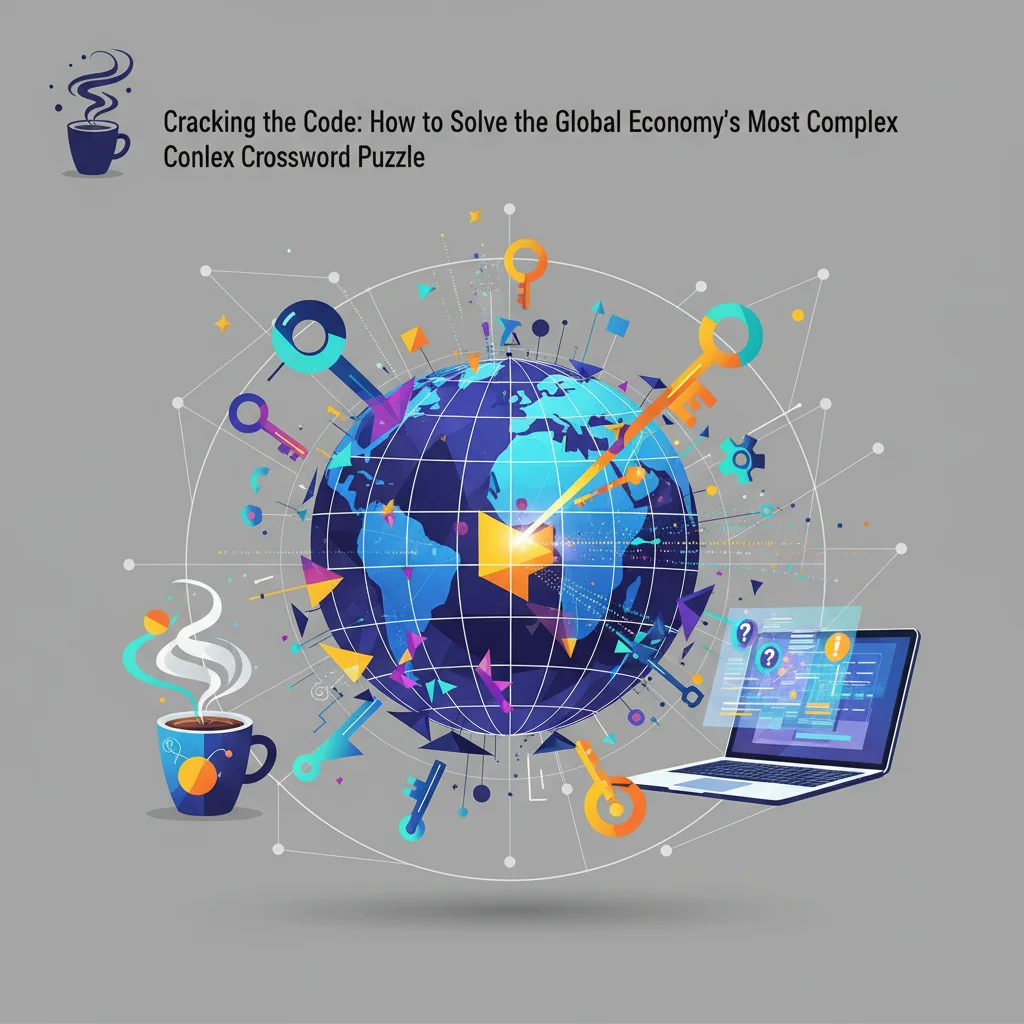
Cracking the Code: How to Solve the Global Economy’s Most Complex Crossword Puzzle
For many, the morning ritual isn’t complete without a cup of coffee and a crossword puzzle. There’s a unique satisfaction in deciphering a cryptic clue, the “aha!” moment when disparate letters snap into a coherent word, and the steady progress as the grid fills. Each answer interlocks, building upon the last, until a complete picture emerges from the black and white squares. This process, as it turns out, is a powerful metaphor for one of the most challenging puzzles of all: navigating the world of modern finance and investing.
The global economy is the ultimate crossword. It’s a vast, interconnected grid where macroeconomic policies, technological disruptions, and market sentiment intersect. The clues are often ambiguous, the answers are rarely obvious, and a single misstep can throw entire sections into disarray. For investors, business leaders, and finance professionals, learning to be a master solver is not just a hobby—it’s essential for success. This guide will frame the complex world of the stock market, banking, and economics through the lens of a puzzle, providing a strategic approach to deciphering the clues and confidently filling in your financial future.
The “Across” Clues: Reading the Macroeconomic Landscape
In any crossword, the “Across” clues often set the stage. They are the long, foundational answers that provide the structure for the shorter “Down” words to intersect with. In the financial world, these are the major macroeconomic indicators—the sweeping trends that define the health and direction of the entire economy. Ignoring them is like trying to solve a puzzle without reading half the clues.
Key indicators like Gross Domestic Product (GDP), inflation rates, and employment figures are the bedrock of any sound analysis. A rising GDP suggests a growing economy, creating a favorable environment for corporate earnings and stock market performance. Conversely, high inflation, as we’ve seen in recent years, can erode purchasing power and prompt central banks to raise interest rates, a move that often cools the market. According to the International Monetary Fund, global growth is projected to remain steady, but this headline figure masks significant regional divergences—a classic cryptic clue that requires deeper investigation.
Central banking policy, particularly the actions of institutions like the Federal Reserve and the European Central Bank, is perhaps the most critical “Across” clue of all. Their decisions on interest rates act as the master key for the entire puzzle, influencing everything from borrowing costs for businesses to mortgage rates for consumers. Understanding the language of central bankers—distinguishing between “hawkish” and “dovish” tones—is paramount for anticipating market movements in trading and long-term investing.
Here is a simplified look at some of the primary “clues” and how investors can interpret them:
| Macroeconomic Clue (Indicator) | What It Signals | Potential Impact on Your “Puzzle” (Portfolio) |
|---|---|---|
| GDP Growth Rate | The overall health and expansion of the economy. | Strong growth is generally positive for equities and corporate profits. Slowing growth may signal a shift towards defensive assets. |
| Inflation Rate (CPI/PCE) | The rate at which the general level of prices for goods and services is rising, and subsequently, purchasing power is falling. | High inflation can erode returns and lead to higher interest rates, pressuring growth stocks. Assets like commodities and inflation-protected bonds may perform well. |
| Unemployment Rate | The percentage of the labor force that is jobless. | Low unemployment can signal a strong economy but may also lead to wage inflation. Rising unemployment is a key recessionary warning. |
| Central Bank Interest Rates | The primary tool used by central banks to control inflation and manage economic growth. | Higher rates can make borrowing more expensive, slowing the economy and negatively impacting bond prices and growth stocks. Lower rates can stimulate the economy. |
The Unlikely Guru: What the World of Finance Can Learn from a Union Boss's Playbook
The “Down” Clues: Sector Trends and Corporate Performance
Once you have a handle on the broad economic environment, it’s time to focus on the “Down” clues. These are the sector-specific and company-level details that must fit within the larger macroeconomic framework. A booming tech sector (a “Down” answer) can exist even in a moderately growing economy (an “Across” answer), but it cannot thrive in a deep recession. The two must interlock logically.
This is where the world of financial technology, or fintech, provides a compelling case study. The fintech revolution is a powerful “Down” clue that intersects with the broader “Across” clues of consumer behavior and banking regulation. The rise of digital payments, robo-advisors, and decentralized finance (DeFi) built on blockchain technology is fundamentally reshaping the financial services industry. A recent PwC report highlights that institutional adoption is a major driver of this growth, signaling a maturation of the sector.
For an investor, this means looking beyond the traditional banking giants and analyzing the disruptors. Which companies are solving real-world problems? Who has a sustainable business model? How will evolving regulations impact their growth? These are the granular questions that help you fill in the letters for that specific clue. The same detailed analysis applies to every sector, from healthcare and energy to consumer staples and industrials. Scrutinizing earnings reports, competitive moats, and management quality is the equivalent of checking whether a word fits with the letters you’ve already filled in from the “Across” clues.
Filling in the Grid: Your Investment Strategy as a Solving Technique
Knowing the clues is one thing; having a strategy to solve the puzzle is another. Your investment strategy is your personal solving technique. Some people start with the clues they know for certain, while others tackle a corner of the puzzle and expand outward. There is no single right way, but a disciplined approach is crucial.
Diversification is the classic technique of working on multiple sections of the puzzle at once. By spreading your investments across different asset classes (stocks, bonds, real estate) and geographies, you avoid the risk of having your entire grid ruined by one or two incorrect answers. If the technology sector (one corner of your puzzle) faces a downturn, your holdings in healthcare or consumer staples (other corners) can provide stability.
Value investing is akin to looking for the obvious, straightforward clues first. It involves identifying well-established companies trading at a price below their intrinsic value—the “low-hanging fruit” of the puzzle. In contrast, growth investing is about tackling the more speculative clues, betting on emerging companies and technologies like fintech or AI that have the potential for explosive growth, even if their current valuations seem high.
Regardless of the chosen strategy, risk management is your pencil and eraser. The financial markets are dynamic. The “clues” can change, and what seemed like a certain answer yesterday might be wrong today. A disciplined approach to risk management—using stop-loss orders, periodically rebalancing your portfolio, and not over-allocating to a single position—allows you to erase mistakes and correct course without tearing a hole in your puzzle. This adaptability is a hallmark of sophisticated trading and long-term investing alike.
The Unseen Balance Sheet: Why the UK's Asylum Policy is a Costly Economic Misstep
The Cryptic Clues: Black Swans, Volatility, and Blockchain
Finally, every great crossword contains a few truly cryptic clues—the ones that use wordplay, anagrams, or abstract thinking and leave most solvers stumped. In finance, these are the “black swan” events: unpredictable, high-impact occurrences that no one saw coming. The 2008 financial crisis, the COVID-19 pandemic, and major geopolitical conflicts are all examples of cryptic clues that completely redrew the puzzle grid.
You cannot predict these events, but you can build a portfolio robust enough to withstand them. This goes back to the principle of diversification and maintaining a long-term perspective. Panic-selling during a market crash is like ripping up the puzzle in frustration. Those who remain patient often see the grid resolve itself over time. As a Financial Times puzzle itself demonstrates, even the most complex problems have logical solutions if approached with discipline.
Disruptive technologies like blockchain can also be seen as a cryptic clue. On the surface, it’s a complex concept, but its potential to decentralize everything from banking to supply chains represents a fundamental shift. Understanding its implications is crucial for identifying both immense opportunities and significant risks. Is it the answer to a more efficient financial future, or a red herring that distracts from more fundamental principles? The best solvers are always learning, expanding their toolkit to be able to tackle these novel and challenging clues.
The Biscuit Barometer: What a Trader's Nervous Habit Reveals About Modern Finance
Conclusion: Becoming a Master Solver
Viewing the global economy and financial markets as a grand crossword puzzle demystifies their complexity and transforms the challenge from intimidating to engaging. It provides a mental model for structuring your analysis: start with the broad “Across” clues of the macro-economy, then meticulously fill in the “Down” clues of sector and company performance. Choose a solving strategy that aligns with your goals and risk tolerance, and always be prepared for the cryptic, unexpected events that make the puzzle truly challenging.
The goal is not to complete the puzzle perfectly in a single day. The clues are constantly changing, and new puzzles are published daily. The real objective is to become a more skilled, patient, and insightful solver over time. By honing your ability to read the grid, interpret the clues, and connect the intersecting answers, you can navigate the complexities of modern finance with greater confidence and build a more resilient and prosperous future.

Related Posts

The Financial Crossword: Deciphering the Most Complex Clues of the Modern Economy

The Anarchist in the Boardroom: Why Radical Thinkers Are Finance’s Unsung Heroes