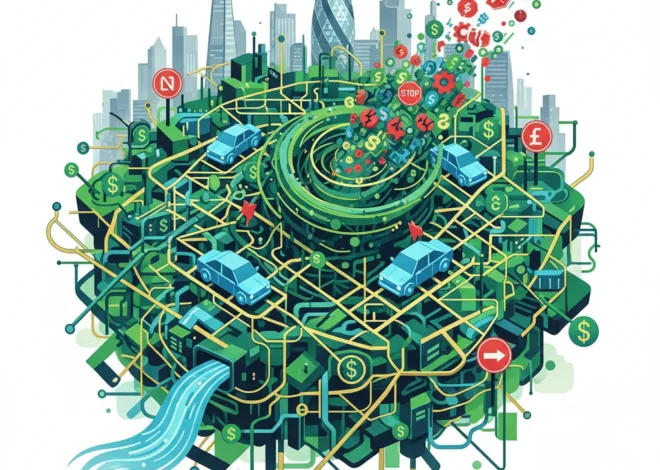
The £1.9 Billion Void: Deconstructing the UK’s COVID Fraud and its Economic Aftermath
In the frantic early days of the pandemic, governments worldwide raced to prop up their economies against an unprecedented shutdown. The UK’s response was a financial blitz of support schemes, a necessary but hastily constructed dam against a tidal wave of economic collapse. Yet, as the waters recede, we are left to survey the damage—not just from the virus, but from the cracks in that very dam. A staggering £1.9 billion lost to fraud and error in just two of the major COVID-19 business support schemes is now deemed “beyond recovery,” a permanent hole in the public purse. While satirical columns may jest about “man flu scams,” the reality is a sobering lesson in finance, governance, and the immense challenge of crisis management.
This isn’t merely a story about lost money. It’s a case study with profound implications for the UK economy, investor confidence, and the future of financial technology. It forces us to ask difficult questions: How did this happen? What are the lasting economic scars? And, most importantly, how can we leverage technology to prevent a repeat performance in the next crisis?
The Anatomy of a Multi-Billion Pound Failure
To understand the scale of the fraud, we must first understand the architecture of the schemes themselves, particularly the Bounce Back Loan Scheme (BBLS). Designed to get cash into the hands of small businesses as quickly as possible, the BBLS was built for speed, not security. It offered 100% government-backed loans up to £50,000, with banks acting as intermediaries but bearing none of the credit risk. The application process was streamlined to the point of being porous, often relying on self-certification with minimal verification.
This “trust-based” model, while well-intentioned, created a perfect storm for opportunists. The National Audit Office (NAO) has repeatedly highlighted the significant risks, estimating that a substantial portion of the £47 billion in Bounce Back Loans is at risk of not being repaid due to a combination of fraud and credit defaults. According to a report from the NAO, the scheme was vulnerable to organized crime, with fraudsters using shell companies, fake businesses, and stolen identities to siphon billions from the Treasury. This wasn’t just a failure of policy; it was a failure to anticipate the darker side of human nature when vast sums of money are on the table with few questions asked.
The Rupee's Plunge: Decoding India's Economic Crossroads and Adani's Sky-High Ambitions
Visualizing the Financial Black Hole
The losses extend beyond a single scheme. The entire suite of COVID support measures, from furlough to business grants, has been targeted. To put the figures into perspective, here is a breakdown of the estimated fraud and error across the UK government’s main COVID-19 support schemes as of late 2022 and early 2023 estimates.
| COVID-19 Support Scheme | Administering Department | Estimated Loss to Fraud & Error (2021-22) |
|---|---|---|
| Bounce Back Loan Scheme (BBLS) | BEIS / British Business Bank | £3.5 Billion (Estimated Lifetime Fraud) |
| Coronavirus Job Retention Scheme (Furlough) | HMRC | £1.1 Billion |
| Self-Employment Income Support Scheme (SEISS) | HMRC | £1.5 Billion |
| Eat Out to Help Out | HMRC | £136 Million |
Note: Figures are based on various reports from HMRC and the NAO. The total estimated loss across all schemes is significantly higher, with some parliamentary reports placing the figure upwards of £15 billion over the lifetime of the programs.
The Economic Ripple Effect: More Than Just a Headline Number
A loss of this magnitude is not an abstract accounting problem; it has tangible consequences for the entire UK economy. Every pound lost to fraud is a pound that cannot be spent on hospitals, schools, or infrastructure. It’s a pound that must eventually be covered by taxpayers or added to the national debt, placing a burden on future generations.
For those in the world of investing and finance, the implications are multifaceted:
- Sovereign Risk: While the UK remains a stable investment destination, events like this chip away at perceptions of government competence. Large-scale, unmanaged fraud can be perceived by international investors as a sign of weak institutional controls, potentially affecting the long-term attractiveness of UK gilts and the stability of the pound.
- Stock Market and Banking Sector: The traditional banking institutions that distributed these loans are caught in the middle. While the loans were 100% government-backed, the reputational fallout and the administrative burden of chasing down bad debts are significant. This saga could influence future public-private partnerships and the regulatory landscape for banks involved in government schemes.
- Inflationary Pressure: Injecting billions of pounds into the economy, with a significant portion being non-productive (i.e., stolen), adds to the money supply without a corresponding increase in economic output. While not the sole cause, this contributes to the inflationary pressures that the Bank of England has been battling.
A Fintech Post-Mortem: Could Technology Have Prevented This?
The crisis has starkly revealed the chasm between the capabilities of modern financial technology and the systems employed by the public sector. A robust fintech-driven approach could have erected significant barriers to fraud without sacrificing speed. Imagine a system built on the following principles:
- Digital Identity Verification: Instead of relying on self-certification, a system integrated with modern digital ID checks (liveness detection, document scanning, biometric verification) could have weeded out a huge number of fraudulent applications based on synthetic or stolen identities from the start.
- AI-Powered Anomaly Detection: Advanced algorithms can analyze thousands of data points in real-time. An AI could have flagged suspicious patterns, such as multiple applications from a single IP address, businesses registered just days before applying, or directors with a history of dissolved companies. This is standard practice in private sector online trading and banking platforms.
- Open Banking Integration: Securely linking to a business’s actual bank account history via Open Banking APIs would have provided a clear, real-time picture of its financial health and trading history, making it far more difficult for shell companies to claim legitimacy.
- The Blockchain Potential: Looking further ahead, a crisis-response ledger built on blockchain technology could offer a new paradigm of transparency and security. Every transaction, from the Treasury to the final recipient, could be recorded on an immutable ledger, creating a perfect audit trail and making fraudulent diversions of funds nearly impossible. While still a nascent technology for public finance, its potential for preventing corruption and error is immense.
Lessons for the Future: Rebuilding a More Resilient Financial System
The £1.9 billion “beyond recovery” is a sunk cost. The real return on investment now comes from the lessons we learn. This episode must catalyze a fundamental rethink of the UK’s public finance infrastructure.
For policymakers, the mandate is clear: invest in a permanent, technologically advanced “crisis response” financial system. This system should be dormant during normal times but ready for immediate activation, with pre-vetted security protocols and partnerships with leading fintech firms.
For investors and business leaders, the takeaway is a renewed appreciation for the importance of governance and institutional quality. The efficiency and integrity of a country’s public financial management are critical variables in any long-term investment thesis. The economics of recovery depend not just on policy, but on the flawless execution of that policy.
Ultimately, the COVID fraud saga is a costly but powerful reminder that in the 21st-century economy, financial resilience is synonymous with technological sophistication. The dam held, but it leaked badly. The next time, we must build it better.
The Billionaire's Gambit: Decoding Andrej Babiš's Rise to Power and Its Impact on the Czech Economy