The New Titans: Why TIME Magazine’s Nod to AI’s Architects is a Defining Moment for Our Future
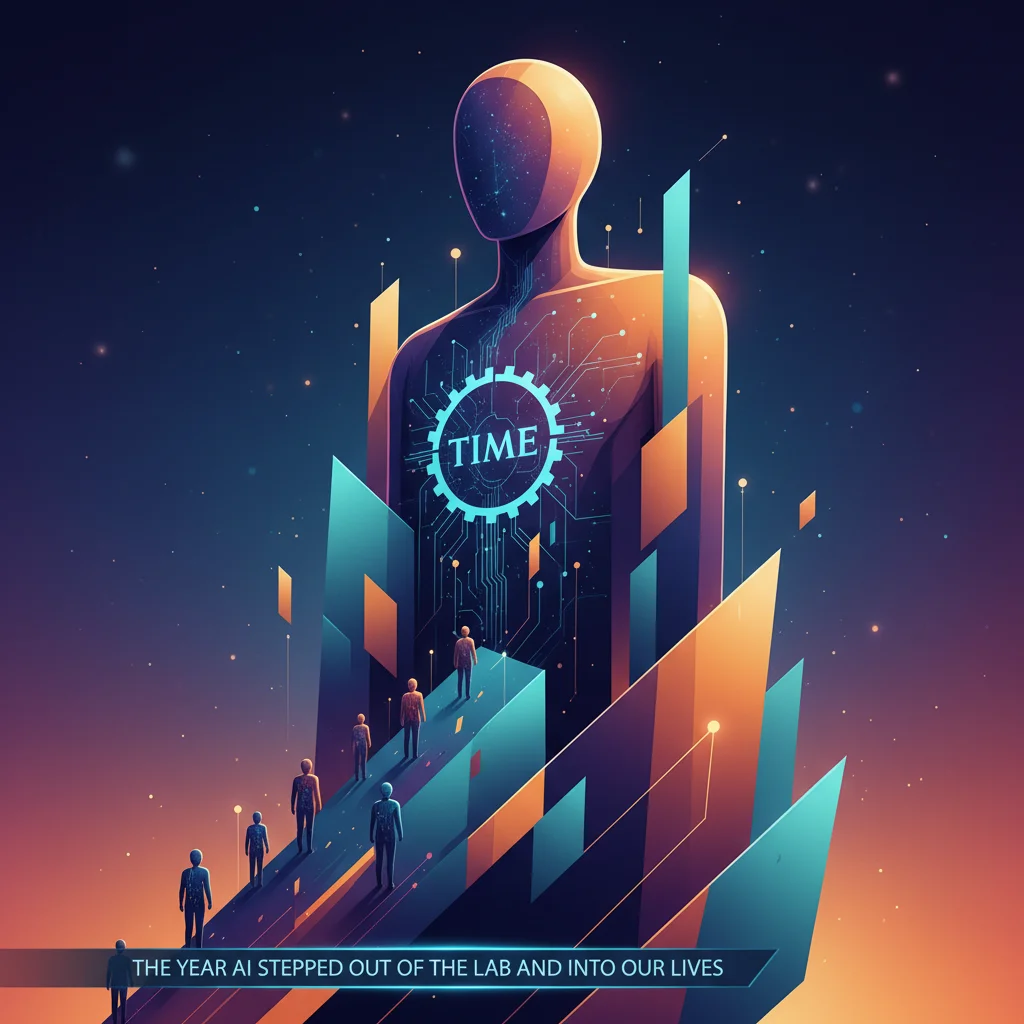
The Year AI Stepped Out of the Lab and Into Our Lives
Every year, the world watches as TIME Magazine unveils its “Person of the Year,” a title bestowed upon the individual or group who, for better or for worse, has most influenced the events of the year. While pop superstar Taylor Swift graced the main cover for 2023, a second, equally significant cover sent a powerful message to the world. It featured the “Architects of AI,” a nod to the key figures steering the most profound technological shift since the dawn of the internet. Among them, Nvidia’s CEO Jensen Huang, a man whose company has become the de facto engine of the artificial intelligence revolution.
This recognition by a mainstream cultural institution like TIME is more than just an accolade for a few tech executives. It’s a cultural timestamp, a declaration that artificial intelligence is no longer a niche concept confined to research papers and developer forums. In 2023, AI became a global conversation, a tool in the hands of millions, and a force reshaping industries from software development to creative arts. It was the year that models like ChatGPT weren’t just a novelty; they became assistants, collaborators, and catalysts for unprecedented innovation.
This blog post will unpack the significance of this moment. We’ll explore the key players leading the charge, dissect the technological and economic forces at play, and analyze what this tectonic shift means for developers, entrepreneurs, and society as a whole. We are standing at the precipice of a new era, and understanding its architects is crucial to navigating the future they are building.
Meet the Conductors of the AI Orchestra
While the AI revolution is the product of decades of research and the work of countless brilliant minds, a few key individuals and the companies they lead have been instrumental in the recent explosion of progress. TIME’s focus highlights the leaders who have successfully translated complex machine learning theory into world-changing products and platforms. Their strategies, rivalries, and philosophies are actively shaping the trajectory of AI.
Here’s a look at some of the central figures in the current AI landscape, whose influence was recognized as part of this pivotal moment:
| Key Figure | Company | Core Contribution to the AI Boom |
|---|---|---|
| Jensen Huang | Nvidia | The “Arms Dealer” of the AI Gold Rush. By pioneering the GPU and building the CUDA software ecosystem, Huang positioned Nvidia to provide the essential hardware—the “picks and shovels”—that powers virtually every major AI model and cloud data center. |
| Sam Altman | OpenAI | The Catalyst for Mainstream Adoption. As CEO of OpenAI, Altman oversaw the launch of ChatGPT, the product that made the power of large language models (LLMs) accessible and intuitive to hundreds of millions of people, sparking a global frenzy of AI development. |
| Demis Hassabis | Google DeepMind | The Pioneer of Deep Research. A long-time leader in AI research, Hassabis’s work on projects like AlphaGo demonstrated the profound capabilities of neural networks. Now, he leads Google’s consolidated AI efforts, a formidable competitor in the race for AGI. |
| Dario & Daniela Amodei | Anthropic | The Champions of AI Safety. Former OpenAI executives who founded Anthropic with a primary focus on AI safety and constitutional AI. Their model, Claude, represents a major alternative to ChatGPT, emphasizing responsible development alongside capability. |
These leaders represent different, yet interconnected, layers of the AI stack. Huang provides the foundational hardware, Altman and the Amodeis build the groundbreaking models, and Hassabis represents the deep-rooted research power of a tech giant. Their collective influence, as noted by publications like the BBC in its coverage of TIME’s announcement, has created a new, powerful epicenter in the tech world.
The AI Arms Race Goes Physical: Why China is Dominating the Humanoid Robot Revolution
The NVIDIA Anomaly: How a Gaming Company Came to Power the Future
To truly grasp the current AI moment, one must understand the story of Nvidia. For years, the company was primarily known to PC gamers for its powerful graphics cards (GPUs). Yet, Jensen Huang and his team made a strategic bet decades ago that has paid off in a way few could have imagined. They realized that the architecture of a GPU—designed to perform thousands of simple calculations in parallel to render complex graphics—was perfectly suited for the mathematics of deep learning.
This wasn’t just a happy accident. Nvidia meticulously built a moat around its hardware with a powerful software layer called CUDA. This platform gave researchers and developers a robust toolkit for programming on Nvidia’s GPUs, making them the gold standard in the academic and research communities. When the deep learning revolution ignited, the entire field was already building on Nvidia’s platform. According to one 2023 market analysis, Nvidia is estimated to hold over 80% of the market for AI chips, a staggering level of dominance.
Today, access to Nvidia’s H100 and A100 GPUs is one of the biggest bottlenecks for startups and even large tech companies. This hardware scarcity has made Nvidia not just a supplier but a kingmaker, with Huang deciding which companies and countries get the computational power needed to build the next generation of artificial intelligence.
The Ripple Effect: A New Gold Rush for Developers and Entrepreneurs
TIME’s recognition is a signal to every corner of the economy: the AI platform shift is here. Just as the internet created companies like Google and Amazon, and mobile created Uber and Instagram, generative AI is creating a fertile ground for a new generation of businesses. This has profound implications for the entire tech ecosystem.
For Developers and Tech Professionals: A new paradigm of programming is emerging. The focus is shifting from writing explicit, rule-based code to working with and fine-tuning intelligent models via APIs. Expertise in prompt engineering, model optimization, and building applications on top of platforms like OpenAI, Anthropic, or open-source alternatives has become one of the most in-demand skill sets. The value is no longer just in writing the code, but in orchestrating the intelligence. This has led to a surge in demand for skills in Python, data science, and MLOps, reshaping career paths across the software industry.
For Entrepreneurs and Startups: The opportunities are immense. A new wave of AI-native SaaS (Software as a Service) companies is emerging, rethinking everything from legal contract analysis to code generation and customer support. The core challenge for these startups is twofold: finding a unique value proposition beyond simply being a “wrapper” for a larger model, and securing the massive amounts of capital and computing resources needed to compete. The rise of AI has also put a spotlight on cybersecurity, creating a critical need for new solutions to protect AI models from data poisoning, adversarial attacks, and misuse.
Digital Necromancy: How Bending Spoons Resurrects 'Dead' Apps for Billion-Dollar Profits
This entrepreneurial explosion is fueling a virtuous cycle. As more startups build on these AI platforms, they create more demand for the underlying cloud infrastructure and Nvidia’s chips, further entrenching the leaders. Data from PitchBook shows that generative AI startups raised nearly $25 billion in 2023 alone, a testament to the venture capital world’s belief in this new frontier.
The Road Ahead: Navigating the Promises and Perils
As we move beyond the initial hype, the AI industry faces significant hurdles that will define its next chapter. The path forward is not a straight line and is fraught with technical, ethical, and societal challenges.
First, the issue of automation and its impact on the workforce looms large. While AI promises to augment human capabilities and create new jobs, it will undoubtedly displace others. Navigating this transition requires a proactive approach from policymakers, educators, and business leaders to invest in reskilling and create a social safety net for those affected.
Second, the ethical guardrails for this technology are still being built. Issues of bias in training data, the potential for mass-produced misinformation, intellectual property rights, and the “black box” nature of some models are critical concerns. The ongoing debate around AI safety, which was at the heart of the leadership turmoil at OpenAI in late 2023, highlights the deep philosophical divisions even among its creators. Effective regulation is needed, but it must be carefully crafted to avoid stifling innovation while ensuring robust cybersecurity and accountability.
Finally, the technological race continues unabated. We are moving towards a future of multimodal models that can understand not just text, but also images, audio, and video. The quest for Artificial General Intelligence (AGI)—a hypothetical AI with human-like cognitive abilities—remains the holy grail for many, driving billions in research investment. The development of more efficient models that can run on local devices rather than in the cloud could also democratize access and change the power dynamics of the industry.
The £1 Million Wake-Up Call: Why a Porn Site's Fine Is a Game-Changer for Every Tech Company
A New Chapter in Human History
TIME Magazine’s decision to spotlight the architects of AI alongside its Person of the Year is a powerful acknowledgment of a fundamental truth: we have entered a new technological epoch. The work of individuals like Jensen Huang and Sam Altman has set in motion a wave of change that will likely redefine our world in ways we are only beginning to comprehend.
This moment is not an endpoint; it’s the firing of a starting pistol. The foundations have been laid, the core technologies have been proven, and the world is now awake to the possibilities. The real story of the AI revolution will be written in the coming years by the millions of developers, entrepreneurs, and creators who build upon this new platform. The responsibility now falls on all of us to ensure that the future we build is not only intelligent but also equitable, safe, and profoundly human.

Related Posts
Sequoia’s Billion-Dollar Handshake: Why Their Landmark Investment in Anthropic Signals a New Era for AI
The $1.1 Billion Voice: How ElevenLabs is Redefining AI and Becoming a Tech Unicorn