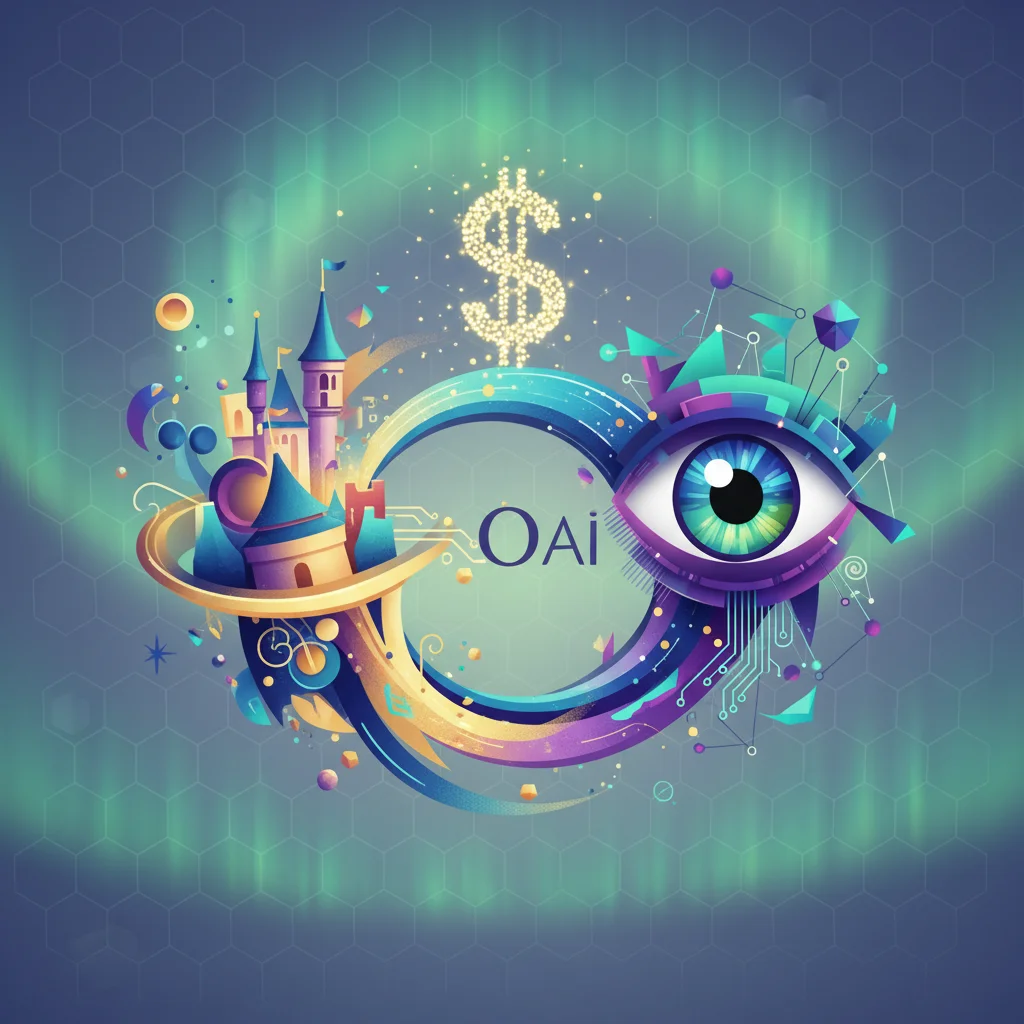
Disney’s New Magic: How a $1 Billion OpenAI Deal is Rewriting the Story of Entertainment
Once upon a time, stories were told to us. We sat in darkened theaters, gathered around screens, and passively consumed the magic crafted by studios like Disney. But what if the next chapter in storytelling wasn’t just told to you, but created by you? That’s the revolutionary promise at the heart of a landmark partnership between two titans of their respective industries: The Walt Disney Company and OpenAI.
In a move that sent shockwaves through both Hollywood and Silicon Valley, a staggering $1 billion agreement has been forged. This deal is set to integrate OpenAI’s powerful generative artificial intelligence into the Disney ecosystem, allowing fans, creators, and perhaps even Disney’s own imagineers to generate videos and images featuring a vast library of over 200 iconic characters. This isn’t just another tech deal; it’s the dawn of a new era where the line between storyteller and audience begins to blur, powered by sophisticated machine learning algorithms.
For developers, entrepreneurs, and tech professionals, this partnership is a watershed moment. It signals the maturation of generative AI from a novel technology into a core component of enterprise strategy for the world’s biggest brands. It raises profound questions about creativity, intellectual property, and the future of digital interaction. Let’s pull back the curtain and explore what this magical collaboration truly means.
The Deal Deconstructed: When Silicon Valley Meets the Magic Kingdom
At its core, the partnership is a fusion of legendary content with cutting-edge technology. Disney, the custodian of arguably the most valuable intellectual property (IP) portfolio on the planet, is granting OpenAI’s models access to a curated selection of its characters. In return, OpenAI provides the powerful engine to bring these characters to life in new and unprecedented ways.
The two key pieces of technology at play are:
- ChatGPT: The conversational AI that has become a household name will likely serve as the primary interface for ideation. Users could craft detailed prompts, write scripts, or brainstorm story scenarios with characters like Iron Man or Elsa.
- Sora: OpenAI’s jaw-droppingly realistic text-to-video model is the real star of the show. Revealed to the public in early 2024, Sora can generate high-fidelity video clips from simple text descriptions. As OpenAI’s own demonstrations have shown, its capabilities are nothing short of cinematic (source). The combination of ChatGPT for scripting and Sora for visualization creates a complete, end-to-end creative suite.
The scope is immense, reportedly covering characters from Disney’s vast empire, including Pixar, Marvel, and Star Wars. This opens up a universe of creative possibilities that were previously the exclusive domain of highly skilled animators and VFX artists.
To understand the magnitude of this shift, let’s compare the traditional creative workflow with the new AI-powered model this deal pioneers.
| Aspect | Traditional Content Creation | AI-Powered Co-Creation (Disney/OpenAI Model) |
|---|---|---|
| Initiator | Studio / Professional Creator | Fan / User / Developer |
| Process | Linear, high-cost (writing, storyboarding, animating, rendering) | Iterative, low-cost (prompting, generating, refining) |
| Tools | Complex software (Maya, Adobe After Effects), render farms | Simple interface (e.g., ChatGPT), cloud-based AI models |
| Output | Static, one-to-many broadcast (e.g., a single film for all) | Dynamic, one-to-one personalization (e.g., a unique video for one user) |
| Barrier to Entry | Extremely high (skill, time, budget) | Extremely low (imagination, subscription fee) |
This table illustrates a fundamental democratization of the creative process. The automation of complex animation and video production tasks could reshape the entire media landscape.
EU vs. Meta: The Antitrust Battle That Could Define the Future of AI
Beyond Fan Art: A New Frontier for Personalized Entertainment
While the initial excitement revolves around fans creating their own “what if” scenarios (e.g., “Show me Yoda having a debate with Buzz Lightyear”), the business implications for Disney are far more profound. This is a strategic move towards a future of deeply personalized, interactive entertainment.
Imagine these scenarios:
- Personalized Marketing: A trailer for a new Marvel movie that features your name or a character directly addressing you.
- Customized Merchandise: Generating a unique, one-of-a-kind comic book cover or animated short for a child’s birthday.
- Theme Park Integration: An interactive experience at a Disney park where an AI-powered Captain Jack Sparrow on a screen has a unique, unscripted conversation with you.
- Educational Content: Moana explaining the principles of navigation or Iron Man teaching basic programming concepts in a way that’s engaging and tailored to a student’s learning pace.
For startups and developers in the tech ecosystem, this signals a massive new market: the “licensed content API.” This could evolve into a SaaS (Software as a Service) platform where developers can pay to integrate licensed, brand-safe character interactions into their own applications, games, and services.
The Ripple Effect: IP, Ethics, and the Future of Creativity
A deal of this magnitude doesn’t happen in a vacuum. It creates ripples that will be felt across multiple industries, raising critical questions that we are only just beginning to grapple with.
The Remaking of Intellectual Property Law
For decades, copyright law has been built on the idea of human authorship. Generative AI challenges this foundation. The U.S. Copyright Office has already stated that works created solely by AI are not eligible for copyright protection (source). This Disney/OpenAI deal creates a new hybrid model. Who owns the copyright to a video generated by a user on OpenAI’s platform using Disney’s characters? Is it the user who wrote the prompt? Is it Disney for providing the IP? Or is it OpenAI for providing the tool? The legal frameworks that emerge from this partnership will set precedents for decades to come.
Cybersecurity and Brand Protection
With great power comes great responsibility. The potential for misuse is enormous. Malicious actors could use these tools to create sophisticated deepfakes, generate content that damages Disney’s family-friendly brand, or spread misinformation. A significant portion of that $1 billion investment will undoubtedly go towards building one of the most advanced content moderation and cybersecurity systems ever conceived. This system will need to analyze prompts and screen video outputs in real-time to prevent the generation of harmful, illegal, or off-brand content. The innovation here won’t just be in video generation, but in AI-powered safety and ethics at an unprecedented scale.
The £1 Million Ghost: Why One Ignored Fine Signals a Gold Rush for AI and Cybersecurity Startups
Impact on the Creator Economy and Creative Professionals
The immediate reaction from many artists, animators, and writers is fear. Does this level of automation make their skills obsolete? The answer is complex. While it may reduce the need for certain types of manual animation or junior-level content creation, it also presents a powerful new tool for professionals. An animator can now generate a dozen variations of a scene in the time it used to take to sketch one. A writer can visualize a script in real-time. The most successful creators will be those who learn to collaborate with AI, using it as a super-powered assistant to augment their own creativity, not replace it.
Looking Ahead: The Dawn of the Algorithmic Storyteller
The generative AI market is projected to be an explosive area of growth, with some analysts predicting it could reach $1.3 trillion in revenue by 2032 (source). Disney’s move is a clear indication that entertainment will be a massive driver of that growth. This partnership is likely just the first step.
What’s next? We could be on the cusp of truly interactive movies where the plot changes based on viewer choices, rendered in real-time. We might see fully-personalized animated series where your child is the main character, interacting with Winnie the Pooh. For the enterprise world, the underlying technology could revolutionize product design, engineering simulations, and corporate training, all powered by the same core artificial intelligence engines.
This partnership between Disney and OpenAI is more than a business deal. It’s a cultural inflection point, a fusion of a century of storytelling artistry with the most powerful creative technology ever developed. It represents a bold, and perhaps necessary, step into a future where the magic of creation is no longer confined to a handful of studios but is placed directly into the hands of the audience.
The story of entertainment is being rewritten, not by a pen or a camera, but by an algorithm. The most exciting part? We all get to help write the next page. The only question is, what story will you tell first?
Humanoid Robots Are Here. Is a Political Storm Coming With Them?

Related Posts
The Humanoid Robot Paradox: Why Factories Are Buying Robots That Are Only Half as Good as Humans
Beyond the Algorithm: What Chomsky and HAL 9000 Reveal About the Future of AI in Finance