AI’s Great Contradiction: Fueling a Data Center Boom While Crushing Call Centers—And Why Nuclear Power is the Shocking Next Chapter
Imagine a force of technology so potent it builds gleaming new cities of servers in one country while simultaneously silencing thousands of phone lines in another. This isn’t a scene from a science fiction novel; it’s the economic reality of artificial intelligence in 2024. The AI revolution is here, and it’s a study in contradictions. It’s a powerful engine of creation and a relentless force of disruption, often in the very same breath.
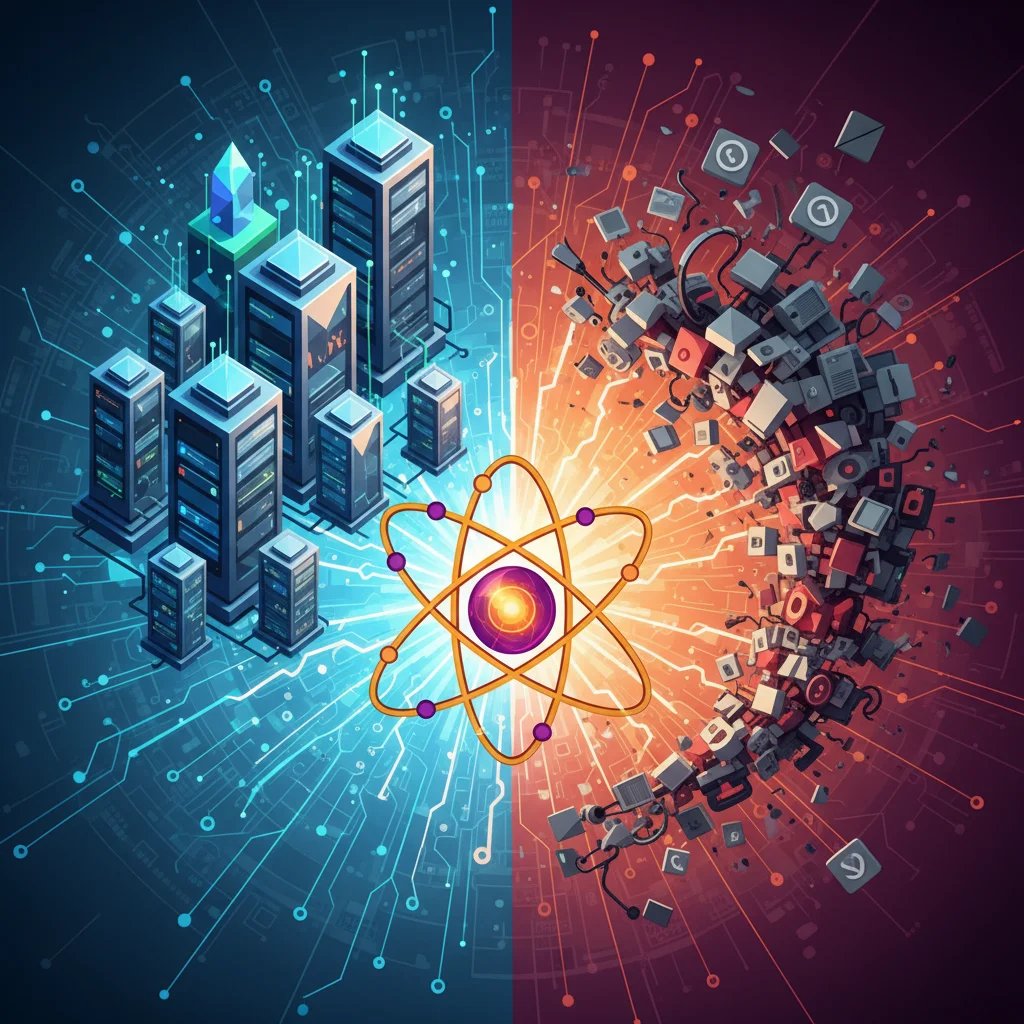
We’re witnessing a seismic shift, particularly across Asia’s dynamic tech landscape. On one hand, AI is fueling an unprecedented construction boom, erecting massive data centers that are the new cathedrals of the digital age. This creates jobs, drives investment, and reshapes entire regions. On the other hand, the very same AI is powering sophisticated automation that renders entire job categories, like customer service agents, increasingly obsolete.
But there’s a third act to this drama, a hidden crisis that underpins it all: AI’s insatiable, world-altering hunger for electricity. The solution being whispered in the boardrooms of Big Tech is as powerful as it is controversial, and it could define the next decade of innovation. Let’s unravel this complex story of what AI giveth, what it taketh away, and the surprising power source it needs to survive.
The “Giveth”: AI’s Insatiable Appetite For Infrastructure
The generative AI boom, powered by models like GPT-4 and its successors, isn’t just about clever software. It’s a physical phenomenon. Training and running these massive models requires colossal amounts of computational power, which means building vast, energy-hungry data centers at a dizzying pace. And right now, Southeast Asia is the global epicenter of this construction frenzy.
Countries like Malaysia, Indonesia, and Thailand are experiencing a modern-day gold rush. Lured by available land, government support, and strategic location, tech giants are pouring billions into the region. Microsoft, Google, and Nvidia are leading the charge, transforming places like Johor Bahru in Malaysia into a critical global hub for the cloud infrastructure that powers AI. This isn’t just about a few new server racks; it’s about the creation of a whole new economic ecosystem.
This boom creates tangible jobs—not just for the highly specialized programmers writing the code, but for construction workers, electricians, HVAC specialists, network engineers, and the cybersecurity professionals tasked with protecting these critical assets. It’s a powerful reminder that the digital world is built on a foundation of steel, concrete, and human labor.
The scale of this investment is staggering, as highlighted by recent reports. According to Nikkei Asia and the Financial Times, this build-out is a direct response to the explosive demand for AI processing power, creating a ripple effect of economic growth that benefits local economies.
To put this regional focus into perspective, here’s a look at the key players transforming Southeast Asia into an AI powerhouse:
| Country | Key Tech Players | Primary Focus & Strategic Advantage |
|---|---|---|
| Malaysia (esp. Johor Bahru) | Microsoft, Google, Nvidia, GDS | Proximity to Singapore, strong government support, and development of specialized data center parks. |
| Indonesia | Amazon Web Services (AWS), Microsoft | Massive domestic market, rapid digitalization, and a growing startup ecosystem demanding local cloud services. |
| Thailand | AWS, Google | Strategic location in mainland Southeast Asia, government’s “Thailand 4.0” digital transformation initiative. |
Beyond the Smartphone: Why Meta's Poaching of an Apple Designer Signals the Next Tech Gold Rush
The “Taketh Away”: The Automation Wave Hits White-Collar Work
For every new data center job created, AI’s shadow looms over other sectors. The same machine learning algorithms that require these massive facilities are becoming frighteningly good at performing tasks once considered the exclusive domain of humans. Nowhere is this clearer than in the Business Process Outsourcing (BPO) industry, a cornerstone of economies like the Philippines.
For decades, the Philippines has been the world’s call center capital, employing millions in a thriving industry. But the ground is shaking. The recent case of Klarna, a Swedish fintech giant, is a stark warning of what’s to come.
Klarna recently deployed an AI-powered customer service assistant that is now handling a staggering two-thirds of all its customer service chats. In just one month, this single piece of SaaS technology performed the work equivalent of 700 full-time human agents. The AI is not just answering simple questions; it’s resolving complex issues, processing returns, and managing disputes with a level of efficiency and accuracy that is difficult for human teams to match, 24/7, in multiple languages.
This is not the clunky, frustrating chatbot of five years ago. This is sophisticated, conversational AI that can understand context, sentiment, and nuance. For companies, the value proposition is irresistible: dramatically lower costs, increased efficiency, and improved customer satisfaction scores. For the millions of workers in the BPO industry, it represents an existential threat.
The Unseen Crisis: AI’s Existential Power Problem
The data centers creating jobs and the AI software eliminating them share a common, voracious need: energy. The computational demands of modern artificial intelligence are pushing the world’s power grids to their limits. Training a single large AI model can consume as much electricity as hundreds of homes for an entire year. And that’s just for training; running the model for daily queries (inference) requires a continuous, massive supply of power.
This energy consumption is AI’s dirty secret. While we see the clean, elegant interfaces of ChatGPT or Midjourney, we don’t see the sprawling, power-guzzling server farms behind them. This creates a fundamental conflict. How can we build a sustainable future powered by green energy while simultaneously building a technology that demands an ever-increasing amount of electricity, much of which still comes from fossil fuels?
This isn’t a future problem; it’s a here-and-now crisis. Tech leaders are openly worrying about energy shortages becoming the primary bottleneck for AI innovation. You can’t build the next generation of AI if you can’t plug it in.
The Nuclear Option: A Controversial Solution for a Digital Age
Faced with this existential power crisis, the tech industry is turning to a solution that is both technologically advanced and deeply controversial: nuclear energy.
For decades, nuclear power has been hampered by public perception issues, safety concerns, and high construction costs. But the relentless physics of AI’s energy demand is forcing a major re-evaluation. Tech giants like Microsoft and Amazon are now actively exploring ways to power their future data centers directly with nuclear energy (source).
The focus is particularly on a new class of technology: Small Modular Reactors (SMRs). Unlike the gigantic nuclear plants of the past, SMRs are designed to be smaller, safer, and more scalable. They can be built in a factory and assembled on-site, potentially providing a dedicated, carbon-free, 24/7 power source right next to a data center campus. For a facility that must never, ever go down, the appeal of a stable, independent power grid is immense.
Here’s how nuclear SMRs stack up against other power sources for the unique demands of AI data centers:
| Power Source | Pros for AI Data Centers | Cons for AI Data Centers |
|---|---|---|
| Solar & Wind | Carbon-free, decreasing costs. | Intermittent (not 24/7), requires large land area, needs battery storage backup. |
| Natural Gas | Reliable 24/7 power, can ramp up/down quickly. | Emits CO2, volatile fuel prices, contributes to climate change. |
| Nuclear (SMRs) | Carbon-free, extremely power-dense, provides stable 24/7 baseload power, small land footprint. | High upfront cost, public perception challenges, long-term waste disposal, regulatory hurdles. |
The move towards nuclear isn’t just a whim; it’s a strategic calculation. The industry recognizes that relying on intermittent renewables alone cannot satisfy the constant, baseload power that AI requires. Nuclear energy, particularly through SMRs, presents a pragmatic, if contentious, path forward.
A Major U-Turn: Why India Scrapped Its Mandatory Cybersecurity App and What It Means for Tech
Conclusion: Navigating the AI Paradox
The story of AI in Asia is a microcosm of the global challenges and opportunities ahead. We are grappling with a technology that is simultaneously a creator and a destroyer, an engine of economic growth and a source of profound societal anxiety. The rise of data center empires in Malaysia and the threat to BPO workers in the Philippines are two sides of the same revolutionary coin.
And underpinning it all is the raw, physical demand for energy, which is forcing a fascinating and urgent conversation about powering our digital future, pushing technologies like nuclear SMRs from the fringe to the forefront of strategic planning.
For all of us—developers, entrepreneurs, tech professionals, and citizens—the path forward requires a new kind of literacy. We must understand not only the programming and algorithms but also the geopolitical, economic, and environmental consequences of our creations.
- For Developers & Tech Professionals: The future is in building energy-efficient software and understanding the full stack, from the cloud infrastructure to the power grid that supports it. Skills in MLOps, distributed systems, and green computing will be paramount.
- For Entrepreneurs & Startups: The opportunities are immense. Beyond building the next great AI model, there are fortunes to be made in creating the picks and shovels for this gold rush: innovative data center cooling technologies, AI-driven energy management platforms, and robust cybersecurity for this new class of critical infrastructure.
The question is no longer if AI will reshape our world, but how we choose to manage its contradictory impacts. The challenge is to harness its incredible power for creation while mitigating its potential for disruption, ensuring that the benefits of this revolution are shared broadly and powered sustainably.