The Bartender’s Test: Why AI Can’t Replace the Human Touch in Finance
The Unseen Ingredient in High-Stakes Decisions
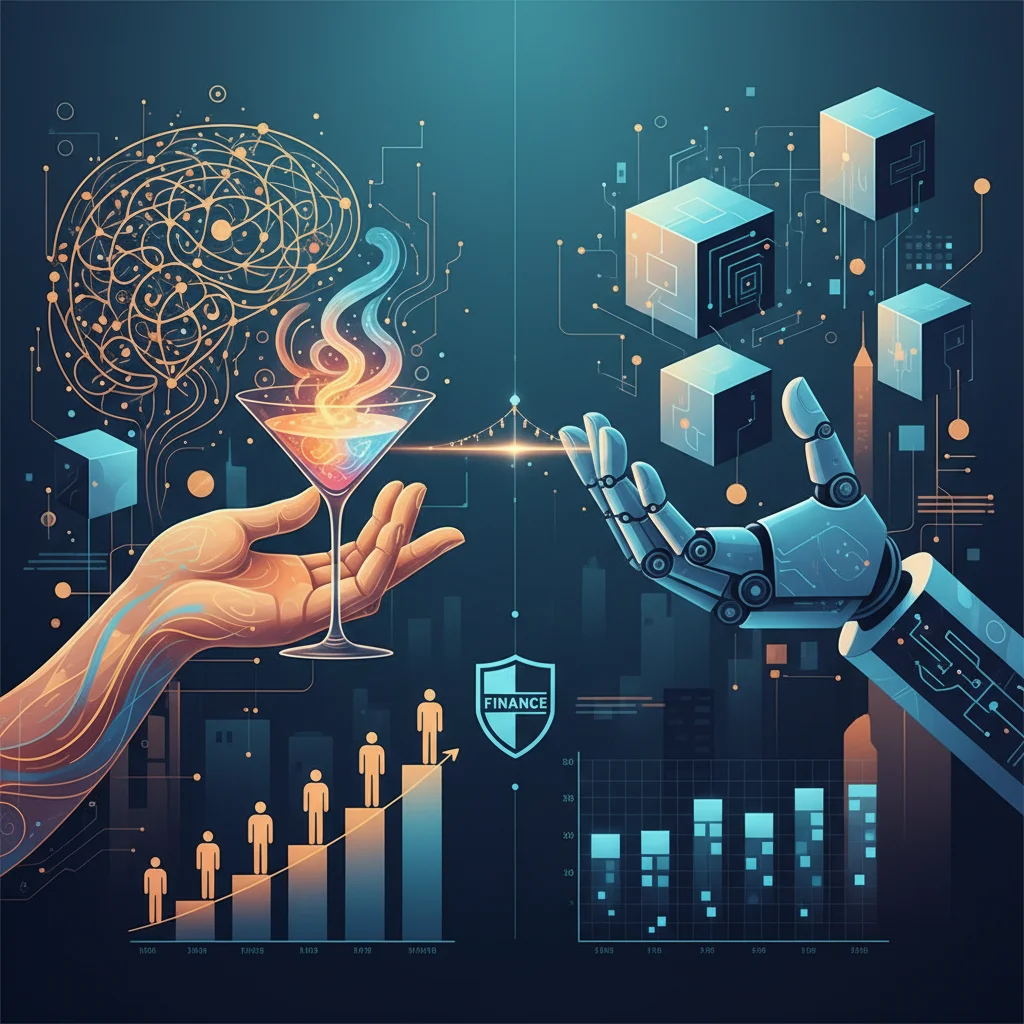
In a concise yet profound letter to the Financial Times, attorney Jonathan FX O’Brien offered a simple, elegant challenge to the champions of artificial intelligence. He wrote that he would be convinced of AI’s supremacy only when a machine could look at him, understand his mood, and mix the perfect, bespoke cocktail without a single verbal instruction. “When AI masters mixology,” he quipped, “let me know.” This seemingly simple analogy cuts to the heart of a debate raging through the halls of finance, law, and every other high-stakes profession: What is the true value of human expertise in an age of ever-smarter machines?
The rise of sophisticated AI has been nothing short of revolutionary, particularly in the world of finance and investing. Algorithms now execute trades in microseconds, robo-advisors manage portfolios for millions, and AI-driven systems detect fraudulent transactions with superhuman speed and accuracy. The global AI in Fintech market is booming, projected to reach nearly $50 billion by 2030, reshaping everything from personal banking to institutional asset management. This wave of financial technology promises efficiency, data-driven precision, and the democratization of financial tools.
Yet, O’Brien’s “bartender test” serves as a crucial reminder of the algorithm’s blind spot. A great bartender, like a great financial advisor or lawyer, does more than follow a recipe. They read the room. They sense hesitation, understand unspoken anxieties, and build trust. They blend technical skill with empathy, intuition, and seasoned judgment. While AI can process terabytes of data from the stock market, can it understand a client’s fear of outliving their retirement savings? While it can analyze legal precedents, can it craft a novel legal strategy based on a gut feeling about a jury?
This post explores the critical, often unquantifiable, human skills that remain indispensable in the modern economy. We will delve into why the future of professional services isn’t a battle of human versus machine, but a powerful synthesis of both.
The Algorithm’s Ascendancy: Where AI Excels in Finance
Before we explore its limitations, it’s essential to acknowledge the immense power AI has already brought to the financial sector. The technology’s ability to analyze vast datasets, identify patterns, and automate repetitive tasks is transforming the industry’s operational backbone. Key areas of AI dominance include:
- Algorithmic Trading: High-frequency trading (HFT) firms use complex algorithms to analyze market data and execute orders at speeds impossible for humans. These systems can capitalize on minuscule price discrepancies, increasing market liquidity and efficiency.
- Risk Management: Banks and financial institutions deploy AI to analyze credit risk, predict loan defaults, and monitor market volatility. These tools provide a more dynamic and comprehensive view of risk than traditional statistical models.
- Fraud Detection: AI algorithms are exceptionally skilled at identifying anomalous patterns in transaction data, flagging potential fraud in real-time and saving consumers and institutions billions annually.
- Robo-Advisors: Fintech platforms use algorithms to create and manage diversified investment portfolios based on a user’s stated goals and risk tolerance, offering low-cost investment solutions to a broad audience.
These applications demonstrate AI’s undeniable strength in handling structured, data-intensive tasks. They are faster, more consistent, and often more accurate than humans at processing information and executing predefined rules. But this is only half the picture.
Beyond the Headlines: Decoding the Putin-Trump Envoy Meeting and Its Shockwaves for Global Finance
The Human Element: Beyond Data and Precedent
Where AI’s capabilities begin to fray is at the intersection of data and human experience. The most critical decisions in investing and business are rarely black and white; they are painted in shades of gray, influenced by emotion, context, and long-term vision. This is where human intelligence, honed by years of experience, proves its enduring worth.
1. Empathy and Behavioral Coaching
The stock market is driven by more than just economics and balance sheets; it’s driven by fear and greed. A robo-advisor can rebalance a portfolio during a market downturn, but it cannot provide the calm, reassuring voice that stops an investor from panic-selling at the bottom. A seasoned financial advisor understands the behavioral biases that lead to poor decision-making. They act as a crucial emotional buffer, guiding clients through volatility with wisdom that no algorithm, trained on historical data alone, can replicate. This is the essence of fiduciary duty—acting with a deep understanding of a client’s entire well-being, not just their financial data points.
2. Strategic Creativity and “Big Picture” Thinking
AI models, including large language models, are fundamentally pattern-recognition machines. They are excellent at extrapolating from existing data but struggle with true out-of-the-box thinking. A human expert can connect disparate concepts—geopolitical shifts, emerging social trends, and novel technologies like blockchain—to formulate a unique investment thesis. They can imagine futures that don’t yet exist in the training data. This creative leap is the hallmark of visionary investing and strategic business leadership. It’s the difference between optimizing a known process and inventing a new one.
3. Navigating Ambiguity and Ethical Gray Areas
Professional life is filled with ambiguity. Is a particular tax strategy aggressive or fraudulent? Does a proposed merger truly serve shareholder interests, or just the CEO’s ego? These questions require nuanced ethical judgment, not just a probabilistic calculation. A 2022 study from PwC highlighted that while trust in AI is growing, concerns about ethics, governance, and bias remain significant barriers to adoption. Humans are accountable. They can be reasoned with, held to ethical codes, and understand the spirit, not just the letter, of the law. This layer of ethical oversight is non-negotiable when dealing with people’s life savings or corporate futures.
To better illustrate this distinction, consider the different approaches to common financial tasks.
The table below compares how an AI-only system, a human-only professional, and an augmented human-AI team might handle key responsibilities in the financial world.
| Financial Task | AI-Powered Approach | Human-Centric Approach | The Synthesis (Human + AI) |
|---|---|---|---|
| Portfolio Management | Automatically rebalances based on predefined risk tolerance and market triggers. Optimizes for tax-loss harvesting. | Conducts periodic reviews, discusses life changes (marriage, inheritance), and provides behavioral coaching during market volatility. | The advisor uses AI for daily monitoring and optimization, freeing up time to focus on strategic, goals-based conversations and long-term planning with the client. |
| Economic Forecasting | Analyzes vast historical datasets (GDP, inflation, employment) to generate probabilistic models of future economic conditions. | Interprets quantitative data within the context of qualitative factors like political instability, consumer sentiment, and policy shifts. | The economist uses AI models to generate a baseline forecast, then applies their domain expertise to adjust for nuances and “black swan” events the model can’t predict. |
| Client Risk Assessment | Uses a standardized questionnaire to assign a numerical risk score (e.g., 1-10). | Engages in deep conversation to understand the emotional and psychological aspects of risk, discerning the difference between stated and actual risk tolerance. | The advisor uses an AI-driven tool for an initial assessment, then uses the results as a starting point for a nuanced, in-depth conversation to create a truly personalized risk profile. |
The Hidden Economic Toll of 'Carspreading': A New Risk for Your Portfolio?
The Future of Work: A Shift in Value
The integration of AI into professional services will not lead to mass replacement, but rather a profound redefinition of roles. The World Economic Forum’s Future of Jobs Report 2023 emphasizes that skills like analytical thinking, creative thinking, and emotional intelligence will be in the highest demand. Tasks that are repetitive, predictable, and data-intensive will increasingly be automated. This frees up human professionals to focus on higher-value activities that machines cannot perform: building relationships, providing empathetic counsel, solving complex and novel problems, and exercising ethical judgment.
For investors and business leaders, the takeaway is clear. When evaluating a service, don’t just look at the sophistication of the technology. Ask where the human element lies. For a simple, set-it-and-forget-it investment account, a robo-advisor may be perfectly sufficient. But for complex estate planning, navigating a once-in-a-lifetime business sale, or managing wealth through turbulent economic times, the wisdom and steady hand of an experienced human advisor, augmented by powerful AI tools, is invaluable.
Conclusion: The Enduring Need for a Good Bartender
We return to the simple brilliance of the bartender test. An AI can be programmed with thousands of cocktail recipes, access real-time data on ingredient popularity, and even analyze the chemical composition of a perfect drink. But it cannot, as of yet, look a weary traveler in the eye, sense their need for comfort and conversation, and create an experience that transcends the mere mixture of liquids in a glass.
The Investor's Fog of War: Navigating Market Uncertainty in an Age of Geopolitical Turmoil
In the world of finance, the stakes are infinitely higher than a well-made cocktail. The most valuable professionals will be those who master their technical craft and cultivate the deeply human skills of empathy, creativity, and wisdom. They will use AI not as a crutch or a replacement, but as a powerful tool to enhance their ability to serve their clients. The future of finance isn’t artificial intelligence; it’s augmented humanity. And until an AI can truly understand the human heart, the best advisors, like the best bartenders, will always have a place behind the bar.

Related Posts
The Trillion-Dollar Choice: Why the UK’s Next Geopolitical Move Will Define Your Portfolio
The Pentagon’s New Playbook: How the US-China Strategy Will Reshape Global Finance and Your Investments