The Poverty Paradox: Why Free Markets and Social Safety Nets Are Two Sides of the Same Coin
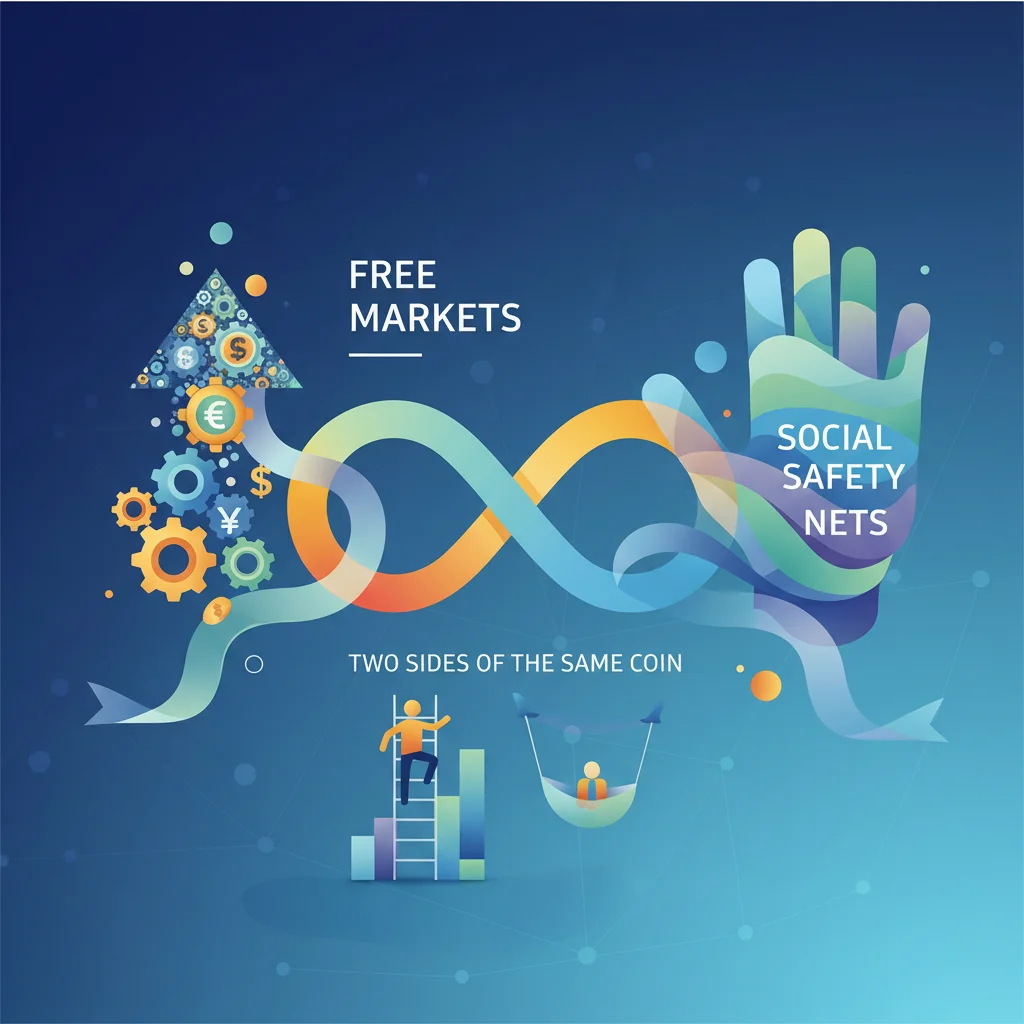
In the grand theater of economic debate, few topics command the stage with as much enduring passion and ideological division as the fight against poverty. It’s a debate that often feels like a zero-sum game, forcing us into one of two camps. Do we unleash the raw power of free markets to generate wealth, or do we build robust social safety nets to protect the vulnerable? A recent letter to the Financial Times by David White perfectly captured this conundrum. He highlighted two seemingly contradictory statements published on the same day: one from the Joseph Rowntree Foundation advocating for a stronger social security system, and another from economist Deirdre McCloskey championing a liberal economy as the true engine of prosperity for the poor. Mr. White concluded, “Both can’t be true.”
But what if they can? What if this perceived dichotomy is a false choice? This article argues that not only can both be true, but that the most resilient and prosperous societies are those that master the delicate art of integrating both. The engine of a dynamic, liberal economy and the suspension of a strong social safety net are not opposing forces; they are complementary systems essential for sustainable, long-term growth. For investors, business leaders, and finance professionals, understanding this synergy is crucial to navigating the complexities of the modern global economy.
The Engine of Prosperity: Making the Case for a Liberal Economy
Deirdre McCloskey’s argument is rooted in centuries of economic history. The core premise is that the most powerful anti-poverty program ever devised is economic growth, fueled by free enterprise, innovation, and open markets. When individuals are free to start businesses, get jobs, and trade, they create value. This value generation, aggregated across millions of people, is what we call economic growth.
The historical evidence is compelling. The “Great Enrichment” that began in the 19th century saw a dramatic and unprecedented rise in living standards, first in Europe and North America, and now across much of Asia. According to the World Bank, the share of the world’s population living in extreme poverty fell from over 35% in 1990 to under 10% before the pandemic. This monumental achievement wasn’t primarily the result of international aid or welfare programs, but of market-based economic expansion, particularly in countries like China and India that embraced elements of a liberal economy.
How does this work in practice? The mechanisms are multifaceted:
- Capital Formation and Investing: A liberal economy encourages saving and investing. The stock market and other financial markets channel this capital to the most promising ventures, funding innovation, building infrastructure, and creating jobs.
- Job Creation: The primary way people escape poverty is through stable, well-paying employment. A dynamic economy, where businesses are constantly competing and expanding, is the most effective job-creation machine.
- Innovation and Productivity: Competition incentivizes businesses to become more efficient and innovative. This leads to higher productivity, which translates into higher wages and better, more affordable goods and services for everyone.
In the 21st century, this dynamic has been supercharged by financial technology, or fintech. Innovations in digital banking and micro-lending have given entrepreneurs in developing nations unprecedented access to capital. Mobile trading platforms have democratized access to investing, allowing more people to participate in the wealth created by the market. This is McCloskey’s vision in action: a system that empowers individuals to build their own prosperity.
Solving the Market's Matrix: Why Investing is Like the Ultimate Crossword Puzzle
The Suspension System: The Indispensable Role of the Social Safety Net
If the liberal economy is the engine, then the social safety net is the suspension and steering system, ensuring the vehicle can navigate rough terrain without falling apart. To dismiss it is to ignore the inherent nature of market capitalism: it is volatile, prone to cycles of boom and bust, and it naturally produces unequal outcomes.
The Joseph Rowntree Foundation’s call to strengthen social security isn’t an anti-growth stance; it’s a pro-stability one. A well-designed safety net—comprising unemployment benefits, healthcare access, retirement security, and support for the disabled—serves several critical economic functions:
- Automatic Stabilizer: During an economic downturn, unemployment benefits and other support payments automatically increase, injecting demand into the economy when it’s needed most. This cushions the fall and speeds up the recovery, a core tenet of modern economics.
- Investment in Human Capital: A child who grows up with access to good nutrition and healthcare is more likely to become a productive adult. Public education and health services are not just social expenses; they are long-term investments in the quality of a nation’s workforce.
- Risk Mitigation and Entrepreneurship: A strong safety net can actually encourage risk-taking. An aspiring entrepreneur may be more willing to leave a stable job to start a new business if they know that a failed venture won’t result in personal catastrophe for their family.
- Social Cohesion: Extreme inequality can lead to social and political instability, which is toxic for long-term investing and economic growth. A safety net that provides a basic floor of dignity and opportunity ensures that the majority of citizens feel they have a stake in the system, fostering trust and stability.
Data from the OECD consistently shows that countries with higher levels of social spending often exhibit lower levels of income inequality (as measured by the Gini coefficient) and higher levels of social mobility. This isn’t about stifling the market; it’s about creating the stable foundation upon which a market can thrive sustainably.
Rethinking the Mansion Tax: A Blueprint for a Smarter, Fairer Property Levy
The Synthesis: Why Both Are True
The fallacy in the “both can’t be true” argument is that it presents the engine and the suspension as mutually exclusive choices. In reality, you need both. An engine without suspension makes for a brutal, unsustainable ride that will eventually break down. A suspension system without an engine goes nowhere.
The most successful advanced economies in the world are, without exception, mixed economies. They combine the dynamism of market capitalism with significant social insurance and public investment. They simply strike the balance in different places, reflecting their unique history and political culture. The challenge is not to choose one over the other, but to calibrate the relationship between them.
To illustrate this, let’s compare a few different models of advanced capitalism. The following table provides a snapshot of how different countries balance economic output with social support systems.
| Country | Predominant Model | GDP per Capita (PPP, USD) | Gini Coefficient (Post-Tax/Transfer) | Public Social Spending (% of GDP) |
|---|---|---|---|---|
| United States | Liberal Market Economy | $63,500 | 0.39 | 18.7% |
| Germany | Social Market Economy | $54,500 | 0.29 | 25.9% |
| Sweden | Nordic Model | $54,000 | 0.28 | 25.5% |
| Japan | Coordinated Market Economy | $42,900 | 0.33 | 23.1% |
Source: Data compiled from various OECD reports. Figures are approximate and intended for illustrative comparison.
As the table shows, there is no single “correct” formula. The United States prioritizes a higher GDP per capita at the cost of higher inequality, while European nations accept a slightly lower top-line output in exchange for greater social equity and stability. Neither approach is inherently “better,” but they demonstrate that the relationship between wealth creation and social support is a spectrum, not a binary choice.
Implications for the Modern Investor and Leader
For those in finance, this nuanced understanding is more than an academic exercise. It has direct implications for strategy and risk management.
- For Investors: When evaluating sovereign risk or making long-term bets on a country’s stock market, don’t just look at GDP growth. Analyze social cohesion, inequality levels, and the sustainability of its social contract. A country with roaring growth but fraying social fabric is a far riskier long-term investment than a country with moderate growth and high social stability.
- For Business Leaders: Supporting a reasonable social contract is an act of enlightened self-interest. Advocating for public investment in education, healthcare, and infrastructure is not socialism; it’s an investment in the future quality of your workforce and the stability of your consumer base.
- For Finance Professionals: The future of banking and financial technology lies in bridging these worlds. Products that help workers manage income volatility, tools that simplify access to benefits, and platforms that lower the barrier to entrepreneurship are all massive market opportunities that serve both economic growth and social resilience.
The Billion-Pound Time Glitch: Why a One-Hour Mistake Toppled the UK's Top Economic Watchdog
Conclusion: Finding the Right Balance
The provocative assertion that a liberal economy and a strong social security system “can’t both be true” serves as a useful starting point for a deeper conversation. But the historical evidence and the reality of the world’s most successful economies tell a different story. The pursuit of prosperity and the provision of security are not mutually exclusive goals. They are intertwined components of a single, complex system.
The real debate should not be about which ideology to choose, but about where to set the dials. How do we foster innovation without leaving millions behind? How do we provide security without stifling ambition? Answering these questions requires moving beyond rigid ideology and embracing a pragmatic approach. The engine of capitalism is unparalleled in its ability to create wealth, but it is the chassis of a stable, inclusive social contract that allows that engine to drive society forward for the long haul.