Nvidia’s Tightrope Walk: Navigating the High-Stakes US-China AI Chip War
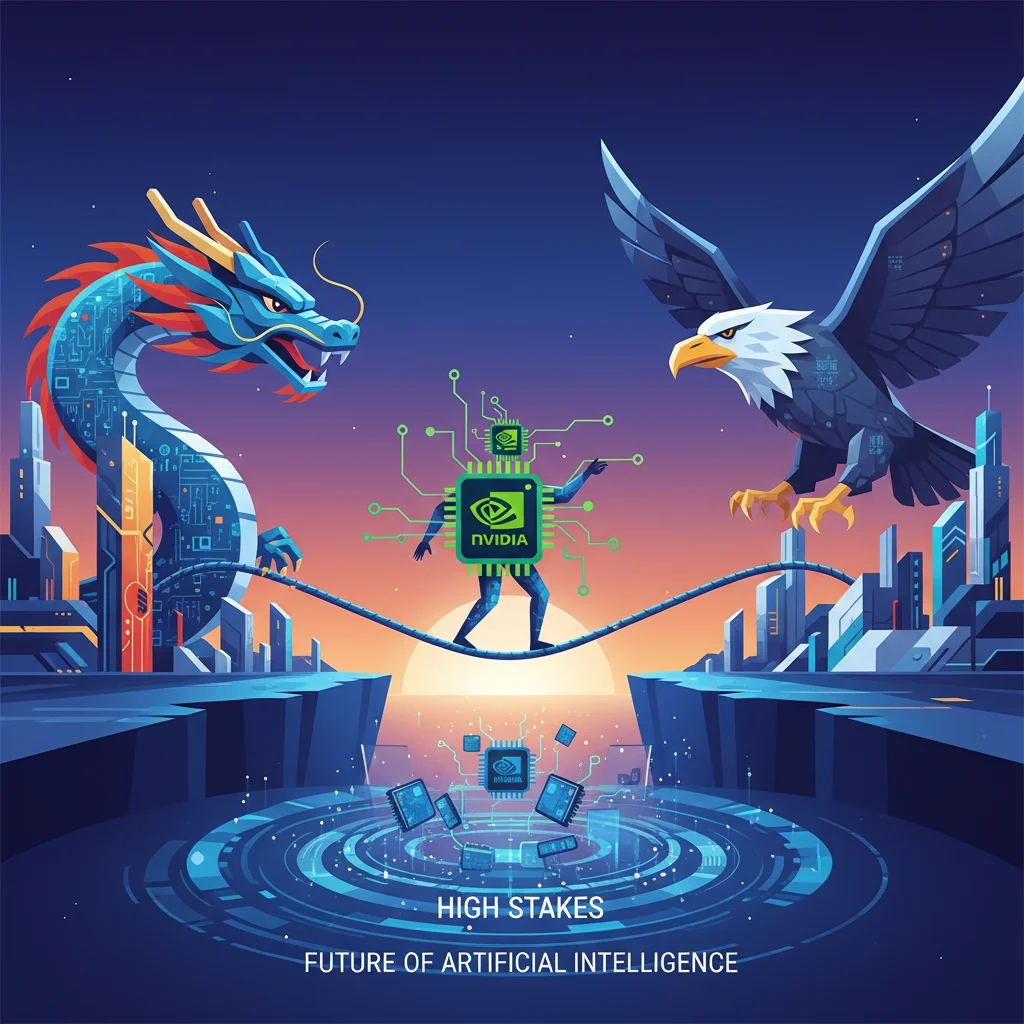
It’s a story that has everything: cutting-edge technology, global superpowers, corporate intrigue, and the future of artificial intelligence hanging in the balance. At the heart of it all is Nvidia, the undisputed king of AI hardware, caught in an escalating geopolitical tug-of-war between the United States and China. You may have even seen a confusing headline suggesting former President Trump gave Nvidia a “green light” to sell chips to China. While the previous administration certainly set the stage, the real drama is unfolding right now, and it’s a complex saga of regulation, innovation, and strategic maneuvering that will define the tech landscape for decades to come.
This isn’t just a story for policy wonks or semiconductor engineers. If you’re a developer, an entrepreneur, or a leader at a tech startup, the shockwaves from this conflict will reach you. The availability of high-performance computing, the cost of cloud services, and the very architecture of future AI software are all being shaped by these decisions. So, let’s untangle this complex web and understand what’s really going on, why it matters, and what it means for the future of innovation.
The Golden Goose: Why Nvidia’s Chips are the Keys to the AI Kingdom
To grasp the scale of this issue, you first need to understand why Nvidia’s chips are so critical. We’re not talking about the graphics card in your gaming PC, though they share a common ancestry. We’re talking about specialized, high-powered processors known as AI accelerators or GPUs (Graphics Processing Units) that have become the essential engine for modern artificial intelligence.
Think of training a large language model like ChatGPT. It’s like trying to read every book in the world’s largest library, understand the connections between every word, and then be able to generate new, coherent sentences. This requires an astronomical amount of parallel calculations. While a traditional CPU is like a single, brilliant scholar who can read one book very carefully, a GPU like Nvidia’s A100 or H100 is like an army of thousands of librarians reading different books simultaneously and sharing notes. This parallel processing power is what makes large-scale machine learning possible.
Nvidia’s dominance isn’t just about the hardware. It’s also about their software ecosystem, CUDA (Compute Unified Device Architecture). CUDA is a programming platform that allows developers to unlock the massive parallel processing power of Nvidia’s GPUs for general-purpose computing. This decade-plus head start in software has created a deep “moat” around Nvidia’s business, making it the default choice for virtually every major AI lab, cloud provider, and research institution on the planet. According to a report from Reuters, Nvidia controls an estimated 80% to 95% of the AI chip market, making them a critical chokepoint in the global AI supply chain.
Beyond the Hype: Why HSBC’s Deal with AI Startup Mistral is a Tectonic Shift for Finance and Tech
The Great Wall of Policy: Unpacking US Export Controls
The U.S. government, recognizing that advanced AI is a cornerstone of economic and military power, has moved to restrict China’s access to this critical technology. The strategy isn’t to cut China off completely, but to prevent it from acquiring the most powerful, cutting-edge chips that could be used for military applications or to surpass the U.S. in the AI race.
The restrictions, primarily enforced by the U.S. Department of Commerce, are highly technical. They don’t just ban specific chips by name. Instead, they set performance thresholds. Initially, in October 2022, the rules targeted two main metrics:
- Peak Performance: The raw computational power of a single chip.
- Interconnect Speed: The speed at which multiple chips can communicate with each other.
This second point is crucial and often overlooked. Training a truly massive AI model requires linking thousands of GPUs together into a supercomputer. If the connections between those chips are slow, it creates a bottleneck that drastically increases training time and cost, no matter how powerful the individual chips are. It’s like having a team of brilliant engineers who can only communicate via snail mail—their collective progress would be painfully slow. The U.S. government’s rules were designed to specifically cripple this large-scale clustering capability.
The Art of the Downgrade: Nvidia’s Compliance Cat-and-Mouse Game
Faced with the prospect of losing a market worth billions, Nvidia didn’t just give up. They did what any smart tech company would do: they read the rules carefully and engineered a solution. They created special, downgraded versions of their flagship chips specifically for the Chinese market. The first of these were the A800 and H800, which were modified versions of the world-leading A100 and H100.
They were designed to fall *just* below the U.S. export control thresholds. The raw compute power was often similar, but the critical chip-to-chip interconnect speed was significantly reduced. Let’s look at a simplified comparison of the flagship H100 and its first China-variant, the H800.
The table below illustrates how Nvidia tailored its products to meet the initial regulations, primarily by limiting the interconnect bandwidth.
| Feature | Nvidia H100 (Global) | Nvidia H800 (China Variant) | Key Implication |
|---|---|---|---|
| FP16/BF16 Tensor Core Performance | ~2,000 TFLOPS | ~2,000 TFLOPS | Single-chip performance remained very high. |
| Interconnect Bandwidth (NVLink) | 900 GB/s | 400 GB/s | This was the key downgrade. Reduced speed for large-scale AI model training. |
| Targeted Regulation | Exceeded the U.S. export control limits. | Designed to fall just below the initial 600 GB/s interconnect speed limit. | A direct response to the specific wording of the 2022 rules. |
This strategy worked, for a while. Nvidia was able to continue selling billions of dollars’ worth of chips to Chinese tech giants. But the U.S. government was watching. In October 2023, the Commerce Department updated and tightened the rules, closing the “loophole.” The new regulations were more comprehensive, using a “performance density” metric that made even the A800 and H800 illegal to export to China. As Commerce Secretary Gina Raimondo stated, the goal is to limit China’s access to advanced semiconductors that could be used to “undermine U.S. national security” (source).
Nvidia is now on its third generation of China-specific chips, including the H20, which are even more significantly curtailed to comply with the latest, much stricter rules. It’s a high-stakes cat-and-mouse game where the rules are constantly changing.
The Ghost in the Machine: When AI Sings, Who Owns the Voice?
The Ripple Effect: Global Impacts on Startups, Software, and Cybersecurity
This geopolitical chess match isn’t happening in a vacuum. It has profound implications for everyone in the tech ecosystem, from the largest SaaS providers to the smallest startups.
For China’s Tech Giants and Startups
Companies like Alibaba, Baidu, and Tencent, which were major buyers of Nvidia’s best chips, now face a significant hardware deficit. They are forced to make do with less powerful alternatives, explore cloud services outside of China (which comes with its own data security challenges), or invest heavily in domestic alternatives from companies like Huawei. This hardware constraint could slow their pace of innovation in generative AI.
For Nvidia and the Global Supply Chain
For Nvidia, China represents a massive market. The export controls have already cost the company billions in potential revenue. While demand from the rest of the world is currently insatiable, this move introduces significant long-term risk. It also highlights the fragility of our globalized tech supply chain. A single policy document from Washington D.C. can reshape a multi-hundred-billion-dollar industry overnight.
For Developers and Entrepreneurs Worldwide
The immediate impact is on the cost and availability of computing power. The massive demand for AI chips has led to shortages and soaring prices for cloud computing instances that use these GPUs. Startups focused on artificial intelligence now face a much higher barrier to entry when it comes to training their own large-scale models. This could lead to a consolidation of power among a few tech giants who can afford to build their own massive GPU clusters. The need for efficient programming and model optimization has never been greater.
AI vs. Artist: The Jorja Smith Case and the Future of Musical Identity
For Cybersecurity and Automation
A bifurcated tech world, with two separate AI ecosystems, presents new cybersecurity challenges. Different hardware standards, software stacks, and data protocols could create unforeseen vulnerabilities. It also complicates global collaboration on using AI to solve shared problems. On the other hand, the drive for efficiency could spur new waves of automation, as companies use AI to optimize everything from software development to supply chain management to get more out of the hardware they have.
The Road Ahead: A New Era of Geopolitical Tech
The saga of Nvidia’s AI chips is more than just a business story; it’s a defining moment in the 21st century. We are moving from an era of relatively open technological globalization to one of strategic competition and technological nationalism. The line between a commercial product and a national security asset has become irrevocably blurred.
The core tension remains: the U.S. wants to slow China’s military and technological ascent, while China is determined to achieve self-sufficiency and leadership in foundational technologies. Nvidia, and the entire semiconductor industry, is caught in the middle, forced to navigate a treacherous path between a massive market and the laws of its home country. As a BBC report succinctly puts it, Nvidia is “at the centre of a geopolitical tug-of-war.”
For all of us in the tech world, the message is clear: the ground beneath our feet is shifting. The assumption of a single, global standard for hardware and software is no longer a given. The future of innovation will be shaped not just by brilliant engineers and visionary entrepreneurs, but by the complex interplay of policy, power, and national interest. The race for AI dominance has just begun, and the rules of the game are being rewritten in real-time.