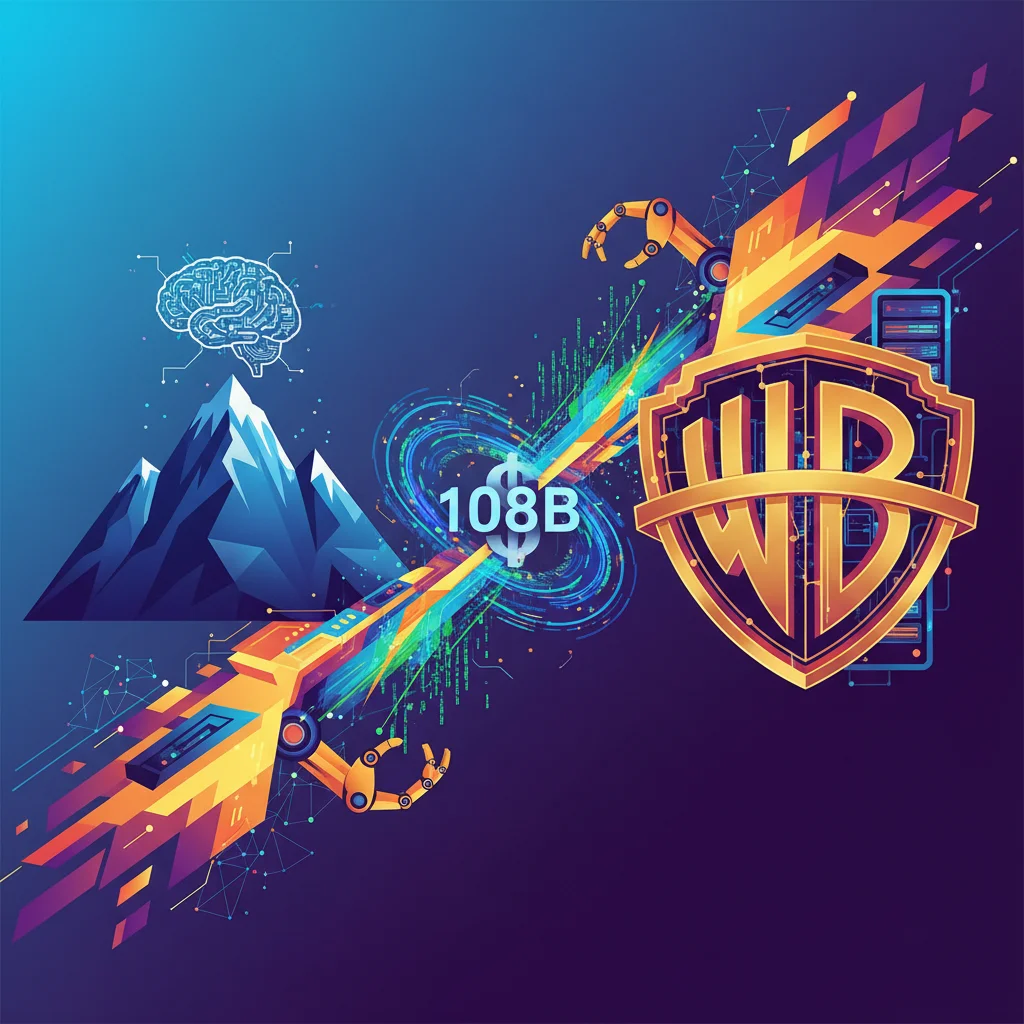
Hollywood’s $108B AI Power Play: Why the Paramount vs. Warner Bros. Saga is a Tech Epic
In the high-stakes world of Hollywood, drama isn’t just confined to the silver screen. Behind the velvet ropes and blockbuster premieres, a different kind of story is unfolding—one of corporate intrigue, colossal ambition, and a staggering $108 billion hostile bid. We’re talking about the audacious attempt by Skydance Media’s David Ellison, backed by Paramount, to acquire Warner Bros. Discovery.
On the surface, this looks like another chapter in the age-old story of media consolidation. But if you’re a developer, an entrepreneur, or a tech professional, you need to look closer. This isn’t just about merging movie studios; it’s a battle for the most valuable resource of the 21st century: data, packaged as intellectual property. It’s a story about cloud infrastructure, cybersecurity, and the immense potential of artificial intelligence to reshape an entire industry. The rejection of this massive offer wasn’t just about boardroom politics; it was a complex decision rooted in the geopolitical realities of modern technology and finance.
Let’s unpack why this Hollywood blockbuster-that-never-was is a crucial case study for anyone building the future of software, AI, and digital innovation.
The Titans and the Trillion-Dollar Prize
To understand the magnitude of this move, you first need to grasp the sheer scale of the players involved. We’re not talking about small startups; these are global media empires with legacies stretching back a century. A merger would create a content behemoth with an unparalleled library of intellectual property.
Here’s a snapshot of the assets at stake:
| Asset Category | Warner Bros. Discovery | Paramount Global |
|---|---|---|
| Flagship Movie Studio | Warner Bros. Pictures (Harry Potter, DC Universe, The Matrix) | Paramount Pictures (Mission: Impossible, Top Gun, Transformers) |
| Major TV Networks | HBO, CNN, TNT, Discovery Channel, Food Network | CBS, MTV, Nickelodeon, Comedy Central |
| Streaming Service (SaaS) | Max (formerly HBO Max) | Paramount+ |
| Key IP Franchises | Game of Thrones, Looney Tunes, Friends | Star Trek, SpongeBob SquarePants, Yellowstone |
For decades, the value of these assets was measured in box office receipts and advertising revenue. But in the modern era, the equation has changed. This vast library of films, shows, and characters represents something far more powerful: a massive, proprietary dataset for training the next generation of artificial intelligence models.
Imagine feeding every frame of the Harry Potter series into a machine learning algorithm to generate new scripts, concept art, or even entire animated scenes in the same style. Think about using decades of CNN archives to train an AI on journalistic patterns and global events. This content isn’t just for watching anymore; it’s for teaching. The company that controls the best data will build the smartest AI, creating an insurmountable competitive advantage. This is the real prize in the new Hollywood gold rush.
AI vs. Artist: The Jorja Smith Case and the Future of Musical Identity
The Geopolitical Firewall: Why the Deal Was Dead on Arrival
So, with such a compelling prize on the table, why was Ellison’s nine-figure offer rebuffed? The Financial Times report points to a critical factor: the source of the money. The bid was reportedly backed by a consortium that included sovereign wealth funds from China and the Middle East. According to the source, Warner Bros. Discovery’s board had significant concerns about the “financial backing” from these entities.
This is where the story pivots from a business negotiation to a matter of national and digital security. For tech professionals, this scenario should sound alarmingly familiar. In a world increasingly defined by digital borders and data sovereignty, the origin of capital carries immense weight. Here’s why:
- Cybersecurity and IP Theft: Handing over the keys to America’s most iconic cultural assets to entities with ties to geopolitical rivals is a monumental cybersecurity risk. The fear isn’t just about someone stealing the script for the next Batman movie; it’s about the potential for large-scale IP theft, corporate espionage, and the compromise of sensitive communications and data infrastructure.
- Data Sovereignty: Warner’s assets include CNN, a global news organization. The prospect of foreign state influence over a major American news network is a non-starter from a regulatory and ethical standpoint. This highlights the growing importance of data governance and the “digital citizenship” of the companies that control our information.
- Regulatory Hurdles: Any such deal would face intense scrutiny from the Committee on Foreign Investment in the United States (CFIUS). The U.S. government has become increasingly aggressive in blocking acquisitions of critical infrastructure—and in the 21st century, a media and communications giant absolutely qualifies as critical infrastructure.
The rejection shows that in today’s tech-driven M&A landscape, a compelling financial offer isn’t enough. The deal’s architecture, including its capital sources and cybersecurity implications, is just as important as the price tag.
The Hidden Tech Stack: A Merger’s True Battlefield
Beyond the glamour, a media merger is fundamentally a technology integration project of epic proportions. Winning the bid is just the first step; the real war is fought by engineers, developers, and IT strategists in the trenches of the digital infrastructure.
The Cloud and SaaS Integration Gauntlet
The most visible challenge would be merging the streaming services: Max and Paramount+. This is not as simple as flipping a switch. It involves:
- Cloud Migration: Both services likely run on different cloud providers (AWS, Azure, Google Cloud) with unique architectures. A decision must be made: migrate one to the other, or attempt a complex multi-cloud integration? This alone is a task that could take years and cost hundreds of millions.
- SaaS Unification: Every aspect of the user experience—from the subscription billing system (a classic SaaS model) to the content recommendation engine—is built on a different software stack. Merging user databases, payment information, and watch histories without massive data loss or security breaches is a Herculean task.
- Automation and DevOps: To manage the combined infrastructure, a new, unified DevOps pipeline would be essential. This requires immense investment in automation tools to streamline content ingestion, transcoding, and deployment across a global network. Every minute of downtime translates to millions in lost revenue and subscriber trust.
Apple's Big AI Shake-Up: Why Poaching a Microsoft Exec is a Massive Tell
The AI Arms Race
As we discussed, the true long-term value lies in the data. A merged entity would have an unparalleled dataset to build industry-leading machine learning models. The applications are endless:
- Hyper-Personalization: Using viewing data to create recommendation engines so precise they can predict what you want to watch before you do.
- Automated Production: Leveraging generative AI to assist in scriptwriting, create digital backlots, de-age actors, or even generate entire scenes, drastically reducing production costs.
- Predictive Analytics: Analyzing scripts, casting choices, and market trends to predict a film’s box office potential with greater accuracy, transforming how projects get greenlit.
This is where innovation happens. The race is on to build the foundational AI models for entertainment, and the company with the most diverse and extensive library of content will win.
Lessons for Startups and Entrepreneurs
You don’t need $108 billion to learn from this saga. The failed bid offers critical insights for startups and tech innovators looking to disrupt or partner with large enterprises:
- Understand the Geopolitical Landscape: If your startup is seeking funding, especially from international sources, be aware of the regulatory and security implications. The source of your capital can become a feature or a bug.
- Solve Integration Problems: The immense pain of merging legacy systems creates opportunities. Startups that build best-in-class tools for data migration, API integration, and multi-cloud management are invaluable.
- Focus on Niche AI Applications: You can’t out-train Hollywood on a general entertainment AI model. But you can build specialized AI/ML tools that solve specific industry problems—like AI-powered sound mixing, automated color grading, or royalty-tracking software.
- Cybersecurity is Not an Option: The media industry is a prime target for cyberattacks due to its high-value IP. Startups offering specialized cybersecurity solutions for protecting pre-release content and securing production workflows have a massive market waiting.
The Ghost in the Machine: When AI Sings, Who Owns the Voice?
The Final Cut: More Than a Movie Deal
The failed Paramount-Warner Bros. bid was far more than a juicy piece of Hollywood gossip. It was a stark illustration of the forces shaping modern business, where technology, finance, and geopolitics are inextricably linked. It confirmed that even in a creative industry like entertainment, the underlying value is increasingly found in data, cloud platforms, and the potential for AI-driven innovation.
For those of us in the tech world, this is a powerful reminder. The code we write, the platforms we build, and the security protocols we implement are the invisible scaffolding supporting the global economy. The next great Hollywood epic might not be a superhero movie, but the story of the developers and engineers tasked with merging two digital empires—a blockbuster challenge, if there ever was one.

Related Posts

A Canary in the Coal Mine: What One Restaurant’s Closure Reveals About the Broader Economy
The Ghost in the Machine: Why China Intervened in Meta’s Tiny Dutch VR Deal